Crude Oil and Indian Markets Explained for Beginners
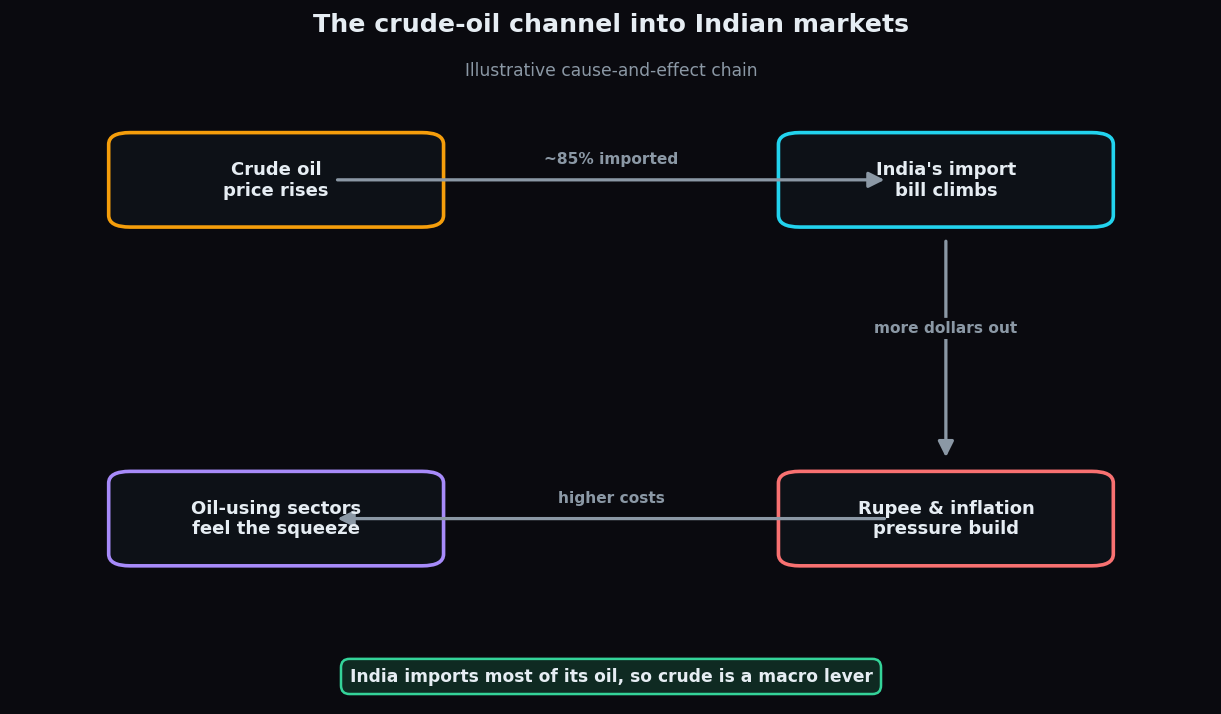
India runs on oil it does not produce. Roughly four out of every five barrels the country burns are imported, paid for in US dollars, and shipped in from across the world. That single fact makes the price of crude oil one of the most important numbers on the macro dashboard — a lever that quietly reaches inflation, the rupee, government finances, and a long list of company profit margins.
This guide explains what crude oil is, why its price matters so much for India, the exact channel through which it flows into markets, and who tends to win and lose when it moves.
What is crude oil, and why does India care?
Crude oil is unrefined petroleum — the raw material that gets processed into petrol, diesel, jet fuel, and feedstock for plastics, paints, and fertilisers. Its global price is usually quoted per barrel (about 159 litres) in dollars, using benchmarks like Brent (the global standard) and WTI (the US grade).
India imports the large majority of its crude. So when the world price rises, India's import bill — the total dollars spent bringing goods in — climbs almost automatically. It is like a household that must buy a fixed amount of a product every month: if the price jumps, the budget strains whether you like it or not.
The inflation channel, step by step
Here is how a rise in crude travels through the economy:
- Higher crude, higher fuel costs. Petrol and diesel get more expensive to produce.
- Transport costs rise. Almost everything — vegetables, cement, courier parcels — moves on diesel, so shipping costs climb.
- Prices rise broadly. Those costs seep into everyday goods. That general rise in prices is inflation.
- The rupee feels pressure. A bigger import bill means more dollars must be bought and sent abroad, which can weaken the rupee. A weaker rupee makes the same barrel cost even more in rupee terms — a loop that can feed on itself.
Higher inflation also matters for interest rates: central banks often respond to persistent inflation by keeping rates higher, which ripples into valuations across the market.
A worked example (illustrative numbers)
Suppose crude rises from $70 to $90 a barrel — up about 29%. Imagine India imports 5 million barrels a day (round numbers to show the idea):
- Extra cost per day: 5 million × $20 = $100 million a day of additional import spending.
- Over a month that is roughly $3 billion in extra dollars leaving the country.
- That demand for dollars nudges the rupee weaker, which lifts the rupee cost of oil again.
These figures are made up to illustrate the mechanics, not a live estimate. The point is the direction: a crude spike is a headwind for inflation and the currency at the same time.
Winners and losers
Crude does not hurt everyone. It reshuffles the deck.
- Potential winners: oil producers and explorers, who sell crude and gas at higher prices. Some energy-linked firms can benefit too.
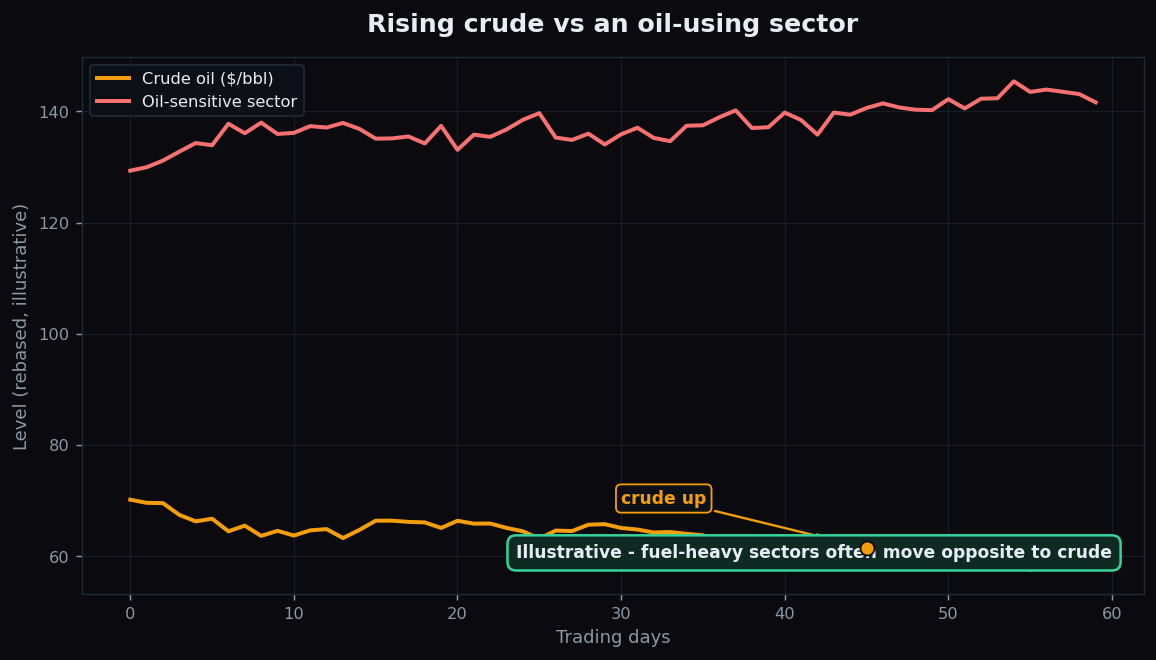
- Typical losers: businesses that use a lot of oil as raw material or fuel — airlines (jet fuel is a huge cost), paint makers (crude-based inputs), tyre companies, and logistics-heavy firms. Their margins get squeezed when they cannot pass the cost on quickly.
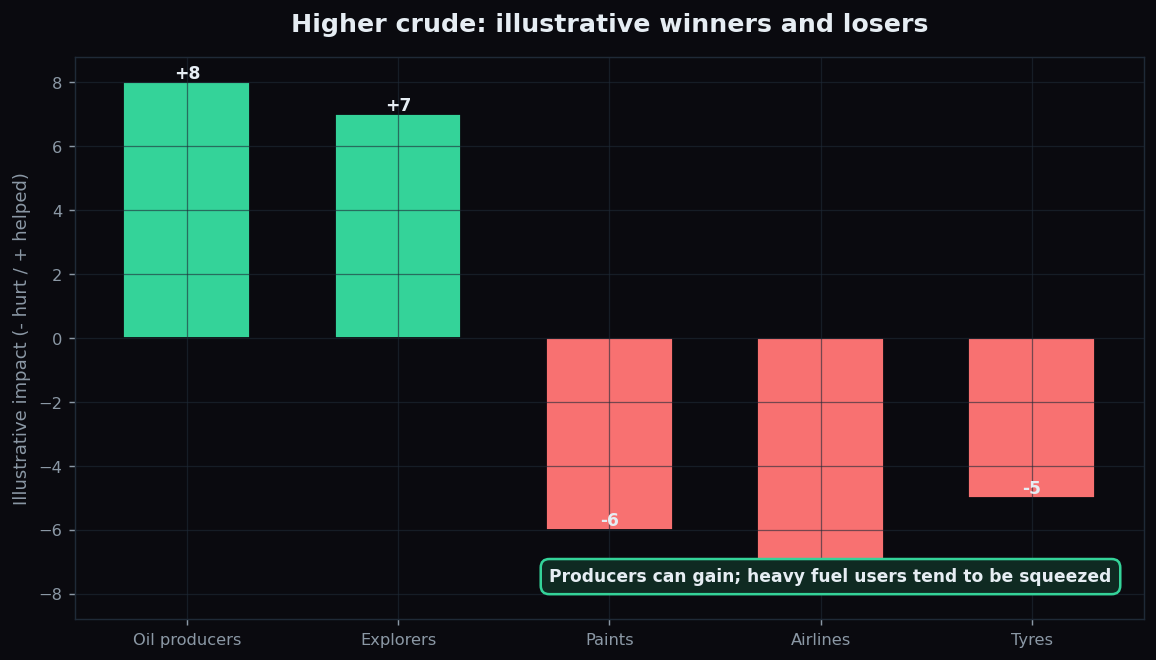
An easy way to remember it: if a company digs oil up, higher prices tend to help; if a company burns oil or turns it into products, higher prices tend to hurt.
The honest catch
The crude story is real but rarely clean. Prices are set by global supply, demand, and geopolitics that no one forecasts reliably. A rise driven by strong global growth can coincide with a rising market; a rise driven by a supply shock can coincide with a falling one — same price move, opposite backdrop. Governments can also soften the blow through taxes and subsidies, breaking the textbook chain. And markets are forward-looking: by the time a crude headline hits your screen, some of it may already be in prices.
So treat crude as one important gauge of the macro weather, not a switch that flips the market in a predictable direction.
Crude, the rupee, and inflation are three dials that move together — and it is easy to lose track of them. TrueTrend gathers these macro cues into one plain-English daily read, so you can see the context behind the tape instead of piecing it together yourself. Start free and follow the setup each morning.
Key takeaways
- India imports most of its oil, so crude is a direct lever on the import bill, the rupee, and inflation.
- The chain runs: crude up → fuel and transport costs up → broad prices up → rupee pressure, sometimes in a loop.
- Oil producers can gain; heavy oil users (airlines, paints, tyres, logistics) often get squeezed.
- The reason crude is moving (growth vs supply shock) matters as much as the move itself.
- Markets are forward-looking — a crude headline may already be partly priced in.
See these concepts on live market data — free
Create a free TrueTrend account to watch daily support/resistance levels, market regime, and option-positioning charts on NIFTY, BankNifty and 12 more instruments. Every level we publish is scored on a public scoreboard — misses included. No card required.
Free forever tier · daily levels with published hit-rates across every instrument. Descriptive market structure, not investment advice.
Not ready for an account? Get the daily levels by email.
One short email each market day — the indices' call wall, put wall, gamma flip and max pain, and how the last session's levels scored. Free, no account, unsubscribe anytime.
Descriptive market structure, not investment advice. We never share your email.