Demat and Trading Accounts Explained for Beginners
When you sign up to invest in shares, you are asked to open not one account but two: a demat account and a trading account. Almost every beginner asks the same question — why two? Aren’t they the same thing? They are not, and the difference is genuinely simple once you see it: one account holds your shares, the other places your orders. Get that one distinction and the whole setup clicks into place. Let us walk through it.
The two accounts, in one line each
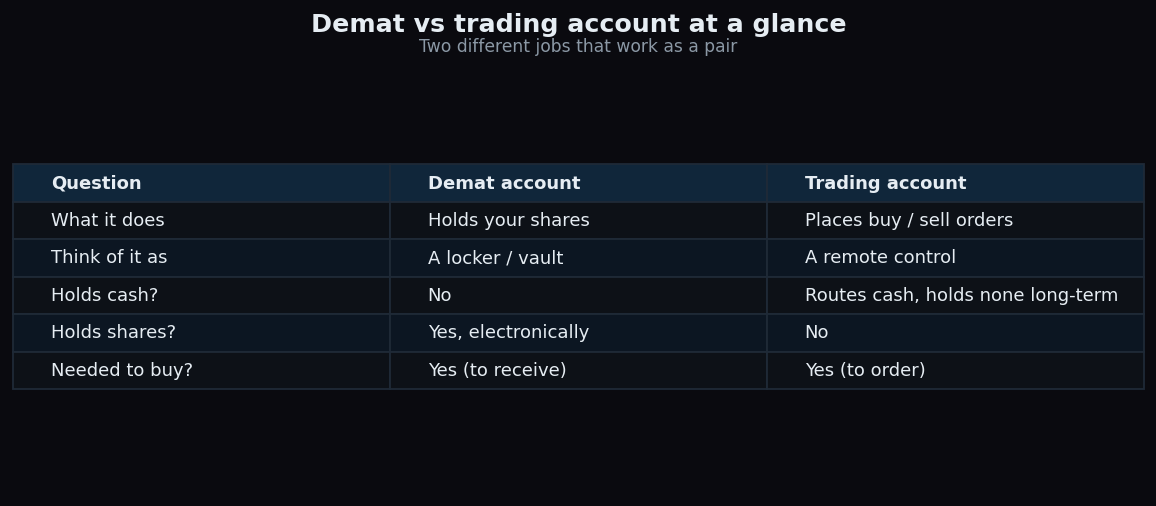
A demat account (short for “dematerialised”) holds your shares in electronic form. It is a digital locker. When you own shares, they sit safely inside your demat account as entries, no paper certificates involved.
A trading account is the tool you use to buy and sell. It connects to the stock exchange and places your orders. It does not store your shares; it is the channel through which buy and sell instructions travel.
The cleanest analogy: your demat account is a locker that holds your valuables, and your trading account is the remote control you press to buy more or sell what you have. A locker cannot place orders; a remote control cannot store anything. You need both, working together.
Why the jobs are split
It feels like extra paperwork, but the split exists for good reasons of safety and clarity. Holding shares and trading them are genuinely different activities, handled by different parts of the financial system.
Your shares in the demat account are kept by a central record-keeper (a depository), the way a bank vault safeguards deposits. Your trading account, run by your broker, is just the doorway to the market. Keeping the vault separate from the doorway means the place that stores your wealth is not the same as the place that moves it — a sensible separation that protects your holdings even as orders fly back and forth.
How money and shares actually flow
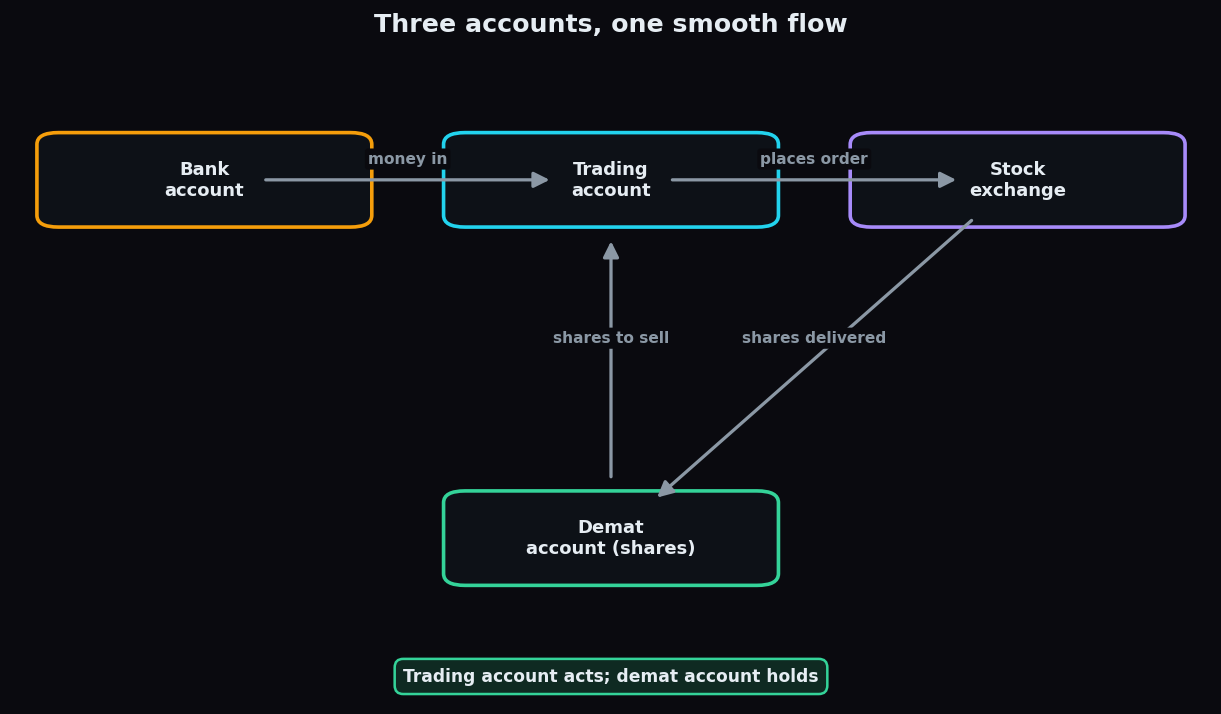
Here is where it all comes together. Picture the journey of a single buy order, start to finish.
- Money starts in your bank account. This is your cash, sitting where it always does.
- You fund the trading account. To buy, you move money from your bank into your trading account, giving it cash to work with.
- The trading account places the order. You tap “buy 10 shares,” and the trading account sends that instruction to the exchange, where it meets a willing seller.
- Shares land in your demat account. Once the trade is done and settled, the 10 shares are delivered electronically into your demat account — the locker — where they now live.
Selling runs the same loop in reverse. The trading account places a sell order; the shares move out of your demat account to the buyer; and the cash from the sale flows back to your trading account, from where you can sweep it to your bank. Cash and shares simply trade places, with the trading account acting and the demat account holding.
A worked example
Round numbers make it concrete. You have 10,000 rupees in your bank. You want to buy 50 shares of a company trading at 100 rupees each — a 5,000-rupee purchase.
- You transfer 5,000 from your bank into your trading account. Bank balance: 5,000 left.
- Through the trading account, you place an order for 50 shares at 100. It matches with a seller; 5,000 leaves the trading account.
- After settlement, 50 shares appear in your demat account. Your locker now shows 50 shares; your trading account cash is back near zero.
Later you decide to sell 20 of those shares at 110. The trading account places the sell order; 20 shares leave your demat account; and 2,200 rupees (20 × 110) flow into your trading account, ready to move back to your bank. At every step, the trading account did the acting and the demat account did the holding.
Why this matters for a beginner
- Less confusion at signup. You will understand why two accounts open together — one to hold, one to act.
- You know where your shares are. Your holdings live in the demat account, safe even if you never place another order for years.
- You know where cash sits. The trading account temporarily routes cash; it is not a savings account, and it is not where shares are stored.
- Troubleshooting is easier. “I bought but don’t see the shares” usually means the trade hasn’t settled into the demat account yet — a normal, short delay.
The honest catch
The setup is simple, but a few practicalities deserve a clear head. Accounts can carry charges — annual maintenance on the demat account and brokerage on trades — so it is worth reading the fee sheet before you sign anything. Money and shares do not move the instant you tap a button; trades take a settlement period to complete, so a brief gap between order and delivery is normal, not a fault. And convenience cuts both ways: because buying and selling is now a single tap, it is easy to act on impulse. The accounts are a neutral pipe — they hold and move what you decide, and they make no judgement about whether a decision is wise. That part stays entirely with you.
Once the plumbing is clear, you can spend your energy on understanding the market itself rather than the mechanics. TrueTrend is built to help everyday learners read market structure and context in plain language. You can start free and learn at your own pace.
Key takeaways
- A demat account holds your shares electronically; a trading account places your buy and sell orders. You need both.
- Think locker (demat) and remote control (trading) — one stores, one acts.
- The jobs are split for safety: the place that stores your wealth is kept separate from the place that moves it.
- Buying flow: bank → trading account → exchange → shares delivered into demat; selling reverses it.
- Your shares stay safely in the demat account even when you are not trading; the trading account only routes cash temporarily.
- Watch for maintenance and brokerage fees, expect a short settlement delay, and remember the accounts make no decisions for you.
See these concepts on live market data — free
Create a free TrueTrend account to watch daily support/resistance levels, market regime, and option-positioning charts on NIFTY, BankNifty and 12 more instruments. Every level we publish is scored on a public scoreboard — misses included. No card required.
Free forever tier · daily levels with published hit-rates across every instrument. Descriptive market structure, not investment advice.
Not ready for an account? Get the daily levels by email.
One short email each market day — the indices' call wall, put wall, gamma flip and max pain, and how the last session's levels scored. Free, no account, unsubscribe anytime.
Descriptive market structure, not investment advice. We never share your email.