Diversification: Don't Put All Eggs in One Basket
There is one piece of market wisdom so old it has become a proverb: don't put all your eggs in one basket. In finance this idea has a name — diversification — and it is one of the few genuinely free improvements available to an investor. This post explains what diversification is, why spreading risk works, the crucial role of correlation, and where the idea reaches its limits. It is educational only, with illustrative examples — not advice on how to build any particular portfolio.
What diversification means
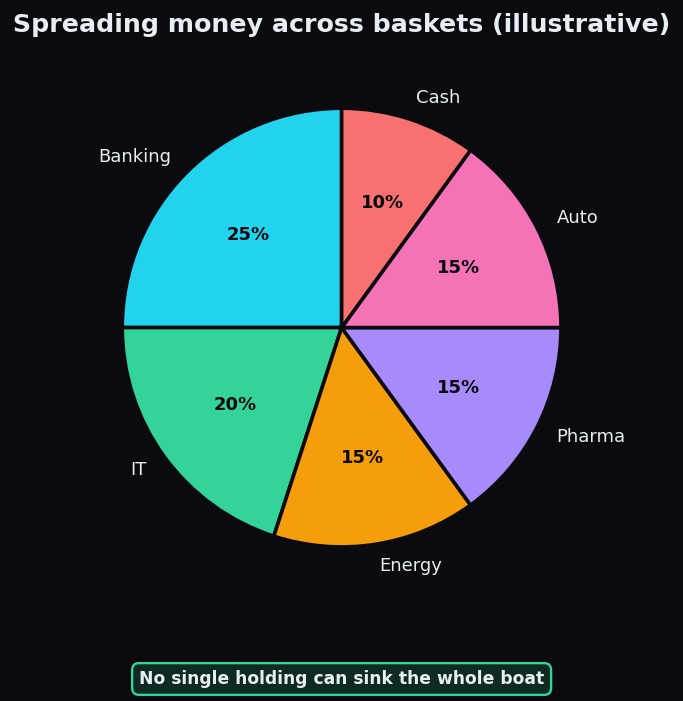
Diversification is spreading your money across many different holdings so that no single one can sink the whole ship. The logic is simple: if you own one stock and it falls 40%, your whole portfolio falls 40%. If you own twenty holdings and one falls 40%, the damage to the total is small because the other nineteen carry on independently.
The pie above is a purely illustrative split across sectors and a slice of cash. The exact numbers do not matter — what matters is the shape of the idea: many baskets, so one broken egg is a bad day, not a catastrophe.
Why spreading risk works
Every holding carries two kinds of risk. The first is specific risk — danger unique to one company: a factory fire, a fraud, a failed product, a bad quarter. The second is market risk — danger that hits everything at once, like a recession or a rate shock.
Here is the key: diversification is very good at reducing specific risk and useless against market risk. When you hold many unrelated companies, their private disasters tend to cancel out — one firm's scandal is another firm's ordinary Tuesday. But if the entire market falls, owning fifty stocks does not save you, because they all share that same market risk. Diversification removes the risk you are not paid to take (single-company luck) while leaving the risk that actually earns a return over time.
The role of correlation
Correlation measures how much two holdings move together. If two things always rise and fall in lockstep, they are highly correlated and owning both barely diversifies anything — it is almost like owning a double dose of one. If two things move independently, or even in opposite directions, combining them smooths the ride.
This is the part beginners miss: diversification is not about the number of holdings, it is about how differently they behave. Owning ten banking stocks feels diversified but is not — on a bad day for banks, all ten fall together. Owning a bank, an IT firm, a pharma company and some cash is far better spread, because their fortunes depend on different forces.
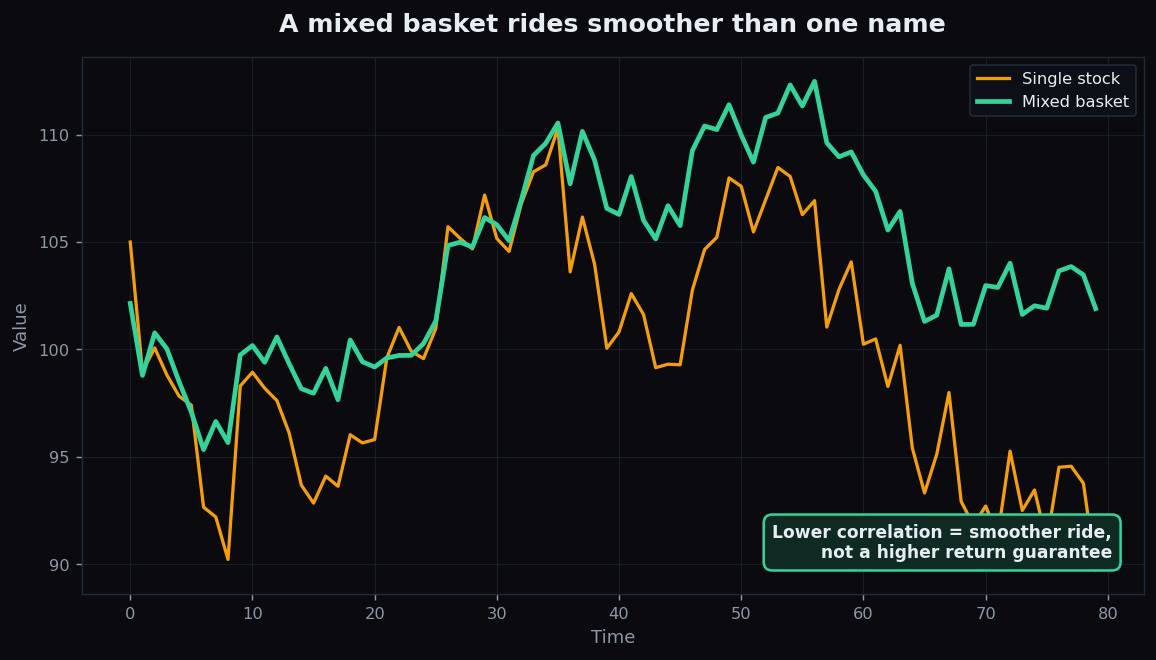
The chart contrasts a single volatile holding with a mixed basket of lower-correlation holdings. Notice the basket's path is smoother — the sharp lurches partly cancel out. That smoother ride is the visible payoff of low correlation.
A worked example with round numbers
Imagine two illustrative portfolios, each worth 1,00,000.
Portfolio A holds one stock. It has a rough year and falls 40%. Value: 60,000. The whole account felt every bit of that single company's bad luck.
Portfolio B splits the money across five unrelated holdings of 20,000 each. In the same year, one of them suffers the same 40% fall — losing 8,000. The other four, driven by different forces, are roughly flat on average. Value: 1,00,000 − 8,000 = 92,000.
Same disaster, same 40% crash in one holding — but an 8% dent instead of a 40% one. Portfolio B did not predict the crash or avoid it. It simply made sure one bad egg could not spoil the whole basket. That is diversification in a single number.
An everyday analogy
A farmer who plants only one crop is betting the whole year on that crop's weather, pests and prices. A farmer who plants several different crops accepts that any one of them might fail — but is nearly certain the whole farm will not fail at once. Diversification is that second farmer's strategy applied to money: give up the fantasy of the perfect single bet in exchange for the near-certainty of surviving to farm again next year.
The honest catch — the limits
Diversification is powerful but often oversold. Its limits are real:
- It cannot beat market risk. In a broad crash, correlations rush toward one — things that normally move apart suddenly fall together. Exactly when you want diversification most, it works least.
- Over-diversification dilutes. Past a point, adding holdings barely reduces risk further but does guarantee mediocrity — you end up owning so much that you simply track the average. There is a reason for the jibe about "di-worse-ification".
- Fake diversification is common. Twenty holdings that are secretly all the same bet (all rate-sensitive, all one sector, all one theme) give the feeling of safety without the substance. Count behaviours, not tickers.
- It lowers the peaks too. Smoothing the ride means you also give up the giant gains a single lucky pick could have delivered. Diversification is a trade of upside dreams for downside protection.
None of this makes diversification a bad idea — it is still one of the most reliable tools available. It just is not a force field. It manages risk; it does not abolish it.
Understanding how different parts of the market move together is the heart of diversification — and of good analysis generally. TrueTrend turns that kind of market-structure thinking into plain, honest signals; you can create a free account to explore the approach for yourself.
Key takeaways
- Diversification spreads money across many holdings so no single one can sink the portfolio.
- It removes specific risk (single-company luck) but not market risk (a broad crash).
- Correlation is what matters — holdings that behave differently diversify; ten of the same thing do not.
- Spreading 1,00,000 across five unrelated holdings can turn a 40% single-stock hit into an 8% portfolio dent.
- Limits are real: correlations spike in crashes, over-diversifying dilutes returns, and it trims the upside too.
See these concepts on live market data — free
Create a free TrueTrend account to watch daily support/resistance levels, market regime, and option-positioning charts on NIFTY, BankNifty and 12 more instruments. Every level we publish is scored on a public scoreboard — misses included. No card required.
Free forever tier · daily levels with published hit-rates across every instrument. Descriptive market structure, not investment advice.
Not ready for an account? Get the daily levels by email.
One short email each market day — the indices' call wall, put wall, gamma flip and max pain, and how the last session's levels scored. Free, no account, unsubscribe anytime.
Descriptive market structure, not investment advice. We never share your email.