Economic Moats Explained: Durable Advantages
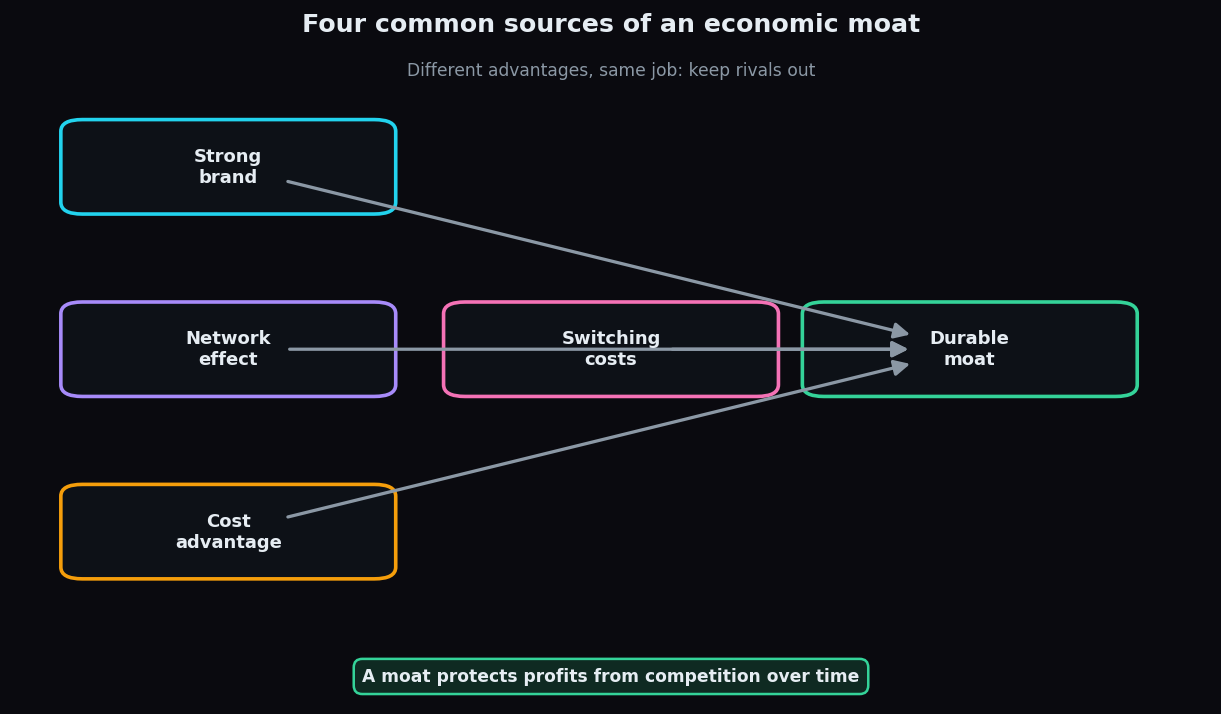
Warren Buffett popularised a vivid image for what makes a business worth owning for the long run: an economic moat. Picture a medieval castle. The wider and deeper the water around it, the harder it is for attackers to get in. In business, a moat is whatever keeps competitors from storming in and stealing a company's profits. This post explains what a moat is, the main kinds, and why the idea is so useful — without pretending moats last forever.
What an economic moat is
An economic moat is a durable competitive advantage: something about a company that lets it keep earning healthy profits year after year, even when rivals would love to take them away. The key word is durable. Any business can have a good year. A moat is what makes the good years repeat and resist erosion.
Why does that matter? In a free market, high profits act like a magnet. When a company earns fat margins, competitors rush in, cut prices, and copy the product — and profits get competed away. A moat is the reason that does not happen quickly. It is the structural feature that keeps the castle standing while everyone else tries to break in.
The four common types of moat
Moats come in a handful of recognisable shapes. Four show up again and again.
1. Brand and reputation
A trusted brand lets a company charge more than a no-name rival for a similar product. Consider a fictional snack maker, Sunrise Foods. Shoppers reach for its biscuits out of habit and trust, and will pay ₹10 more than for an unknown pack. That extra ₹10, repeated across millions of packets, is the moat. A newcomer has to spend years and huge marketing budgets to earn the same trust.
2. Network effects
A product with a network effect gets more valuable as more people use it. Think of a fictional online marketplace, Orbit Bazaar. Buyers go there because it has the most sellers; sellers list there because it has the most buyers. Each new user makes the platform better for everyone else, which pulls in yet more users. A tiny rival simply cannot match that gravity, however good its app is.
3. Cost advantage
If a company can make the same product more cheaply than anyone else, it can undercut rivals on price and still earn a profit — or match their price and pocket a fatter margin. A fictional cement maker, Ironclad, that sits on its own limestone quarry next to its plant pays far less for raw material and transport than a competitor trucking stone across the state. That structural cost edge is hard to copy.
4. Switching costs
Sometimes leaving a product is simply too painful, so customers stay. A fictional payroll-software firm, Ledgerly, is woven into a client's salary runs, tax filings and staff records. Ripping it out to save a little money risks chaos and retraining. Those switching costs lock customers in and give Ledgerly pricing power year after year.
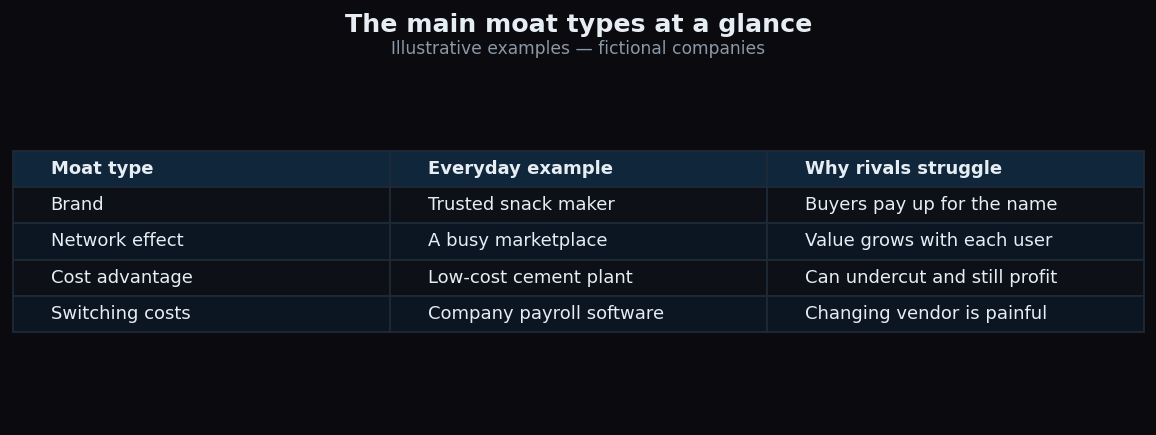
Different mechanisms, one job: each makes it costly, slow, or risky for a competitor to take the company's customers.
Why moats matter to a long-term investor
Moats matter because they protect future profits, and future profits are what a long-term owner is really buying. A business without a moat may earn great margins today, but those margins are on loan — competition will come to collect. A business with a moat can compound its earnings for years because the competition is held at bay.
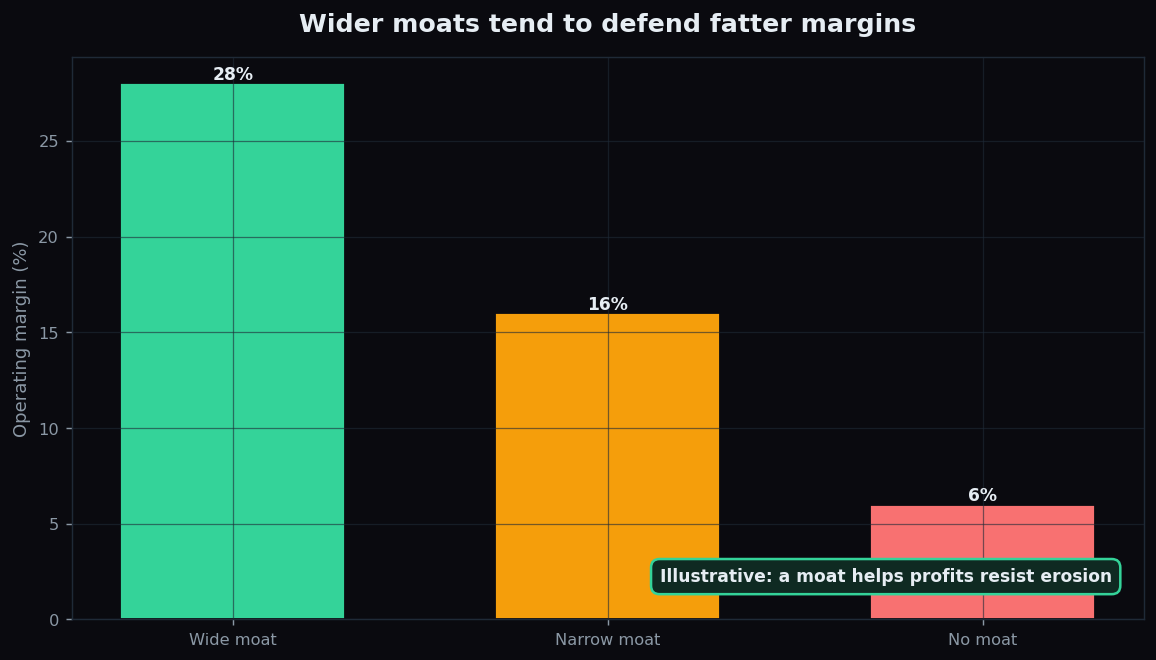
Here is an illustrative picture. Suppose a wide-moat company holds an operating margin around 28%, a narrow-moat company around 16%, and a no-moat company around 6%. The numbers are made up, but the shape is the point: the stronger the moat, the more a company can defend a high margin when rivals attack. A no-moat firm's margin gets squeezed toward the bare minimum the market will allow.
A worked example
Say two fictional firms each earn ₹100 crore of profit this year. Ferro Steel has no moat; Sunrise Foods has a strong brand. Over the next five years, competition slowly grinds Ferro's profit down to ₹70 crore, while Sunrise's brand lets it nudge profit up to ₹130 crore. Same starting point, very different destinations — and the difference is the moat. That is why an investor with a long horizon cares less about this year's profit and more about whether it can be defended.
The honest catch
Moats are powerful but they are not magic, and it is easy to over-trust them:
- Moats can erode. Technology, regulation and shifting tastes fill in moats all the time. Yesterday's unbeatable brand can fade; a network can be leapfrogged by a new platform.
- They are easier to see in the past than the future. It is simple to point at a dominant company and say "moat." Judging whether that moat will still hold in ten years is genuinely hard.
- A moat is not a valuation. A wonderful business bought at a wildly high price can still be a poor investment. The quality of the business and the price paid are two separate questions.
- Management can waste it. Even a strong moat can be squandered by poor decisions, reckless expansion, or neglect of the very thing that made customers loyal.
So the moat is a lens, not a guarantee. It helps you ask the right question — can this company keep its profits? — rather than handing you the answer.
Curious how durable advantages show up in the numbers over time? TrueTrend's plain-language education and market tools help you build that judgement step by step. Start free and learn to read businesses for yourself.
Key takeaways
- An economic moat is a durable competitive advantage that protects a company's profits from competition.
- High profits attract rivals; a moat is the structural reason those profits are not quickly competed away.
- Four common moat types: brand, network effects, cost advantage, and switching costs.
- Wider moats tend to defend higher margins for longer, which is what a long-term owner is really buying.
- Moats can erode with technology, regulation and taste; they are easier to spot looking back than forward.
- A moat is not a price — even a great business can be a poor investment if bought too dear.
See these concepts on live market data — free
Create a free TrueTrend account to watch daily support/resistance levels, market regime, and option-positioning charts on NIFTY, BankNifty and 12 more instruments. Every level we publish is scored on a public scoreboard — misses included. No card required.
Free forever tier · daily levels with published hit-rates across every instrument. Descriptive market structure, not investment advice.
Not ready for an account? Get the daily levels by email.
One short email each market day — the indices' call wall, put wall, gamma flip and max pain, and how the last session's levels scored. Free, no account, unsubscribe anytime.
Descriptive market structure, not investment advice. We never share your email.