How Do Stock Prices Move? Supply and Demand Explained
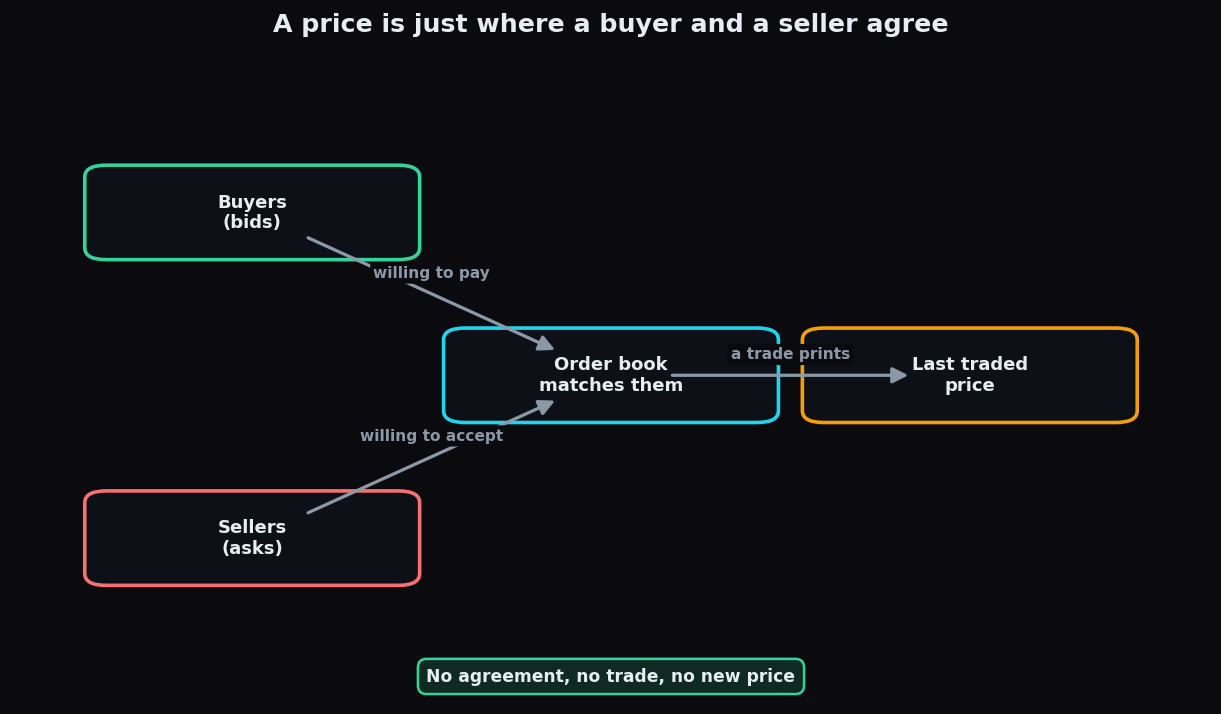
Open any stock app and the number keeps twitching — up a rupee, down two, up again. It can feel random, or like some hidden hand is pushing it. It is neither. A stock price is simply the latest point where one person willing to buy and one person willing to sell agreed on a number. Everything else — news, earnings, rumours, panic — only matters because it changes how badly people want to buy or sell. This post unpacks that one idea so the twitching number finally makes sense.
What a price actually is
A stock price is the price at which the most recent trade happened. Not the price someone hopes for, not an official value stamped by the company — just the last number two strangers actually agreed on. The moment a new trade happens at a different number, that becomes the new price.
To make this work, an exchange keeps an order book: a live list of everyone who wants to buy and everyone who wants to sell, and at what price. Buyers post bids (the price they are willing to pay). Sellers post asks (the price they want to receive). When a bid and an ask meet, a trade prints, and the price updates.
Think of a busy vegetable market. One stall wants 50 rupees a kilo; a shopper offers 45. No deal yet. The shopper nudges to 48, the seller drops to 48, and the tomatoes change hands. The “price of tomatoes” right now is 48 — until the next haggle. A stock works the same way, just faster and with thousands of buyers and sellers at once.
Supply and demand, in plain terms
Demand is how many shares people want to buy. Supply is how many shares people want to sell. Price is the meeting point between the two:
- If buyers crowd in and sellers hold back, the only way to get filled is to bid higher. Price rises.
- If sellers rush out and buyers are shy, sellers must accept less. Price falls.
- If both sides are balanced, the price drifts sideways.
That is the whole engine. Notice what is not in it: there is no rule that a “good company” must go up today. A wonderful business with no buyers at the moment will still slip; a mediocre one everybody suddenly wants will still pop. Price reflects the tug-of-war between supply and demand right now, not a final verdict on the company.
Reading the order book
The order book is where supply and demand become visible. Below is a simplified snapshot. Buyers wait below the current price; sellers wait above it. The gap between the highest bid and the lowest ask is the spread.
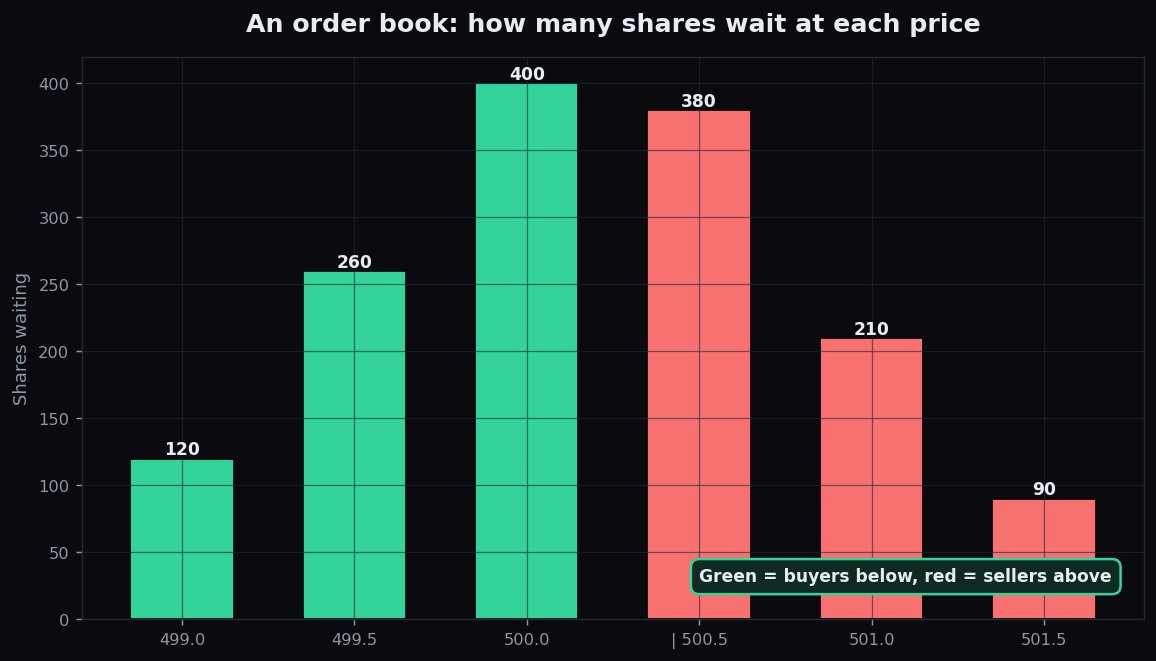
Suppose the highest bid is 500.0 and the lowest ask is 500.5. The spread is 50 paise. If a buyer is impatient and accepts 500.5, a trade prints at 500.5 and that becomes the new price. If big buyers keep lifting each ask — 500.5, then 501.0, then 501.5 — the price climbs as they eat through the sellers stacked above. The depth (how many shares sit at each level) tells you how much buying or selling it takes to move the price. Thin depth means a few large orders can swing it; deep books barely budge.
So where does news fit in?
Here is the part most beginners get backwards. News does not directly set a price. News changes people’s willingness to buy or sell, and that shift moves the order book, and the order book moves the price. News is a trigger, not the price itself.
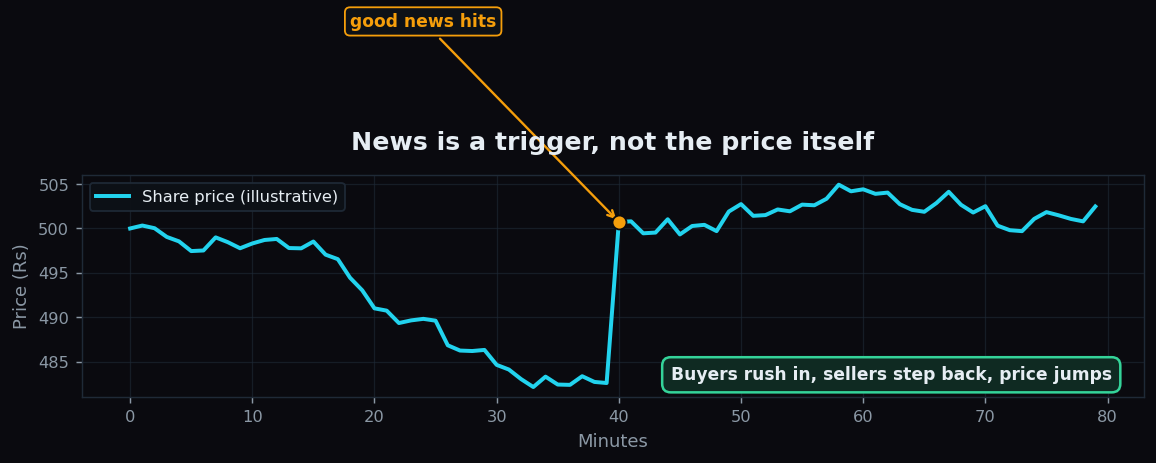
Picture a company that reports surprisingly strong results at 2:00 pm. Instantly, buyers who were waiting at 500 cancel and re-bid at 510, 515. Sellers who were happy to let go at 502 pull their orders, now wanting 520. Demand jumped and supply dried up in the same second, so the price gaps higher — not because a rule says “good news equals up,” but because the crowd repriced what they were willing to pay. Bad news does the mirror image: buyers vanish, sellers panic, and the price drops to wherever a willing buyer still exists.
This is also why a price can fall on good news, or rise on bad news. If everyone already expected a great result and bid it up in advance, the actual announcement can leave nothing new to buy — and the price sags as early buyers take profits. The market trades on the gap between what was expected and what arrived, not on the headline alone.
Why this matters for a beginner
Once you see price as an agreement, several mysteries dissolve:
- Why prices move when “nothing happened.” Something always happened — someone’s willingness to trade changed, even without a headline.
- Why two people disagree and both trade. Every trade needs a buyer who thinks it is worth it and a seller who thinks otherwise. Disagreement is the fuel.
- Why big orders move price more. A large buyer must climb through many asks to get filled, dragging the price up the ladder.
- Why liquidity matters. In a stock with few buyers and sellers, even a modest order can lurch the price, because the book is thin.
The honest catch
The mechanics are simple; predicting them is not. The order book only shows the orders sitting right now — it cannot show you the giant buyer about to arrive, or the news about to break. Prices reflect the crowd’s current mood, and moods flip fast and often irrationally. Understanding how a price forms does not tell you where it goes next; it just stops the movement from looking like magic. Anyone who claims certainty about the next tick is guessing with confidence.
It also helps to remember that what you see in a basic app is a snapshot. Professionals watch order-book depth, the pace of trades, and how aggressively buyers lift offers — context that a single blinking number hides. Treat the last price as one data point in a living auction, not as the truth.
Seeing the order book as a live auction is the first step from guessing to understanding. TrueTrend is built to make that market structure — the balance of buyers and sellers, and how it shifts — readable for ordinary learners. You can start free and explore the context behind the moves, at your own pace.
Key takeaways
- A stock price is just the last number a buyer and a seller agreed on — nothing more official than that.
- The order book holds bids (buyers) and asks (sellers); a trade prints where they meet, setting a new price.
- Demand up or supply down pushes price higher; supply up or demand down pushes it lower.
- News is a trigger: it changes willingness to trade, which moves the book, which moves the price.
- Prices can fall on good news if it was already expected — the market trades on surprises, not headlines.
- The mechanics are simple, but they explain the past, not the future. No one can promise the next move.
See these concepts on live market data — free
Create a free TrueTrend account to watch daily support/resistance levels, market regime, and option-positioning charts on NIFTY, BankNifty and 12 more instruments. Every level we publish is scored on a public scoreboard — misses included. No card required.
Free forever tier · daily levels with published hit-rates across every instrument. Descriptive market structure, not investment advice.
Not ready for an account? Get the daily levels by email.
One short email each market day — the indices' call wall, put wall, gamma flip and max pain, and how the last session's levels scored. Free, no account, unsubscribe anytime.
Descriptive market structure, not investment advice. We never share your email.