How US Markets Affect Indian Stocks: A Beginner's Guide
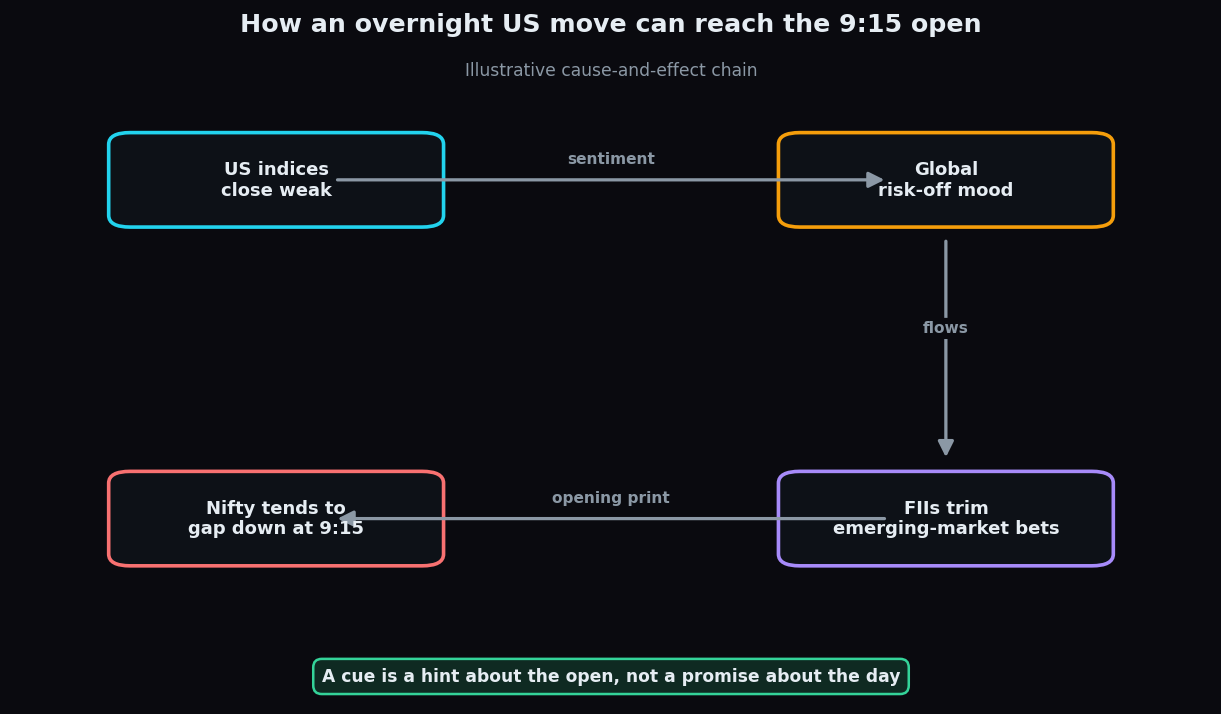
By the time the Indian market opens at 9:15 in the morning, a lot has already happened while you were asleep. New York traded through the night, Tokyo and Hong Kong are already awake, and traders have formed a rough view of the mood. That is why Indian shares almost never open in a vacuum — and why the first question many desks ask is simple: how did the US close?
This guide explains, in plain language, what "US markets" means, why a night on Wall Street can nudge the Nifty, which sectors feel it most, and where this link quietly breaks down.
What we mean by "US markets"
Three US indices get watched the most. The Dow Jones Industrial Average tracks 30 large American companies. The S&P 500 tracks 500 big firms and is the broadest read on US stocks. The Nasdaq is technology-heavy, full of chip, software, and internet names. They close around 1:30 to 2:00 AM Indian time, so their result is fresh news when Indian traders wake up.
A quick definition you will need: an index is just a basket of shares bundled into one number, so "the S&P 500 fell 1%" is shorthand for "the average big US stock had a weak day."
Why a night in New York can move Mumbai
The link is not magic. It runs through people and money.
- Shared owners. Big global funds hold shares in many countries at once. When they turn cautious after a rough US session, they often lighten up across the board — including in India. This is the FII channel (Foreign Institutional Investors: overseas funds that invest in Indian shares).
- Shared mood. Markets run on risk appetite. A scary US session can spread a "risk-off" mood that reaches Asia hours later, and India inherits some of it.
- Shared customers. Some Indian companies earn a large slice of revenue from US clients — software services are the classic case. If US growth looks shaky, their outlook dims too.
Think of it like weather moving west to east. A storm over New York does not guarantee rain in Mumbai, but it raises the odds that the morning opens grey. The cue is a tilt in probability, not a script for the day.
A worked example (illustrative numbers)
Say the S&P 500 closes down 1.5% overnight on worries about US interest rates. The next morning:
- GIFT Nifty — a Nifty futures contract that trades through global hours — is pointing about 120 points below the previous close.
- Indian IT names, which sell heavily to US clients, are indicated weaker in early trade.
- The index opens with a gap down, then spends the day deciding whether to follow through or shrug it off.
Round numbers, made up to show the mechanics. Notice the chain: US close → overnight futures → opening tilt. To go deeper on that pre-open read, see our explainer on GIFT Nifty and global cues.
The correlation is real but loose
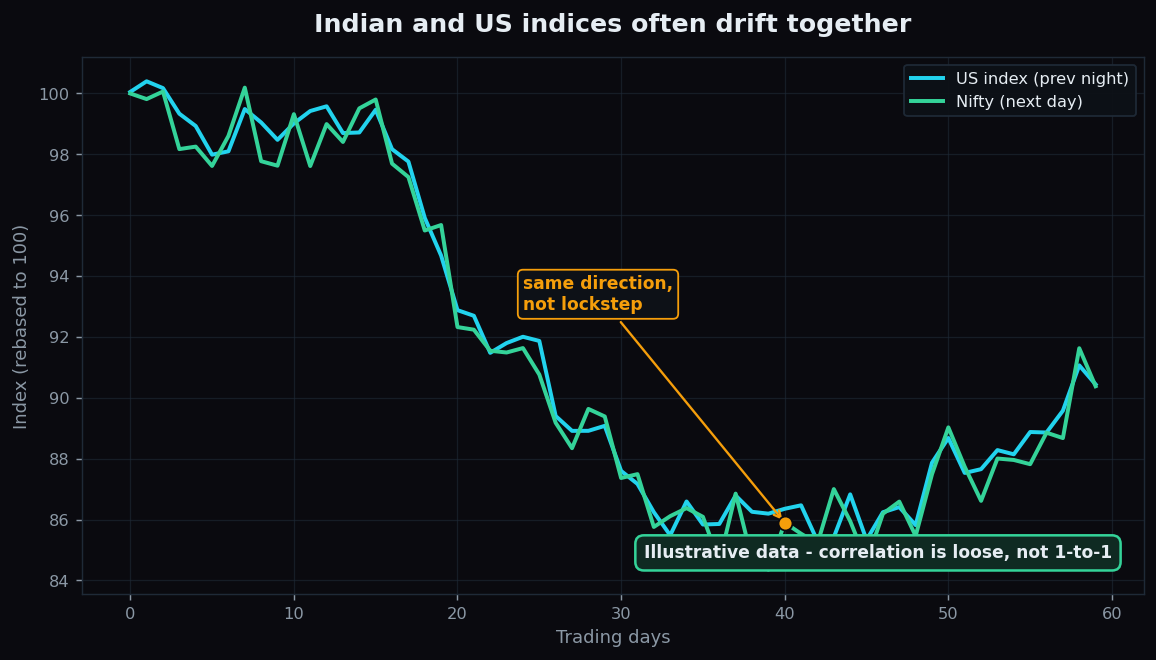
Correlation means two things tend to move together. US and Indian equities are positively correlated over long stretches — but the relationship is loose, not lockstep. Some days India ignores a weak Wall Street entirely because a local trigger (a budget, an earnings surprise, a domestic policy) dominates. The chart above is illustrative: the two lines lean the same way, yet they diverge often.
A useful mental model: US markets set the starting mood, but India's own news writes the rest of the story once trading begins.
Which sectors react the most
Not every part of the market listens to New York equally.
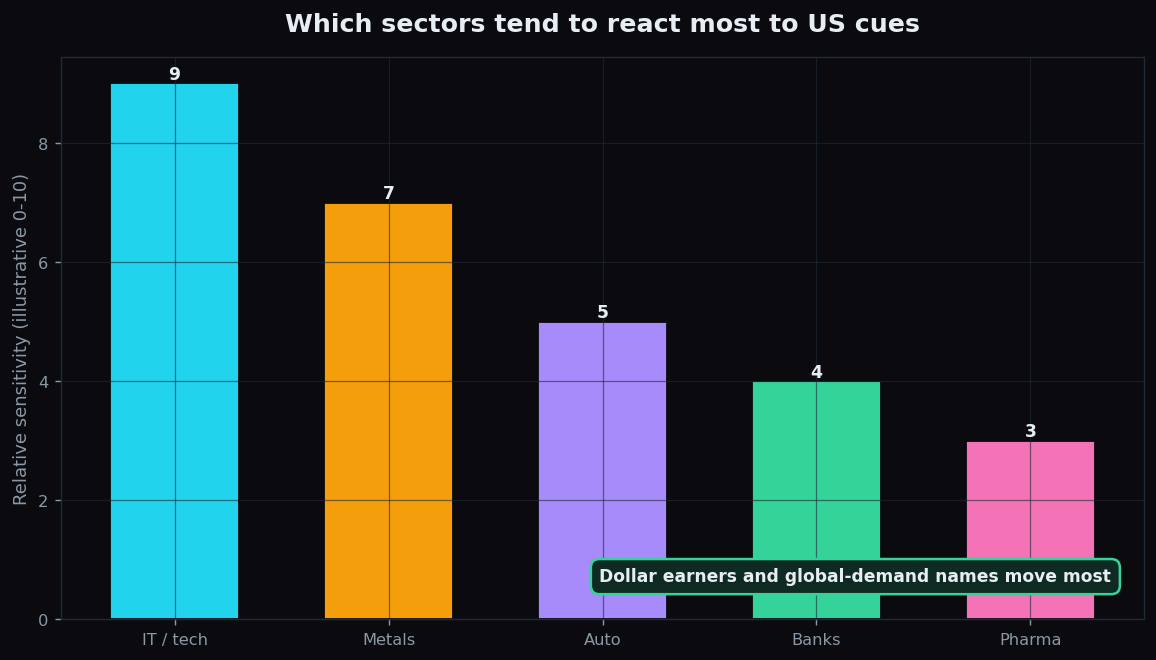
- IT and technology services: the most sensitive, because they earn in dollars from US customers and move with US tech sentiment.
- Metals and commodities: react to global growth expectations set overnight.
- Autos and export-facing manufacturers: feel global-demand cues.
- Domestic-facing banks, consumer staples, utilities: care more about local rates and demand, so they often shrug off overnight noise.
The honest catch
Overnight cues are noisy. A gap-down open can fully reverse by lunch; a strong US session can fade into a flat Indian day. Reacting hard to the pre-open number is how many beginners get whipsawed. The cue tells you the starting weather, not the destination. Time zones also mean you are always reading yesterday's US news against today's Indian reality — and reality can change fast.
Treat global cues as one input among several: context to understand the open, not a signal to act on blindly.
Reading global cues is a skill you build by watching the same setup play out many mornings. TrueTrend turns those overnight signals — US indices, GIFT Nifty, currency and flows — into one plain-English morning read, so you can see the context instead of guessing. Create a free account to follow along.
Key takeaways
- US markets close overnight (around 1:30–2:00 AM IST), so their result is fresh when India opens.
- The link runs through shared global funds, shared mood, and shared US customers — not magic.
- The correlation is positive but loose; India frequently writes its own story once trading starts.
- IT, metals, and exporters react most; domestic-facing sectors often ignore the noise.
- A cue is a tilt in the odds for the open, not a forecast for the whole day.
See these concepts on live market data — free
Create a free TrueTrend account to watch daily support/resistance levels, market regime, and option-positioning charts on NIFTY, BankNifty and 12 more instruments. Every level we publish is scored on a public scoreboard — misses included. No card required.
Free forever tier · daily levels with published hit-rates across every instrument. Descriptive market structure, not investment advice.
Not ready for an account? Get the daily levels by email.
One short email each market day — the indices' call wall, put wall, gamma flip and max pain, and how the last session's levels scored. Free, no account, unsubscribe anytime.
Descriptive market structure, not investment advice. We never share your email.