Inflation and the Stock Market Explained
Every price tag in the economy drifts upward over time. A cup of chai that cost five rupees a decade ago costs far more today. That slow, broad rise in prices is called inflation, and it is one of the most important forces sitting behind the stock market — even though it never appears on a price chart. This post explains what inflation is, why equity investors watch it so closely, and the honest limits of the relationship.
What inflation actually is
Inflation is the rate at which the general level of prices rises over a period, usually measured year over year. In India the most watched gauge is the Consumer Price Index, or CPI — a basket of everyday goods and services (food, fuel, rent, clothing, and more) whose total cost is tracked over time. If that basket cost 100 last year and 106 this year, CPI inflation is 6%.
The simplest way to feel inflation is through purchasing power — how much your money can actually buy. When prices rise 6% a year, the same 100-rupee note buys about 6% less than it did twelve months ago. Inflation is not money disappearing; it is money quietly shrinking in what it can purchase.
Nominal versus real: the idea that changes everything
Here is the single most useful distinction in this whole topic. A nominal return is the number you see on your screen. A real return is that number after subtracting inflation — what your money is worth in actual buying power.
Think of it like walking up an escalator that is moving down. Your nominal return is how fast you climb the steps. Inflation is the escalator sliding down beneath you. Your real progress is the difference between the two.
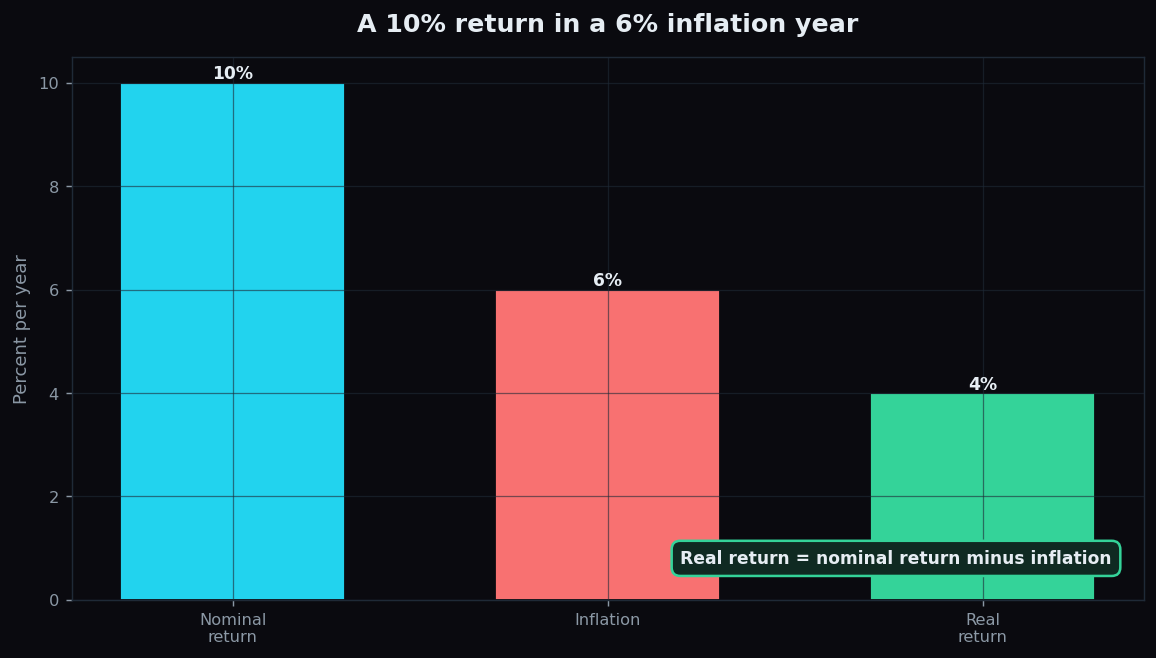
A worked example with round numbers. Say you invest 100 and it grows to 110 in a year — a 10% nominal return. If inflation that year was 6%, your real return is roughly 10% minus 6%, which is about 4%. You are genuinely richer, but only by 4% in terms of what you can buy, not the 10% the screen flashed.
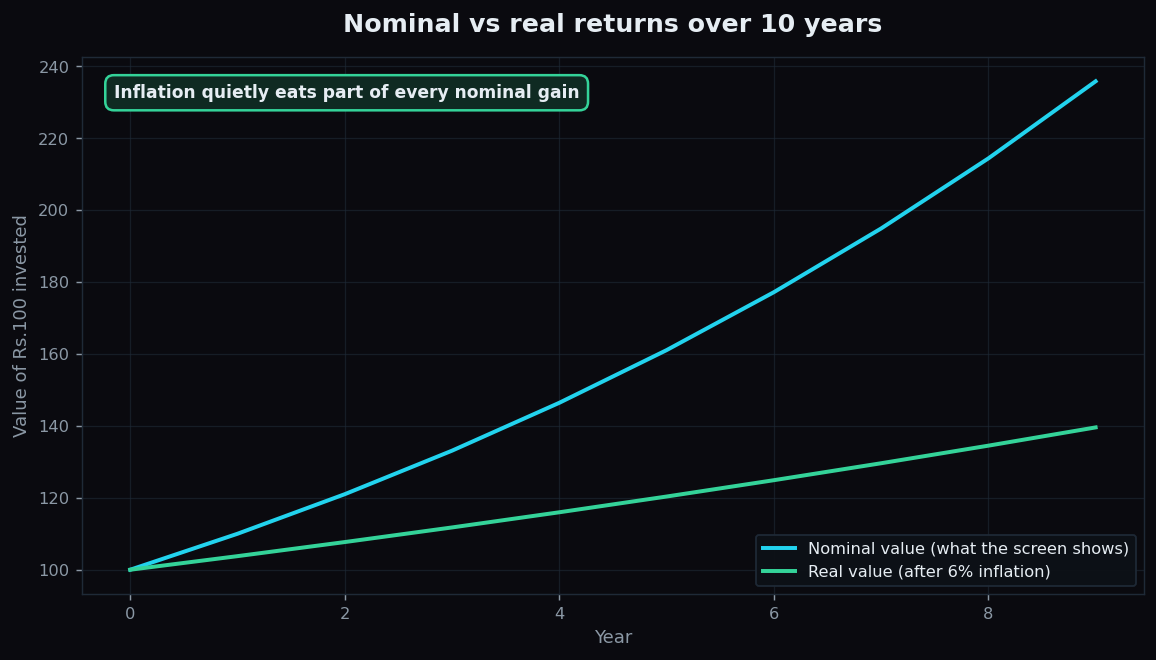
Over a single year the gap looks small. Over a decade it becomes enormous, because inflation compounds just like returns do. The chart above shows how the real (inflation-adjusted) line drifts steadily below the nominal line, year after year.
Why equity investors care so much
Inflation reaches stock prices through two main channels. Neither is a rule that always fires — they are pressures, not switches.
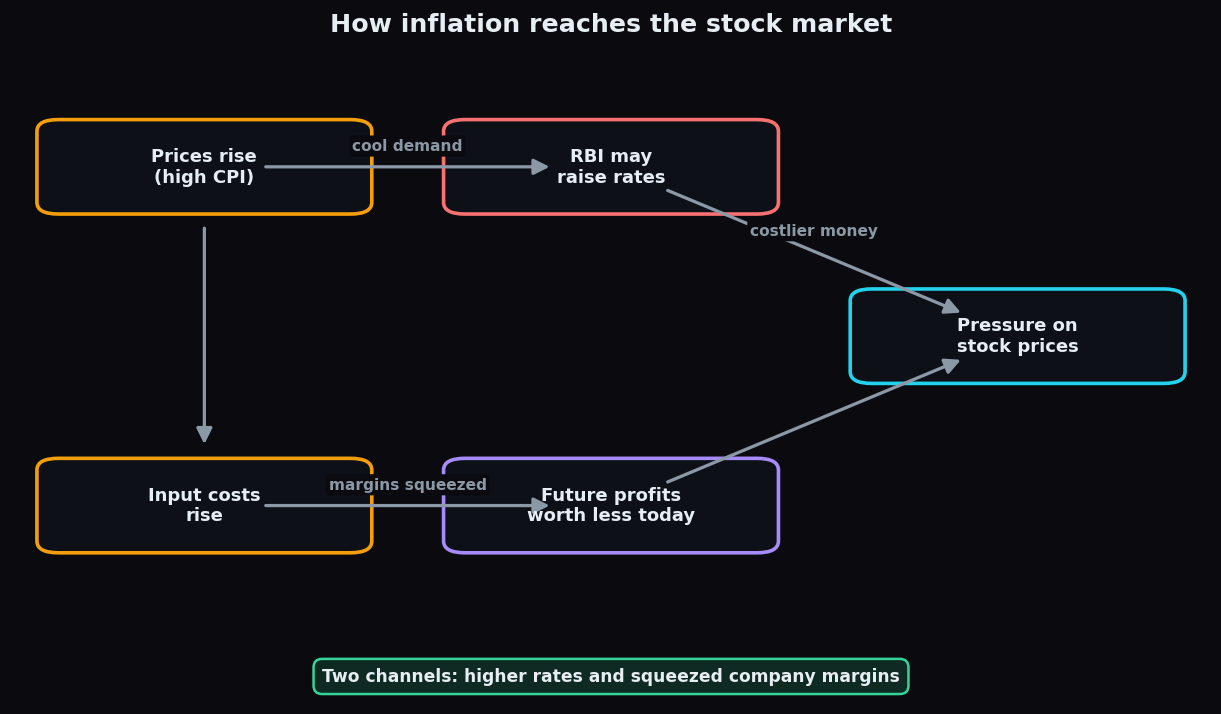
Channel one: interest rates. When inflation runs hot, the central bank — the Reserve Bank of India (RBI) — often raises interest rates to cool demand. Higher rates make borrowing costlier for companies and make safe options like fixed deposits and bonds more attractive compared to shares. Money can rotate out of equities toward those safer yields, which weighs on stock prices.
Channel two: company margins. Inflation raises the cost of a company's inputs — raw materials, wages, energy, transport. If a firm cannot pass those higher costs on to customers, its profit margin (profit as a share of sales) gets squeezed. Lower expected profits can mean a lower stock price.
There is also a subtler, forward-looking effect. A share is worth the company's future profits, valued in today's money. When inflation and interest rates rise, those future profits are discounted more heavily — a rupee earned five years from now is worth less today. Fast-growing companies whose profits sit far in the future tend to feel this most.
Pricing power: the quality that resists inflation
Pricing power is a company's ability to raise its own prices without losing customers. A business selling something people cannot easily give up, or a brand with no close substitute, can pass rising costs straight to buyers and protect its margin. A business in a crowded, price-sensitive market often cannot — it must absorb the cost and watch its margin shrink.
This is why, during inflationary stretches, investors often talk about which companies have pricing power and which do not. It is a descriptive lens on who can defend profits, not a prediction about any single stock.
How the numbers are actually used
On the day CPI data is released, market watchers rarely react to the raw figure alone. They compare it to what was expected. If inflation was expected at 5% and prints at 5%, the market may barely move — the news was already priced in. If it prints at 6.5%, the surprise is what matters, because it changes expectations about future interest rates. This "actual versus expected" habit shows up across almost every macro release, not just inflation.
The honest catch
The link between inflation and equities is real but loose, and it is easy to over-simplify. A few honest caveats:
- The direction is not fixed. Moderate, steady inflation can accompany rising markets, because it often signals healthy demand. It is usually surprising or runaway inflation that unsettles equities.
- Different sectors react differently. Some businesses benefit from rising prices; others suffer. A single market-wide statement hides a lot of variation.
- Many forces act at once. Inflation shares the stage with growth, global flows, currency moves, and sentiment. Isolating its effect on any given day is genuinely hard.
- Data is backward-looking. CPI describes prices that already happened. Markets are busy pricing what comes next.
So inflation is best treated as one important piece of context — a lens for understanding why the mood shifts — rather than a lever you can pull to predict tomorrow's close.
Understanding context like inflation is the difference between reacting to headlines and reading the market calmly. TrueTrend is built to make that market structure clear and beginner-friendly. Create a free TrueTrend account to keep learning the mechanics behind the moves.
Key takeaways
- Inflation is the broad rise in prices over time, measured in India mainly by CPI; it erodes the purchasing power of money.
- Real return = nominal return minus inflation. A 10% gain in a 6% inflation year is about a 4% real gain.
- Inflation reaches equities through two channels: higher interest rates and squeezed company margins.
- Pricing power — the ability to raise prices without losing customers — is what helps a business defend profits when costs rise.
- Markets react to the surprise versus expectations, not the raw CPI number alone.
- The relationship is a loose pressure, not a rule — treat inflation as context, never as a prediction tool.
See these concepts on live market data — free
Create a free TrueTrend account to watch daily support/resistance levels, market regime, and option-positioning charts on NIFTY, BankNifty and 12 more instruments. Every level we publish is scored on a public scoreboard — misses included. No card required.
Free forever tier · daily levels with published hit-rates across every instrument. Descriptive market structure, not investment advice.
Not ready for an account? Get the daily levels by email.
One short email each market day — the indices' call wall, put wall, gamma flip and max pain, and how the last session's levels scored. Free, no account, unsubscribe anytime.
Descriptive market structure, not investment advice. We never share your email.