Margin and Leverage Explained for Beginners
You may have heard that with a few thousand rupees you can control positions worth lakhs in the futures and options market. That magic trick has a name: leverage. It is powerful, it is available to almost anyone with a trading account, and it is the single biggest reason beginners blow up. Understanding what leverage really does — to your gains and, just as importantly, to your losses — is essential before you ever place a leveraged trade.
What margin and leverage mean
Margin is the good-faith deposit you place with your broker to open a leveraged position. You are not paying the full value of the contract; you are putting down a fraction of it and borrowing the rest of the exposure. Leverage is simply the ratio between the size of the position you control and the money you actually put up.
Here is the everyday analogy. Buying a house with a home loan is leverage. If you put down 10% and borrow 90%, you control a whole house with a tenth of its price. If the house value rises 10%, you have doubled your deposit. If it falls 10%, your deposit is wiped out — even though the house only moved a little. The loan magnified both directions. Trading margin works exactly the same way, just faster.
Why leverage magnifies everything
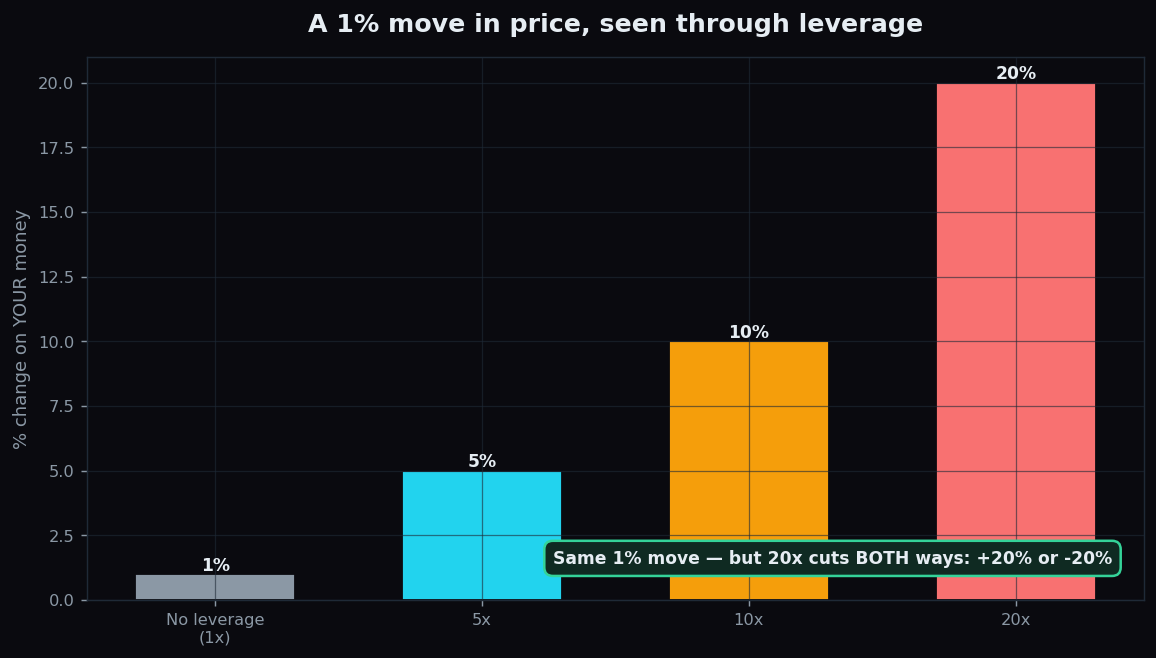
Leverage does not change the market's move. It changes how big that move feels on your money. A 1% move in the underlying price is just 1% if you paid in full. But at 10x leverage that same 1% becomes a 10% swing in your account. At 20x it becomes a 20% swing. The chart below shows the same tiny 1% price move seen through different amounts of leverage.
Read that chart carefully, because the honest version has a second half: the bars point both ways. At 20x, a 1% move in your favour is +20% — and a 1% move against you is -20%. Leverage is a mirror, not a magnet. It does not prefer profits. It amplifies whatever the market hands you.
A worked example with round numbers
Suppose a contract has a notional value of 10,00,000 and your broker asks for 1,00,000 as margin. That is 10x leverage. These are illustrative figures.
- Price rises 2%: the position gains 20,000. On your 1,00,000 that is a +20% return. Feels brilliant.
- Price falls 2%: the position loses 20,000. On your 1,00,000 that is a -20% hit. The same small move, the opposite feeling.
- Price falls 10%: the position loses 1,00,000 — your entire margin is gone, and you may owe more.
The underlying only moved a little in each case. Your account moved ten times as much. That is the whole story of leverage in three lines.
How a margin call works
Because your deposit is only a thin cushion, brokers watch it constantly. When losses eat into that cushion and your account equity drops below a required minimum, you get a margin call — a demand to add funds immediately. If you cannot or do not top up, the broker squares off (force-closes) your position to protect itself, often at the worst possible moment. You do not get a vote.
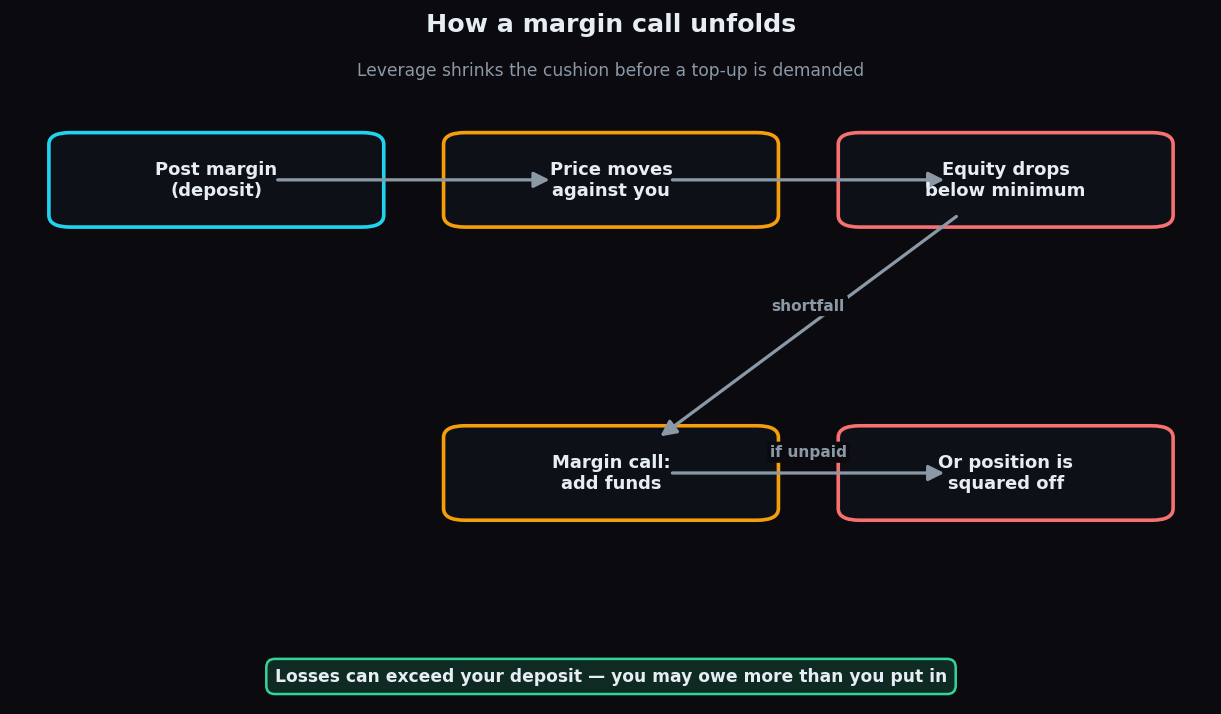
The nasty part is that a margin call tends to arrive exactly when the market is moving violently, which is also when spreads are wide and prices gap. Forced selling into that can lock in a far bigger loss than the chart alone would suggest.
The honest catch
Leverage is often sold as a way to "do more with less." The truthful framing is that it lets you lose more with less, too. Three things beginners routinely underestimate:
- Losses can exceed your deposit. Unlike buying a stock outright, a leveraged position can leave you owing money beyond what you put in.
- Timing risk is real. You might be right about direction eventually, but a temporary swing can trigger a margin call and close you out before you are proven right.
- Costs compound. Leverage magnifies gains and losses, but the friction — brokerage, taxes, the bid-ask spread — is paid on the full notional, not on your small margin.
None of this means leverage is "bad." It means it is a precision tool that punishes carelessness. Position sizing — deciding how much of your capital any single trade can risk — matters far more than picking the direction.
Leverage rewards people who understand context, not luck. TrueTrend translates live market structure into plain language so you can study the terrain before you size a trade. Start free and learn at your own pace.
Key takeaways
- Margin is your deposit; leverage is the ratio of position size to that deposit.
- Leverage magnifies a price move on your money — a 1% move at 20x becomes a 20% swing, up or down.
- A margin call demands more funds when losses shrink your cushion; unmet, the broker force-closes your position.
- Leveraged losses can exceed your original deposit, and forced square-offs often hit at the worst time.
- Because it cuts both ways, disciplined position sizing matters more than being right about direction.
See these concepts on live market data — free
Create a free TrueTrend account to watch daily support/resistance levels, market regime, and option-positioning charts on NIFTY, BankNifty and 12 more instruments. Every level we publish is scored on a public scoreboard — misses included. No card required.
Free forever tier · daily levels with published hit-rates across every instrument. Descriptive market structure, not investment advice.
Not ready for an account? Get the daily levels by email.
One short email each market day — the indices' call wall, put wall, gamma flip and max pain, and how the last session's levels scored. Free, no account, unsubscribe anytime.
Descriptive market structure, not investment advice. We never share your email.