Option Moneyness: ITM, ATM and OTM Explained Simply
Three little abbreviations show up everywhere in options talk: ITM, ATM and OTM. Together they describe an option's moneyness — where the current price of the underlying sits relative to the option's strike. Get this straight and half of options jargon suddenly makes sense, because moneyness quietly drives an option's price, its odds, and its risk.
The three states, defined
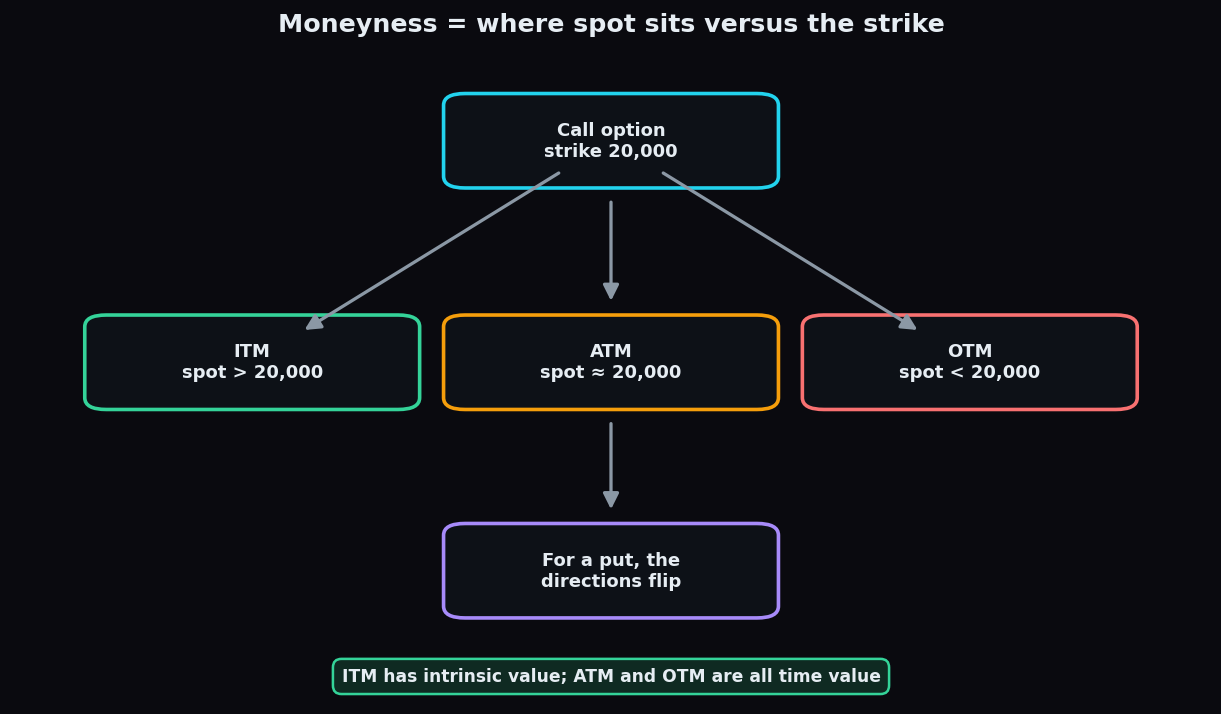
First, the building blocks. The strike is the fixed price written into the option. The spot is the current market price of the underlying. A call is the right to buy at the strike; a put is the right to sell at the strike. Moneyness compares spot to strike:
- In-the-money (ITM) — the option already has built-in value if exercised now. A call is ITM when spot is above the strike; a put is ITM when spot is below the strike.
- At-the-money (ATM) — spot is right at (or very close to) the strike. Neither ahead nor behind.
- Out-of-the-money (OTM) — the option has no built-in value yet. A call is OTM when spot is below the strike; a put is OTM when spot is above the strike.
Notice the mirror: for puts, the ITM and OTM directions flip. That single symmetry is the whole idea.
Intrinsic value versus time value
An option's premium splits into two parts. Intrinsic value is the built-in amount — how deep ITM the option is right now. Time value is the extra a holder pays for the chance that the option moves further into the money before expiry. An ITM option has both intrinsic and time value. An ATM or OTM option has zero intrinsic value — its entire premium is time value, pure hope with a price tag.
A handy analogy: a concert ticket you resell. If the face value is 2,000 and identical tickets are changing hands for 3,200, your ticket has 1,200 of intrinsic value — that is real, bankable. Any amount above 3,200 that a buyer pays because the show might sell out later is time value: it evaporates once the event date arrives.
A worked example
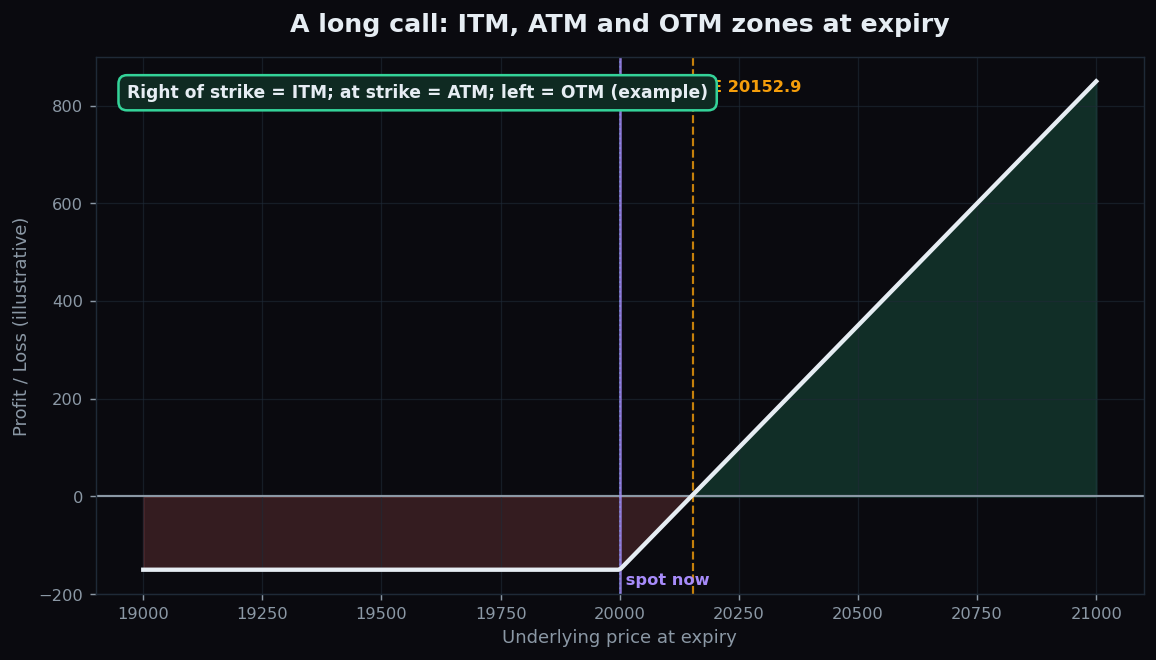
Take a call with a strike of 20,000 and a premium of 150. Read the payoff picture below, which shows the profit or loss at expiry for holding it.
- If spot expires at 20,400, the call is ITM. Its intrinsic value is 20,400 − 20,000 = 400. After the 150 paid, the holder is ahead by 250 per unit.
- If spot expires at 20,000, the call is ATM. Intrinsic value is zero, so the 150 premium is entirely lost at expiry.
- If spot expires at 19,600, the call is OTM. It expires worthless; the holder loses the full 150.
The break-even is 20,150 — the strike plus the premium paid. Anywhere below that, this long call does not turn a profit even though it may still carry value before expiry.
How moneyness changes price and risk
Moneyness is not just a label; it shapes the trade-off you are describing:
- Deep ITM options cost the most (they carry real intrinsic value) but move almost one-for-one with the underlying and have a higher chance of finishing with value.
- ATM options carry the most time value and are the most sensitive to changes in volatility and the passage of time.
- OTM options are the cheapest and can post the largest percentage swings, but they are also the most likely to expire worthless — all reward-and-risk, no floor.
So “cheap” and “expensive” are the wrong lens. A 5 premium and a 500 premium can each be perfectly fairly priced — they simply describe very different odds and payoffs.
The honest catch
Moneyness is a description of the present, not a promise about the future. An option's state changes the instant spot moves, so an ITM option can slip OTM in minutes. Time value decays every single day, which quietly erodes ATM and OTM premiums even when the underlying sits still. And a low OTM premium is low precisely because the odds of it paying off are slim — a cheap option is not the same as a good-value one. Moneyness tells you where you stand right now; it never tells you what to do next. If you want to see how volatility separately eats into a premium, our explainer on how sellers position around this — call writing versus put writing — adds useful context.
TrueTrend labels moneyness and the intrinsic-versus-time-value split in plain language, so beginners can see what a premium is really made of. Create a free account to explore it.
Key takeaways
- Moneyness compares spot to strike: ITM has built-in value, ATM sits at the strike, OTM has none yet.
- For calls, ITM is spot above strike; for puts the directions flip.
- Premium = intrinsic value (only ITM has it) + time value (the price of a chance, which decays).
- In the worked example, the 20,000 call is ITM at 20,400, ATM at 20,000 and OTM at 19,600, with break-even at 20,150.
- Deep ITM is costlier but steadier; OTM is cheap but most likely to expire worthless — moneyness describes odds, not instructions.
See these concepts on live market data — free
Create a free TrueTrend account to watch daily support/resistance levels, market regime, and option-positioning charts on NIFTY, BankNifty and 12 more instruments. Every level we publish is scored on a public scoreboard — misses included. No card required.
Free forever tier · daily levels with published hit-rates across every instrument. Descriptive market structure, not investment advice.
Not ready for an account? Get the daily levels by email.
One short email each market day — the indices' call wall, put wall, gamma flip and max pain, and how the last session's levels scored. Free, no account, unsubscribe anytime.
Descriptive market structure, not investment advice. We never share your email.