The Pre-Open Session Explained: How Markets Open
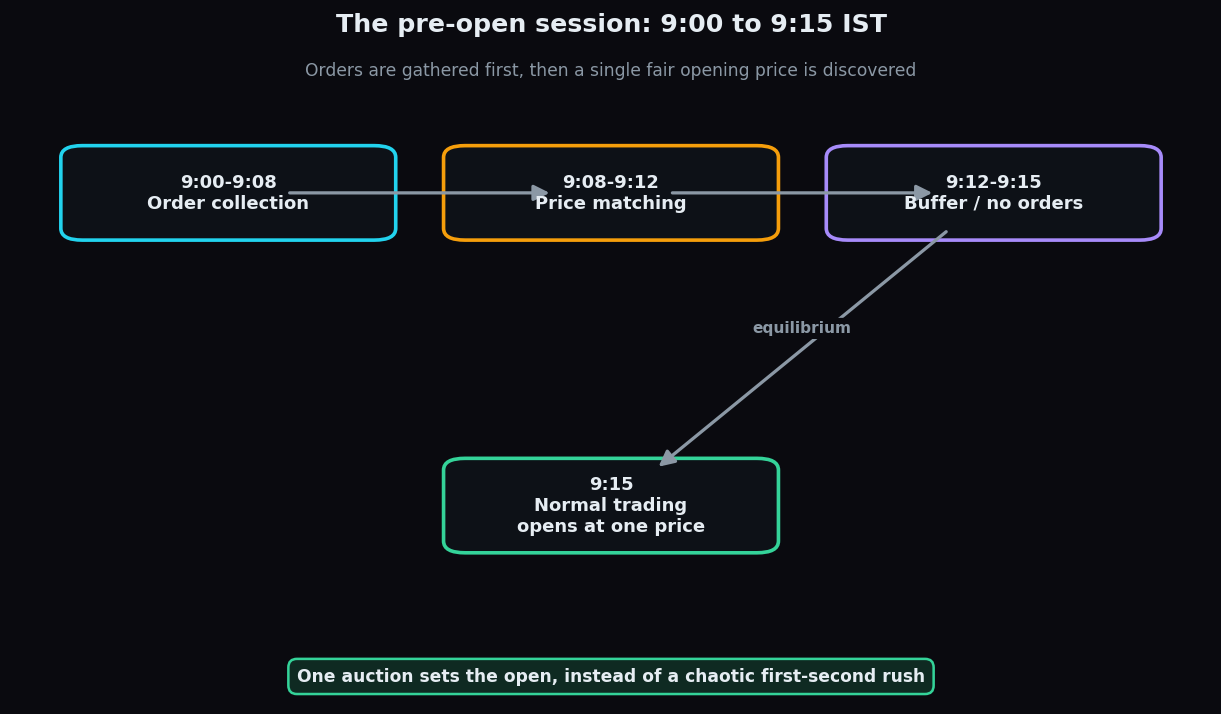
Indian markets officially open for normal trading at 9:15 in the morning. But the real action starts fifteen minutes earlier. Between 9:00 and 9:15 IST there is a special window called the pre-open session, and its whole job is to answer one tricky question calmly: at exactly what price should the day begin?
What the pre-open session is
The pre-open session is a 15-minute auction held before continuous trading begins. Instead of letting the market open with a wild first-second scramble, the exchange collects everyone's orders first, finds a single fair starting price, and then opens normal trading at that price.
The window is split into three parts:
- 9:00 to 9:08 — order collection. Traders place, change, or cancel buy and sell orders. Nothing is matched yet; the exchange is just gathering intentions.
- 9:08 to 9:12 — order matching and price discovery. No new orders. The system crunches all the collected orders and calculates one opening price (more on how below).
- 9:12 to 9:15 — buffer. A short quiet pause that smooths the handover into the regular 9:15 open.
An analogy: think of an auctioneer at the front of a crowded room. Rather than shouting prices randomly, the auctioneer first asks everyone to write down the price and quantity they want, then names the one price at which the most goods can actually change hands. The pre-open session is that auctioneer, run by a computer.
How the single price is discovered
The opening price is found through equilibrium price discovery. In plain terms: the system looks for the price at which the largest number of shares can be traded — where buyers and sellers overlap the most.
Here is the intuition with round numbers. At a low price like ₹95, lots of people want to buy but few want to sell. At a high price like ₹105, lots want to sell but few want to buy. Somewhere in the middle there is a price — say ₹100 — where the quantity buyers will take and the quantity sellers will give line up best. That crossover is the equilibrium, and it becomes the opening price.
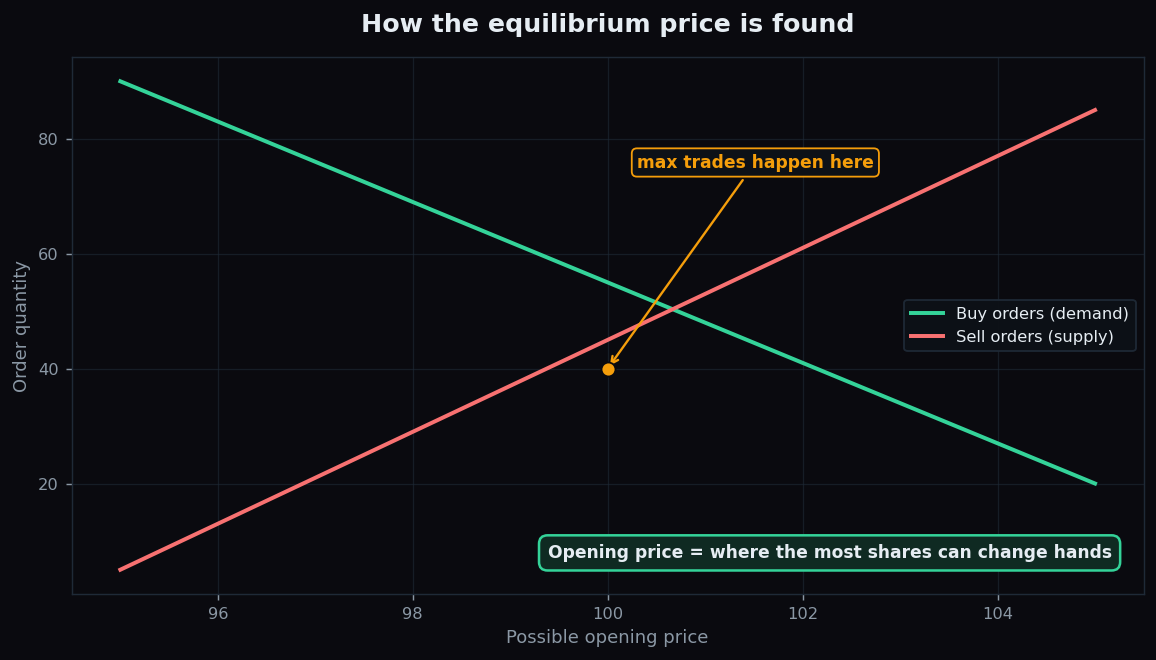
So if 80,000 shares can trade at ₹100 but only 30,000 at ₹102, the system prefers ₹100 — it maximises how much business actually gets done. Everyone who placed orders at or better than that price gets filled at the single common opening price. No one in the auction gets a secretly better deal than their neighbour.
Why the pre-open session exists
The pre-open window exists to absorb overnight surprises in an orderly way. Markets are shut for many hours, and a lot can happen — global moves, company news, policy announcements. When trading resumes, all of that pent-up demand and supply would otherwise hit the screen in the same instant.
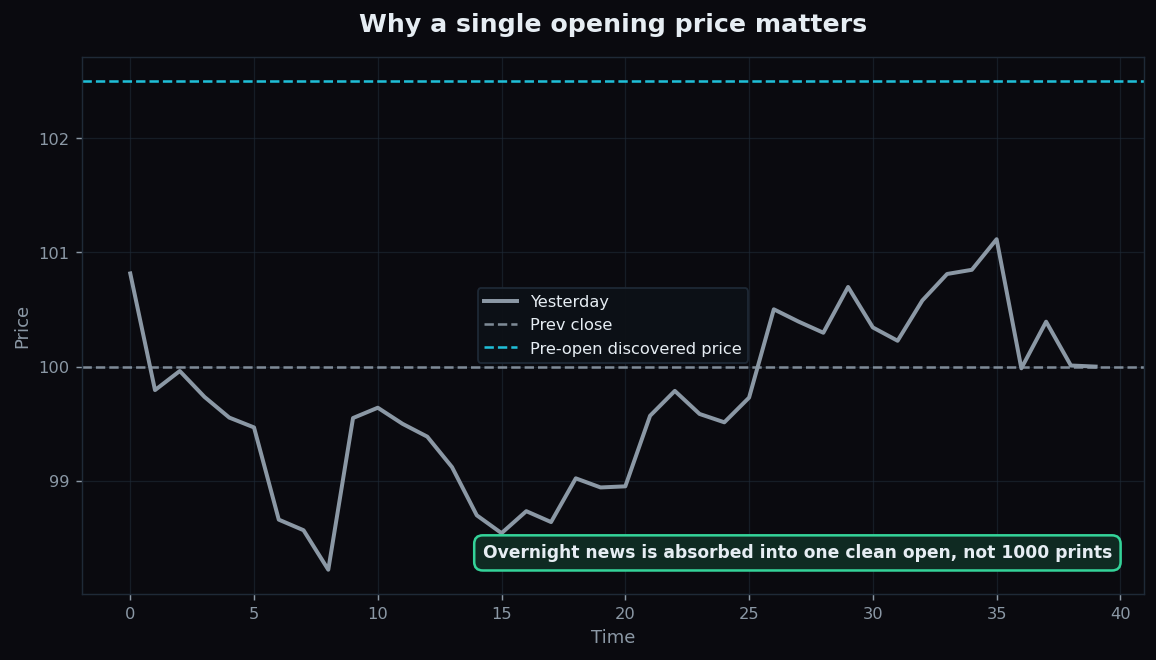
Without a pre-open auction, the first few seconds of trading could be chaotic and easy to distort: a single large order could whip the price around before others react. By collecting orders first and opening at one calculated price, the exchange:
- Reduces wild opening spikes caused by a rush of orders all landing together.
- Builds in a fair "gap" open so overnight news is reflected in one clean price rather than a messy scramble.
- Treats everyone equally — all matched orders in the auction open at the same price.
You will often notice the market "gaps" up or down from yesterday's close at exactly 9:15. That gap is the pre-open session doing its job: it has already digested the overnight mood and settled on a starting number.
The honest catch
The pre-open is helpful, but it is not a complete picture of the day.
- Thin participation early on. Not everyone trades in the pre-open, so the opening price reflects only those who showed up early. It can shift quickly once the full crowd arrives after 9:15.
- It does not predict the day. A strong gap-up open does not promise an up day, and a gap-down does not promise a down day. The pre-open sets a starting point, nothing more.
- Big indices versus small stocks. The mechanism is cleanest in heavily traded names; in thinly traded stocks the discovered price can be jumpy and less meaningful.
- Order types matter. Limit and market orders behave differently inside the auction, and orders placed in the last few minutes may not get the same treatment as earlier ones.
Treat the opening price as the market's first considered guess for the day — carefully calculated, but always subject to revision the moment continuous trading begins.
The opening price is the market's calm first answer to a noisy overnight question — and understanding mechanics like this is exactly what TrueTrend helps beginners do in plain English. Open a free account to keep building your market intuition.
Key takeaways
- The pre-open session runs 9:00–9:15 IST and exists to discover one fair opening price before continuous trading.
- It has three phases: order collection (9:00–9:08), matching (9:08–9:12), and a buffer (9:12–9:15).
- The open is set by equilibrium price discovery — the price where the most shares can trade.
- Its purpose is to absorb overnight news in an orderly way and avoid a chaotic opening scramble.
- The opening price is a starting point, not a forecast; it can move fast once the full market joins after 9:15.
See these concepts on live market data — free
Create a free TrueTrend account to watch daily support/resistance levels, market regime, and option-positioning charts on NIFTY, BankNifty and 12 more instruments. Every level we publish is scored on a public scoreboard — misses included. No card required.
Free forever tier · daily levels with published hit-rates across every instrument. Descriptive market structure, not investment advice.
Not ready for an account? Get the daily levels by email.
One short email each market day — the indices' call wall, put wall, gamma flip and max pain, and how the last session's levels scored. Free, no account, unsubscribe anytime.
Descriptive market structure, not investment advice. We never share your email.