Stock Splits and Bonus Shares Explained Simply
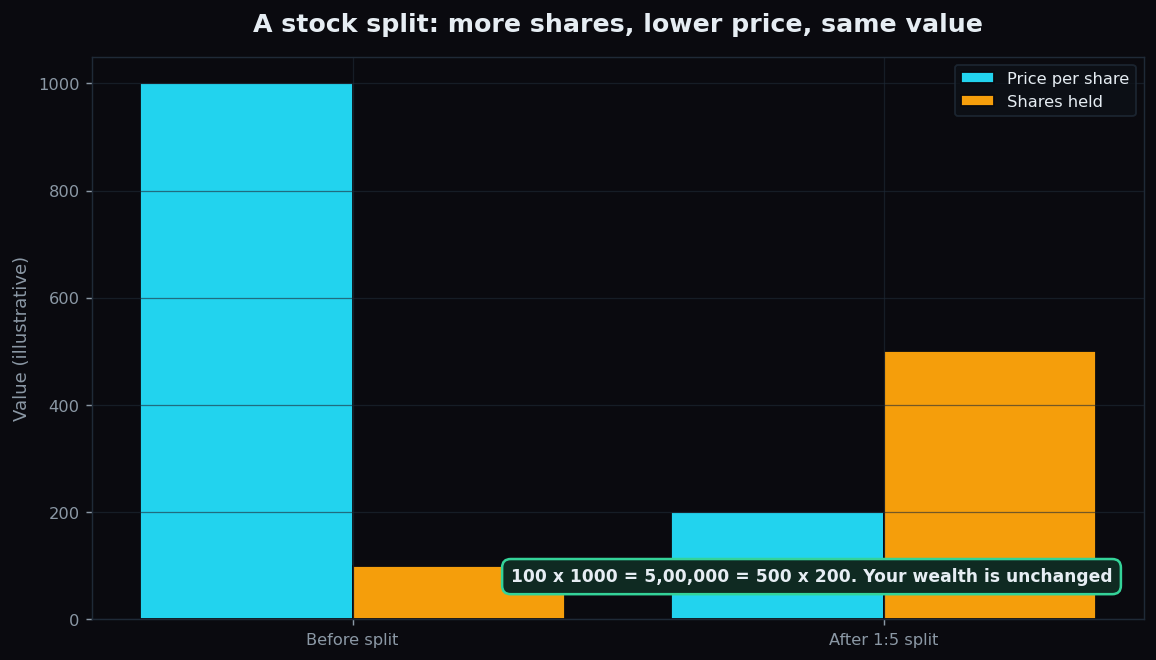
One morning you open your portfolio and your share count has jumped from 100 to 500 — but the price per share has dropped by the same proportion, and your total value has not budged. Nothing was gifted to you out of thin air. You have just experienced a stock split (or its close cousin, a bonus issue). They look dramatic and feel like free money, but the maths is beautifully simple once you see it.
What a stock split is
A stock split divides each existing share into several smaller ones. In a 1:5 split (often read as a five-for-one), every 1 share you own becomes 5 shares, and the price per share is divided by 5. The company's total worth has not changed — only the number of slices the pie is cut into.
Take round numbers. You own 100 shares at ₹1,000 each, so your holding is worth ₹1,00,000. After a 1:5 split:
- Shares: 100 becomes 500
- Price: ₹1,000 becomes ₹200
- Value: 500 × ₹200 = ₹1,00,000 — exactly the same
The classic analogy: cutting a pizza into 10 slices instead of 5 does not give you more pizza. You just have more, smaller slices. A stock split is the company taking its scissors to the share count — the total amount of "pizza" (the company) is untouched.
What a bonus issue is
A bonus issue (or bonus shares) feels even more like a gift: the company hands you extra shares for free, in proportion to what you already hold. A 1:1 bonus means one extra share for every one you own — your share count doubles.
But again, the price adjusts down to keep total value the same. If you held 100 shares at ₹800 (worth ₹80,000) and a 1:1 bonus is issued, you end up with 200 shares at about ₹400 — still ₹80,000. The company is essentially moving money from its reserves into share capital and issuing shares to match. No cash leaves the company, and no extra value lands in your account.
The practical difference between the two is mostly accounting plumbing. A split changes the share's face value (its base accounting value); a bonus issue does not change face value but capitalises reserves. For a beginner holding the shares, the visible effect is nearly identical: more shares, lower price, unchanged total value.
Why total value stays the same
This is the single most important idea, so it is worth seeing it walk through step by step. Start with a ₹1,00,000 holding. A split drops the price sharply, then multiplies the share count by the same factor. The two effects cancel out exactly.
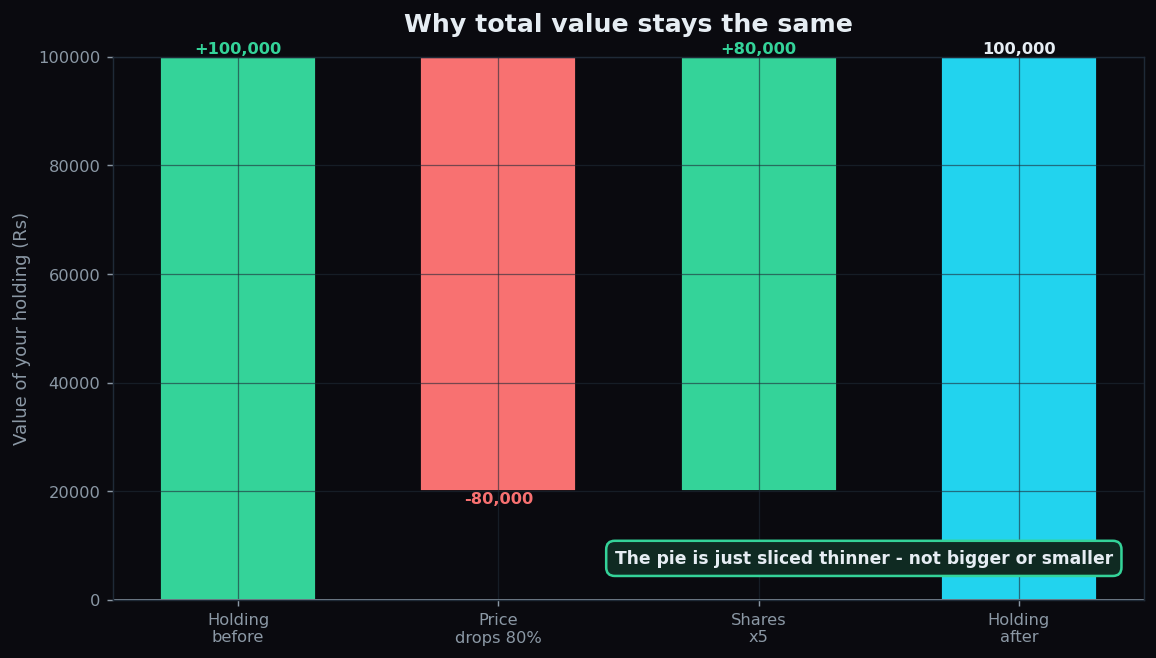
Think of it like exchanging a ₹500 note for five ₹100 notes. You are holding more pieces of paper, but not one rupee more. Anyone who tells you a split or bonus instantly made shareholders "richer" has skipped the part where the price came down to match.
Why companies do it
If it changes nothing about value, why bother? The reasons are about optics and accessibility, not wealth creation.
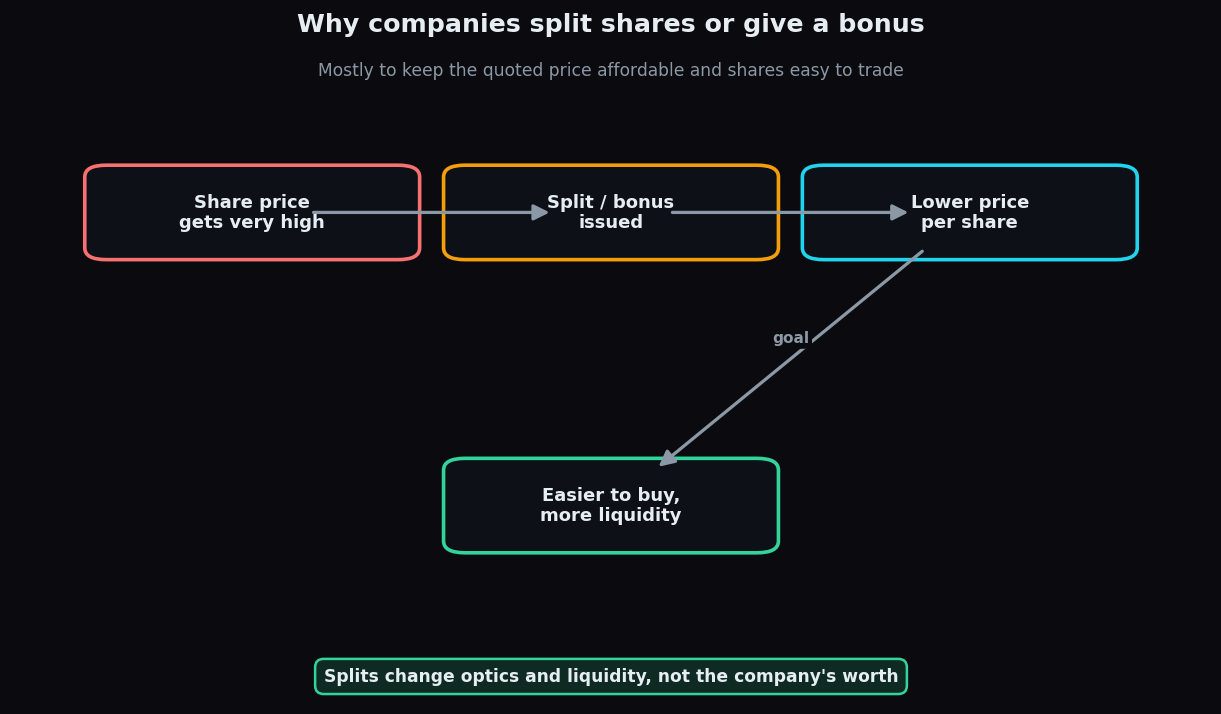
- Affordability. A very high price — say ₹10,000 a share — can feel out of reach for small investors. Splitting it to ₹2,000 lets more people buy round lots, widening the shareholder base.
- Liquidity. More shares outstanding at a lower price often means more units changing hands, which can make the stock easier to trade.
- Signalling confidence. A bonus issue can be a company's way of signalling that it has healthy reserves and expects to keep growing — though a signal is not a promise.
- Psychology. Some investors simply prefer holding 500 shares at ₹200 over 100 at ₹1,000, even though they are identical in value. Companies know this.
The honest catch
Splits and bonuses are easy to over-interpret, so keep these caveats close.
- They create no value. The number on the price tag falls to match the extra shares. Your wealth on the day of the adjustment is unchanged.
- A lower price is not "cheap". A ₹200 post-split share is not a bargain versus its ₹1,000 former self — it is the same company, just sliced thinner.
- Charts adjust historically. Good price charts retroactively adjust for splits and bonuses, so old prices are shown on the new scale. A raw, unadjusted chart can look like a fake crash on the split date.
- The business still matters. Whether the shares are a good thing to own depends on the underlying company, not on how many slices it has been cut into.
Treat a split or bonus as a cosmetic rearrangement of how ownership is counted — useful to understand, but never a reason on its own to assume something good or bad has happened to value.
Corporate actions like splits and bonuses fool a lot of beginners precisely because they look like free money — learning to see through the optics is what TrueTrend's plain-English education is all about. Create a free account to keep separating signal from theatre.
Key takeaways
- A stock split divides each share into more shares and drops the price proportionally; total value is unchanged.
- A bonus issue hands you free shares from the company's reserves, with the price adjusting down to match.
- The core truth: more shares × lower price = the same total value. No wealth is created on the day.
- Companies do it for affordability, liquidity, signalling, and psychology — not to make holders instantly richer.
- A lower post-split price is not "cheap"; the business behind the shares is what actually matters.
See these concepts on live market data — free
Create a free TrueTrend account to watch daily support/resistance levels, market regime, and option-positioning charts on NIFTY, BankNifty and 12 more instruments. Every level we publish is scored on a public scoreboard — misses included. No card required.
Free forever tier · daily levels with published hit-rates across every instrument. Descriptive market structure, not investment advice.
Not ready for an account? Get the daily levels by email.
One short email each market day — the indices' call wall, put wall, gamma flip and max pain, and how the last session's levels scored. Free, no account, unsubscribe anytime.
Descriptive market structure, not investment advice. We never share your email.