T+1 Settlement Explained: When Trades Actually Settle
You tap "buy" on 10 shares of a company, the order fills, and the app says "executed". But the shares are not quite yours yet, and the money has not fully left your account either. There is a short, invisible plumbing step in between called settlement — and in India it now finishes the very next working day. This is the T+1 cycle, and understanding it clears up a surprising number of "where are my shares?" moments.
What "settlement" actually means
Settlement is the moment a trade is truly finished: the buyer's demat account (the electronic locker that holds your shares) actually receives the shares, and the seller actually receives the cash. The day you place and match the trade is called the trade date, written as T. The day the shares and money change hands for good is the settlement date.
"T+1" simply means settlement happens one working day after the trade. Trade on Monday (T), and it settles on Tuesday (T+1). Trade on Friday, and it settles on the next Monday, because weekends and exchange holidays do not count.
Think of it like ordering food online. The instant you pay, the order is placed (that is your trade date). But the meal still has to be cooked and delivered before it is really in your hands (that is settlement). The kitchen here is the clearing corporation — a neutral middle-man that guarantees every buyer gets shares and every seller gets paid, so the two sides never have to trust each other directly.
What T+1 changed
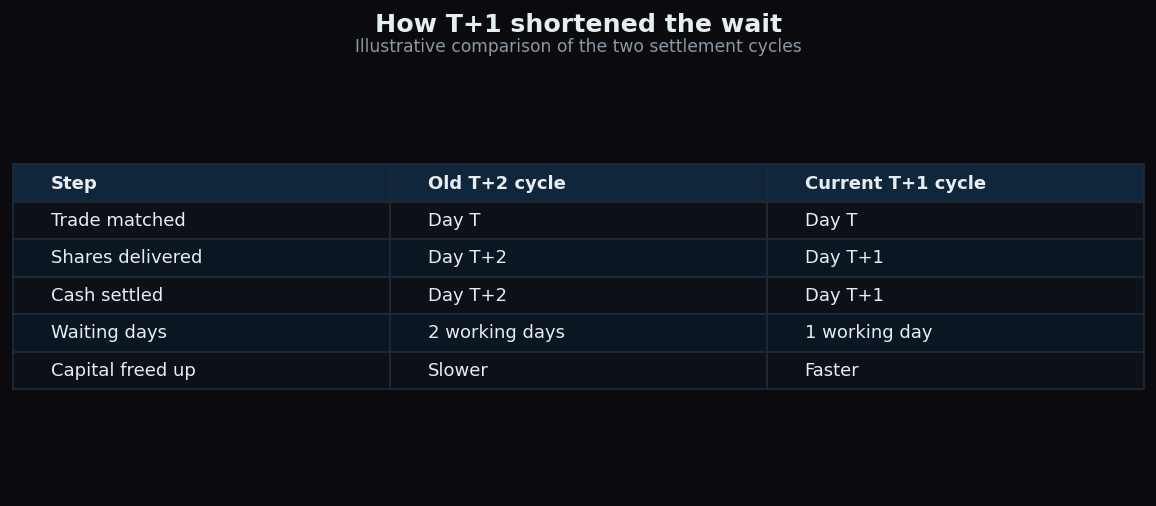
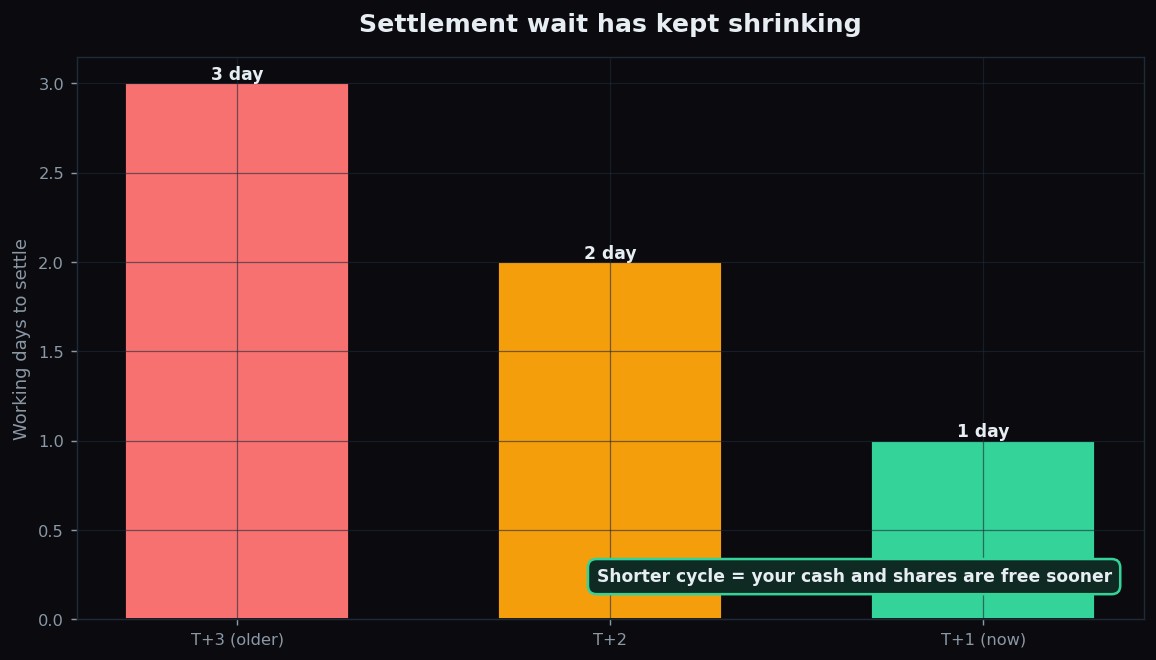
For years, Indian equity trades settled on a T+2 cycle — two working days after the trade. India moved fully to T+1 in early 2023, becoming one of the first big markets to do so. The change sounds tiny — just one day — but it matters in two practical ways.
- Your cash is freed sooner. When you sell shares, the proceeds settle a day earlier, so you can redeploy that money faster.
- Less risk sits in the system. The fewer days a trade stays "open" and unsettled, the smaller the chance that a price swing or a defaulting party causes trouble in between.
The timeline, step by step
Here is what happens behind a simple buy order, with round numbers for clarity. Say you buy 50 shares at ₹200 each, a ₹10,000 trade, on a Wednesday.
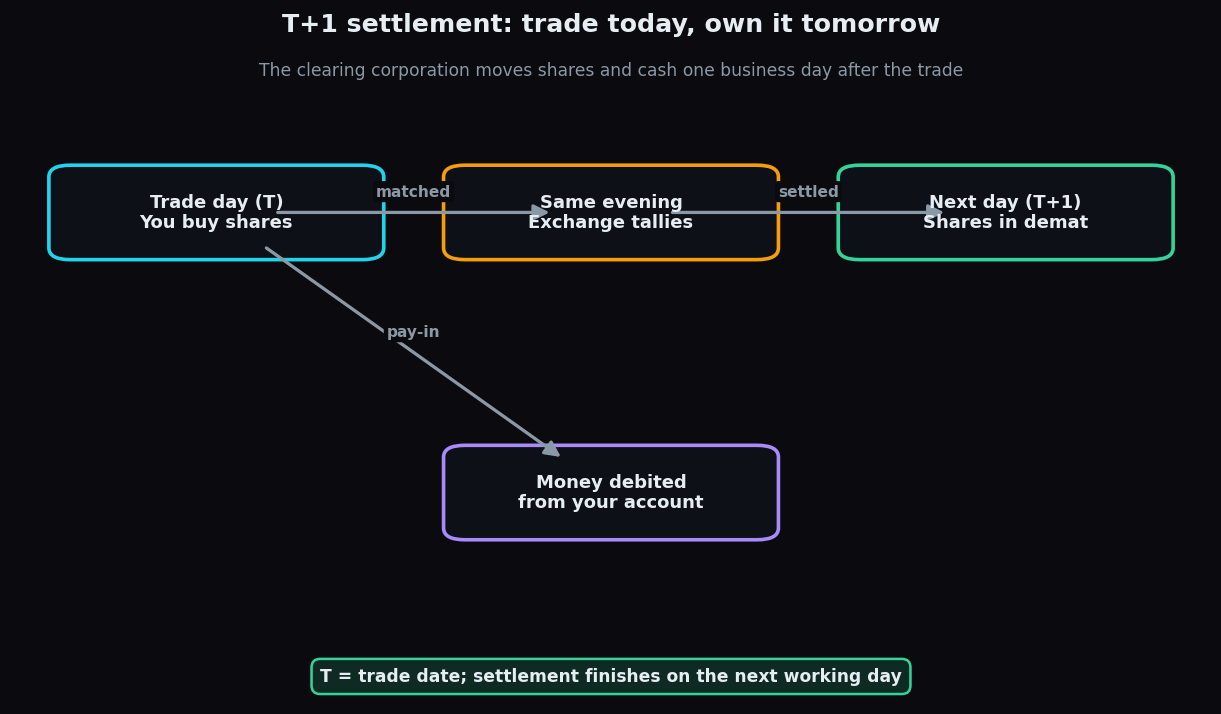
- Wednesday (T): Your buy order is matched against a seller's order on the exchange. The trade is "done" on screen, but nothing has actually moved yet.
- Wednesday evening: The exchange and clearing corporation tally up who owes what. Your broker arranges for your ₹10,000 to be ready — this is called the pay-in.
- Thursday (T+1): The clearing corporation completes the swap. Your ₹10,000 is paid to the seller's side, and 50 shares land in your demat account. The trade is now fully settled. The mirror image happens for the seller: they hand over shares and receive cash.
This is why, if you buy today, you may see the shares show up in your holdings but be unable to deliver them out of your demat until they have settled. They are promised to you, but the plumbing finishes tomorrow.
The honest catch
T+1 is faster, but it is not magic, and a few rough edges remain.
- "Working day" is doing a lot of work. A Friday trade settles Monday; a trade before a long holiday weekend waits even longer. The "+1" counts exchange business days, not calendar days.
- Intraday trades never reach settlement. If you buy and sell the same shares the same day, the two cancel out and only the net cash difference is settled. You never actually take delivery.
- Different products, different cycles. This article is about cash-market equity (delivery) trades. Other instruments and segments can follow their own timelines, so do not assume every product settles on T+1.
- It does not change your profit or loss. Settlement is about when the swap completes, not whether a trade was good. A faster cycle frees your capital sooner; it tells you nothing about direction.
Knowing the cycle simply removes confusion: it explains why funds and shares appear "in transit" for a day, and why your buying power refreshes when it does.
Settlement is the boring plumbing that makes markets trustworthy — and the more market mechanics you actually understand, the calmer your decisions get. TrueTrend turns these moving parts into plain-English context, charts, and education. Create a free account to keep learning the structure behind the screen.
Key takeaways
- Trade date (T) is when your order matches; settlement is when shares and cash actually change hands.
- T+1 means equity trades in India settle one working day after the trade, down from the older T+2.
- A neutral clearing corporation guarantees both sides, so buyer and seller never trust each other directly.
- Faster settlement frees your capital sooner and reduces risk in the system — but counts working days, not calendar days.
- Settlement timing says nothing about whether a trade was wise; it is plumbing, not a signal.
See these concepts on live market data — free
Create a free TrueTrend account to watch daily support/resistance levels, market regime, and option-positioning charts on NIFTY, BankNifty and 12 more instruments. Every level we publish is scored on a public scoreboard — misses included. No card required.
Free forever tier · daily levels with published hit-rates across every instrument. Descriptive market structure, not investment advice.
Not ready for an account? Get the daily levels by email.
One short email each market day — the indices' call wall, put wall, gamma flip and max pain, and how the last session's levels scored. Free, no account, unsubscribe anytime.
Descriptive market structure, not investment advice. We never share your email.