Trading Psychology: Fear and Greed Explained Simply
Markets are made of numbers, but they are moved by feelings. Two feelings do most of the work: fear and greed. Greed is the pull to grab more when things are going up. Fear is the urge to escape when things are going down. Almost every avoidable trading mistake — chasing a stock that has already run, freezing at the bottom, selling in a panic — traces back to one of these two. This post explains the emotional cycle, why it repeats, and why a plain, boring plan tends to beat a clever, emotional one.
What fear and greed actually are
Greed is the feeling that you are missing out and must act now. It shows up as buying more than you planned, holding a winner far past your own reasoning because “it might go higher,” or adding to a position only because the price keeps rising. Fear is the mirror image: the feeling that something bad is about to happen, so you must get out immediately. It shows up as selling a sound position on a scary headline, refusing to act after a loss, or watching a good setup pass because the last one hurt.
Neither feeling is a flaw. They are survival instincts. On a savanna, running from a rustle in the grass kept your ancestors alive even when the rustle was just wind. In markets, the same instinct makes you sell at the exact moment when the crowd is most afraid — often the worst possible time. The instinct is old and fast; the market is a place where old, fast instincts frequently backfire.
The emotional cycle, step by step
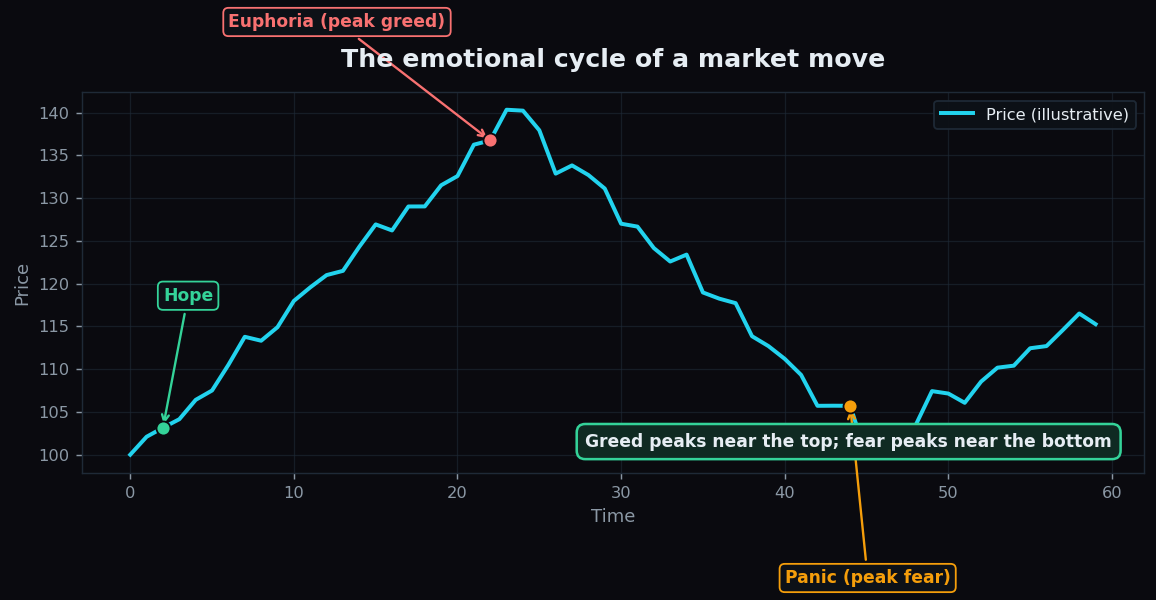
Look at the curve above. It is illustrative — made-up numbers to show the shape, not a real chart. Notice how the feeling and the price peak at opposite moments:
- Early rise — hope. Price ticks up. A few people notice. Interest is cautious.
- Steady climb — confidence. The move is now obvious. Stories appear explaining why it “had” to happen.
- Near the top — euphoria and peak greed. Everyone is talking about it. New buyers pile in precisely because it has already gone up a lot. This is where the most money enters — at the worst average price.
- The turn — denial, then anxiety. Price stalls and slips. Early buyers tell themselves it is a “dip.”
- The fall — fear, then panic. As losses mount, the same people who chased the top now rush for the exit. Selling feeds selling.
- The bottom — capitulation. The last holders give up. Ironically, this is often where the risk is lowest and the next recovery quietly begins.
The cruel joke is the timing: greed is loudest near the top, and fear is loudest near the bottom. If you act on the feeling, you tend to buy high and sell low — the exact opposite of the goal.
An everyday analogy
Think of a supermarket sale. When mangoes are cheap, you happily fill your basket. When the price triples, you buy fewer. That is rational behaviour with groceries. Markets flip this instinct upside down: when prices fall, people want to buy less, and when prices rise, they want to buy more. The same shopper who hunts for grocery discounts will chase a stock precisely because it got expensive. Recognising that flip is half the battle.
Why this matters for real money
The gap between what an investment returns and what an average investor actually earns is often blamed on emotional timing — money tends to arrive after big gains and leave after big drops. You do not need exact figures to feel the point: buying excitement and selling panic is expensive, and it repeats across every generation of traders because the underlying wiring does not change.
A worked example with round numbers
Suppose a stock is at Rs 100. Two traders, Asha and Ravi, both watch it.
- The stock climbs to Rs 150. Headlines turn glowing. Ravi, feeling the FOMO, buys at Rs 150 and, still greedy, doubles his position at Rs 160.
- Asha had a written plan: she would only add near a level she pre-decided, and she would size each position the same. The Rs 150–160 zone was not in her plan, so she did nothing.
- The stock falls back to Rs 120. Ravi, now afraid, sells everything at Rs 120 to “stop the bleeding,” locking a loss on both lots.
- Asha, unmoved, follows her plan and is neither trapped at the top nor shaken out at Rs 120.
Same stock, same chart, wildly different outcomes. The difference was not intelligence or a secret indicator. It was that one person acted on feelings and the other acted on a rule. Note this is an illustration of behaviour, not a suggestion to buy or sell anything.
How disciplined traders use this — the loop and how to break it
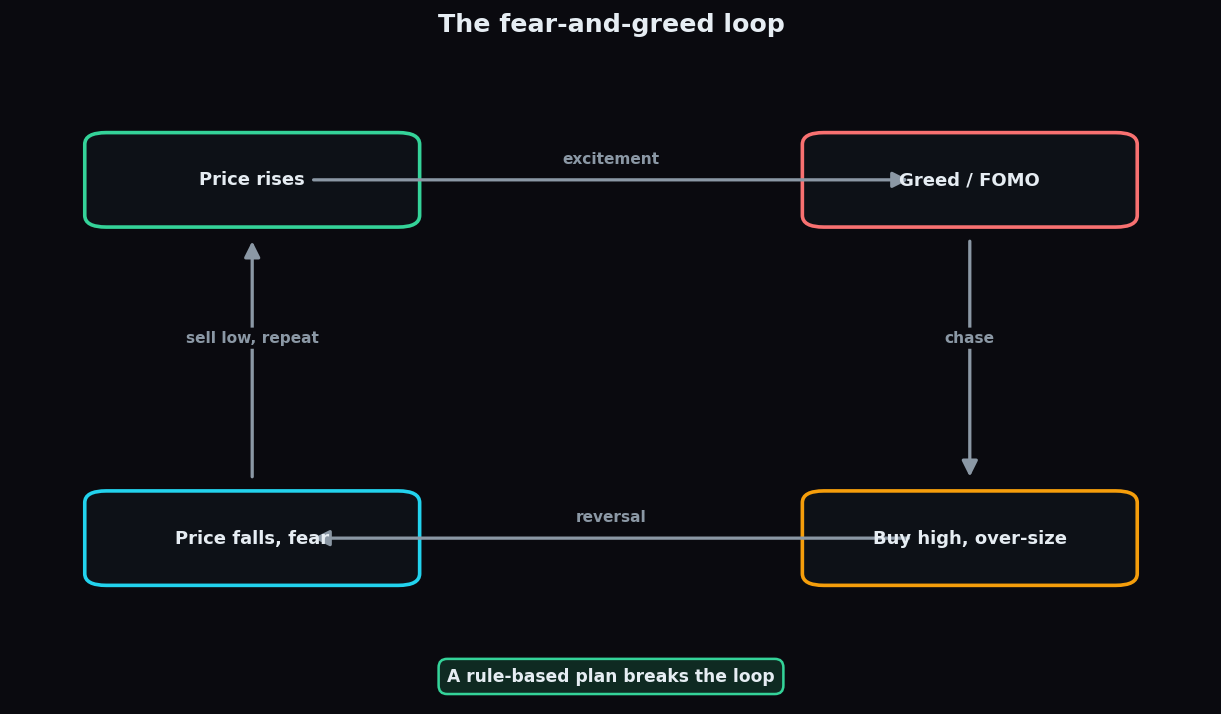
The diagram above shows the loop as a circle because it feeds itself: rising prices create greed, greed creates chasing, chasing sets up the fall, the fall creates fear, fear creates panic selling — and then a new rise starts the whole thing again. You cannot delete the feelings. What experienced traders do instead is decide in advance, when calm, what they will do, so the feeling has less room to drive.
Common discipline tools include:
- A written plan. Entry logic, exit logic, and position size are decided before the trade, in a calm moment — not mid-panic.
- Fixed position sizing. Risking the same small slice each time removes the greedy urge to “bet big” on a hot idea.
- Pre-set exits. Knowing where you are wrong before you enter means fear does not get to invent the exit for you.
- A checklist and a pause. A 60-second pause before acting is often enough for the reflex to fade and the plan to reassert itself.
- A trading journal. Writing down why you entered exposes emotional trades (“because it was flying”) versus planned ones.
None of this is about becoming a robot. It is about making the calm version of you write the rules that the emotional version of you has to follow.
The honest catch
Discipline is simple to describe and genuinely hard to do. Reading about fear and greed does not vaccinate you against them — the feelings arrive anyway, often stronger when real money is at stake. A plan only helps if you actually follow it when it hurts, and most people break their own rules at least a few times before the lesson sticks. There is also no rule that removes losses; a good process still produces losing trades. Discipline improves your average behaviour over many decisions, not the outcome of any single one. And a plan built on a bad idea will fail no matter how calmly you follow it — controlling emotion is necessary, not sufficient.
Studying market structure and context — instead of reacting to every green or red candle — is exactly what keeps emotion in check. TrueTrend is built as an education-and-analytics lens on that structure. You can create a free account to explore the concepts at your own pace, no pressure and no tips.
Key takeaways
- Greed pulls you to buy near tops; fear pushes you to sell near bottoms — the emotional cycle is timed against you.
- The instinct is normal and ancient; markets simply punish it, because they invert the “cheap is good, expensive is bad” logic that serves you elsewhere.
- Discipline — a written plan, fixed sizing, pre-set exits, a pause, a journal — is what breaks the loop.
- Rules do not erase losses or feelings; they improve your average decisions over many trades.
- Everything here is educational and illustrative, not advice — the goal is to understand your own behaviour, not to be told what to do.
See these concepts on live market data — free
Create a free TrueTrend account to watch daily support/resistance levels, market regime, and option-positioning charts on NIFTY, BankNifty and 12 more instruments. Every level we publish is scored on a public scoreboard — misses included. No card required.
Free forever tier · daily levels with published hit-rates across every instrument. Descriptive market structure, not investment advice.
Not ready for an account? Get the daily levels by email.
One short email each market day — the indices' call wall, put wall, gamma flip and max pain, and how the last session's levels scored. Free, no account, unsubscribe anytime.
Descriptive market structure, not investment advice. We never share your email.