What Is a Dividend? How Companies Pay Shareholders
Owning a share makes you a part-owner of a real business. And like any owner, you can be paid a slice of the profit the business earns. That slice, handed out in cash, is a dividend. It is one of the oldest and simplest ideas in investing — the company makes money, and some of it lands back in your account — yet the surrounding words (yield, ex-date, payout, reinvest) trip up almost every beginner. Let us walk through it slowly, with round numbers, so each term sticks.
What a dividend actually is
A dividend is a cash payment a company makes to its shareholders out of its profits. If you own 100 shares and the company declares a dividend of 3 rupees per share, you receive 300 rupees. You did not sell anything; you simply got paid for being an owner, the way a shop’s owner takes home a share of the year’s earnings.
The key word is out of profits. A company first earns money, pays its costs and taxes, and is left with net profit. The board then decides what to do with that profit: keep it to grow the business, or return part of it to owners as a dividend. Often they do both.
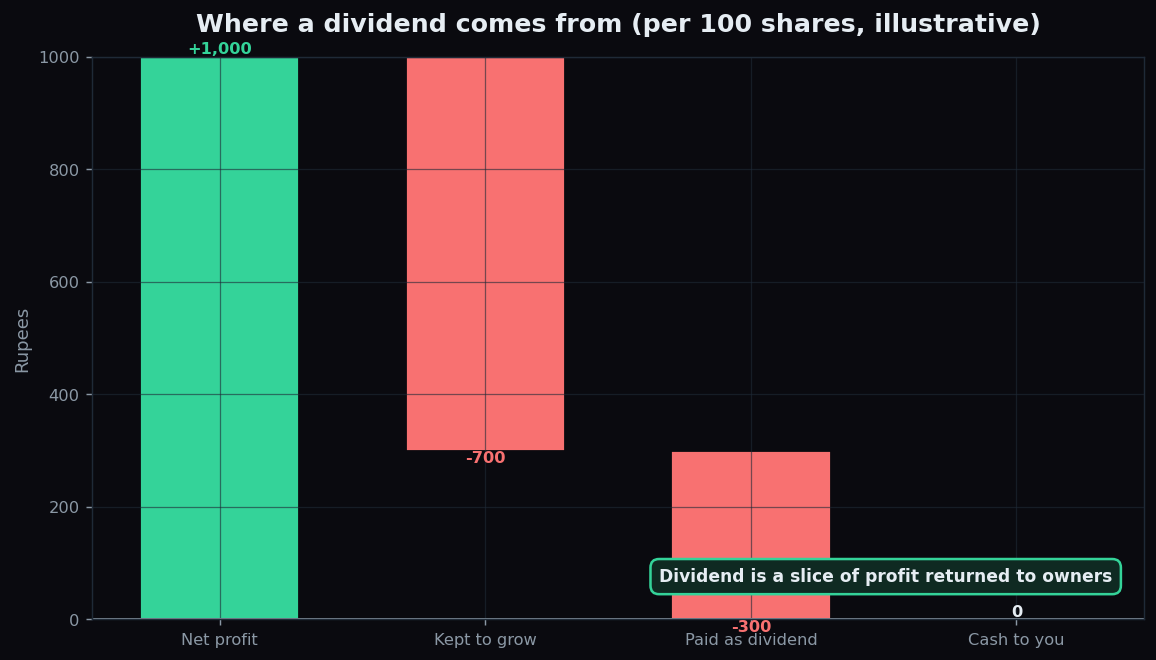
In the illustration above, imagine the company earned 1,000 rupees of profit for every 100 shares you hold. It keeps 700 to reinvest in the business and pays out 300 as a dividend. That 300 is your cash. The 700 stays inside the company, ideally making it more valuable over time. Neither choice is automatically better — it depends on whether the company can grow that retained money faster than you could on your own.
Yield: putting the dividend in context
A dividend of 3 rupees sounds small or large depending on the share price. To compare fairly, investors use dividend yield: the yearly dividend divided by the current share price, shown as a percentage.
Worked example with round numbers. A share trades at 100 rupees and pays 4 rupees a year in dividends. Its yield is 4 / 100 = 4%. Another share trades at 100 rupees but pays only 1 rupee, a 1% yield. Same price, very different cash return. Yield lets you line up companies side by side.
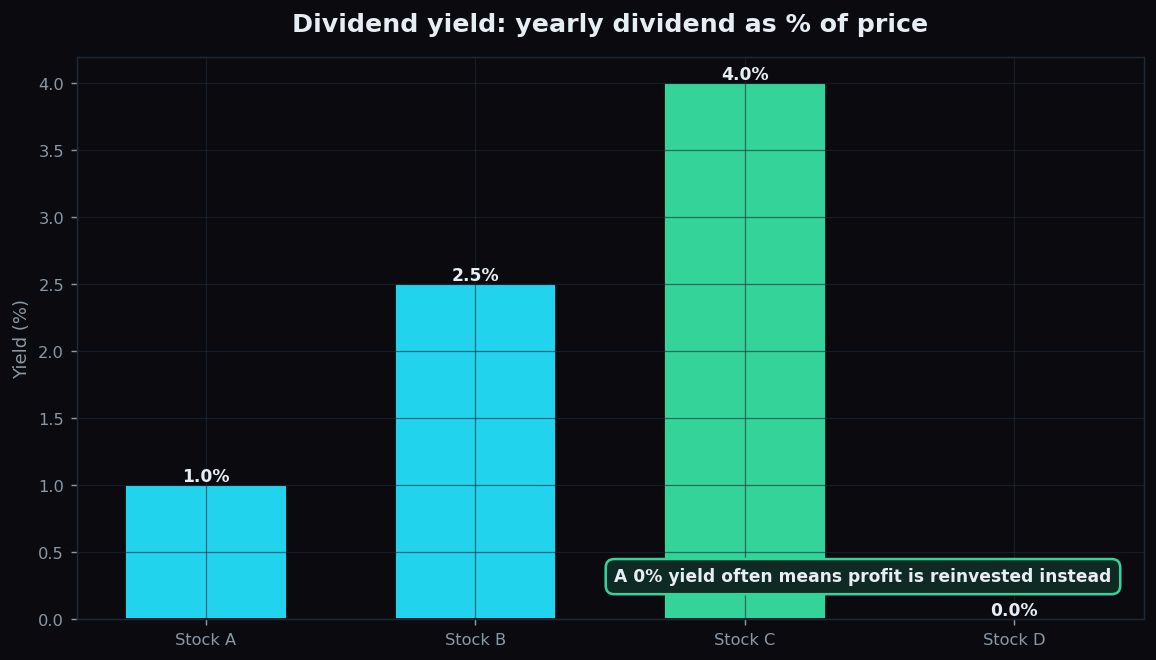
Notice the stock paying a 0% yield in the chart. A zero dividend is not a red flag by itself. Many fast-growing companies deliberately pay nothing, choosing to pour every rupee of profit back into expansion. Their owners hope to be rewarded by a rising share price instead of a cash dividend. So a high yield is not “good” and a low yield is not “bad” — they reflect different strategies. A very high yield can even be a warning, if the price has fallen sharply because the business is in trouble.
The ex-date: who actually gets paid
Dividends come with a calendar, and one date matters most to a buyer: the ex-dividend date, or ex-date. To receive a declared dividend, you must own the share before the ex-date. Buy on or after the ex-date, and the dividend goes to the previous owner instead.
There is a neat consequence. On the morning of the ex-date, the share price typically opens lower by roughly the dividend amount. Why? Because a buyer that day no longer gets the upcoming payment, so the share is worth a touch less without it. If a 100-rupee share is about to pay a 3-rupee dividend, it might open near 97 on the ex-date. You are not magically richer by buying just before the ex-date — you get 3 rupees in cash, but the share drops about 3 rupees. The total value in your pocket is roughly unchanged; the dividend mostly moves value from share price into cash.
Payout versus reinvest
Once the cash arrives, you face a choice every owner faces: spend it, or plough it back in by buying more shares. Reinvesting means each dividend buys a few more shares, which then earn their own dividends — the snowball known as compounding.
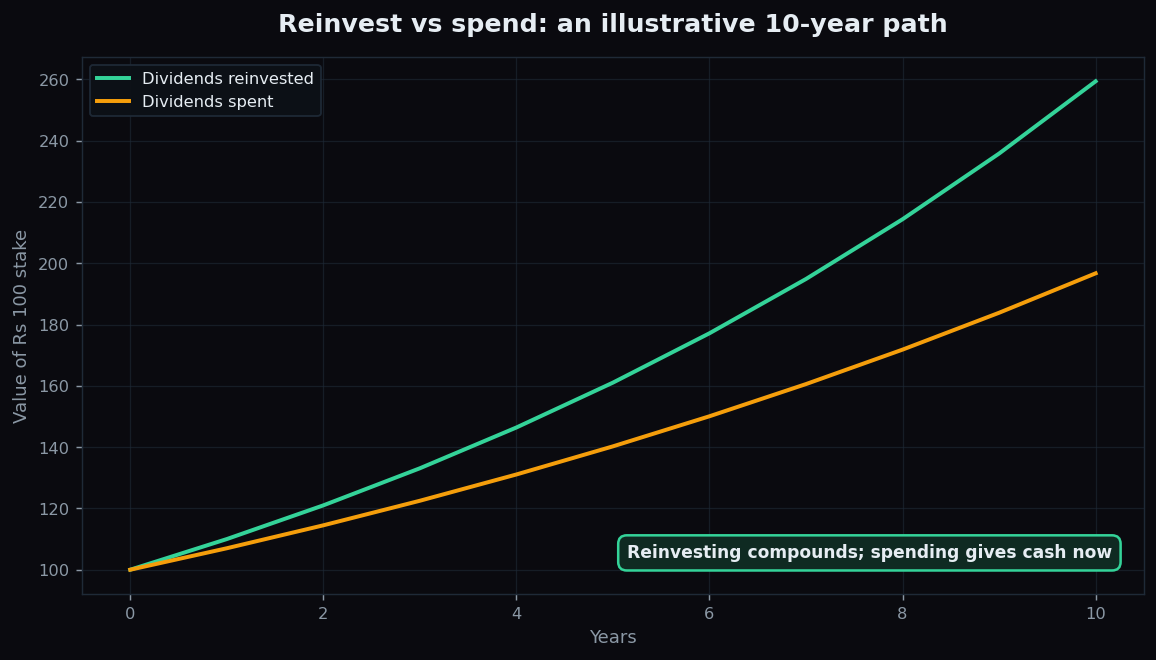
The chart shows an illustrative 100-rupee stake over ten years. In the reinvested path, dividends buy more shares and the stake compounds faster. In the spent path, you enjoy the cash each year but the stake grows more slowly. Both are valid: a retiree may want the cash to live on; a young saver may prefer the snowball. The numbers here are made up to show the shape of the idea, not a promise — real returns vary every year and can be negative.
Why dividends matter
- Real cash, not paper gains. A dividend is money in hand, independent of whether the share price went up that week.
- A signal of discipline. A company that pays steady dividends is telling owners it earns genuine, regular profit — though this is a soft hint, not proof.
- A second engine of return. Over long stretches, reinvested dividends have historically been a meaningful slice of total stock returns, alongside price gains.
- A reason to read the strategy. Whether a firm pays out or reinvests tells you how it thinks about growth.
The honest catch
Dividends are comforting, but they are not guaranteed and not free money. A board can cut or cancel a dividend in a hard year, and often does — a past payment is no promise of a future one. A dividend also is not extra value created from nothing: as the ex-date shows, paying cash out lowers the share price by roughly the same amount, so a dividend partly returns value you already owned. And chasing the highest yield can backfire, because an unusually fat yield is sometimes the market warning that the price — and maybe the business — is falling. A dividend is one useful fact about a company, not a verdict on it.
Dividends are just one thread in the bigger story of how a business and its share price behave. TrueTrend is built to help everyday learners read that story — the structure and context behind a stock — in plain language. You can start free and learn at your own pace.
Key takeaways
- A dividend is a cash slice of a company’s profit, paid to shareholders simply for owning the stock.
- Dividend yield = yearly dividend ÷ share price; it lets you compare cash returns fairly across companies.
- A 0% yield is not bad — many growing firms reinvest all profit instead of paying out.
- You must own the share before the ex-date to receive the dividend; the price usually drops by about the dividend amount that day.
- Reinvesting dividends compounds your stake; spending them gives cash now — both are valid choices.
- Dividends are not guaranteed; boards can cut them, and a very high yield can be a warning sign.
See these concepts on live market data — free
Create a free TrueTrend account to watch daily support/resistance levels, market regime, and option-positioning charts on NIFTY, BankNifty and 12 more instruments. Every level we publish is scored on a public scoreboard — misses included. No card required.
Free forever tier · daily levels with published hit-rates across every instrument. Descriptive market structure, not investment advice.
Not ready for an account? Get the daily levels by email.
One short email each market day — the indices' call wall, put wall, gamma flip and max pain, and how the last session's levels scored. Free, no account, unsubscribe anytime.
Descriptive market structure, not investment advice. We never share your email.