What Is a Stop-Loss? Risk Control Explained
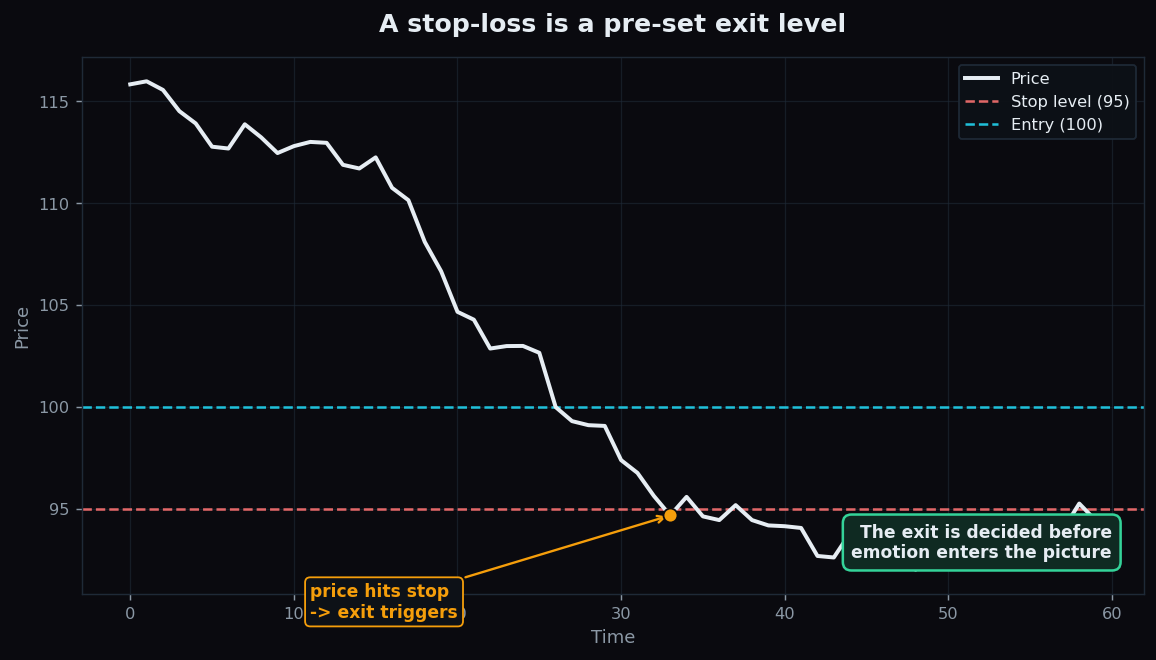
Most losses that ruin a beginner do not start big. They start small, get ignored, and grow while hope quietly replaces judgement. A stop-loss is the simple tool designed to prevent exactly that. It is a decision, made in advance and in a calm mind, about the point at which an idea has failed. This post explains what a stop-loss is, the main types, and a plain worked example. It is educational only, with illustrative round numbers — not advice on where you personally should place one.
What a stop-loss is
A stop-loss is a pre-set price level at which you exit a losing position to cap the damage. The name is literal: it stops the loss from growing. The core idea is timing. You decide before entering — while you are still calm and objective — the price at which you will admit the idea is wrong. Then, if price reaches that level, the exit is already decided and you do not have to argue with yourself in the heat of the moment.
In the chart above, the entry is 100 and the stop level is 95. As long as price stays above 95, the idea is intact. The moment it trades below, the plan says exit — no debate, no "let me give it one more day". That pre-commitment is the entire value of a stop.
Why it matters
The deepest reason is psychological. Once you own a position, your brain stops being neutral. A falling price triggers a very human sequence: denial ("it will bounce"), then hope ("just back to my entry and I will exit"), then panic. Each stage makes you hold longer than you planned. A stop-loss removes the decision from that emotional moment and hands it to the calmer version of you who set it earlier.
The maths matters too, because losses are not symmetric. A 10% loss needs an 11% gain to recover. But a 50% loss needs a 100% gain just to get back to even — the hole gets steeper the deeper you fall. Cutting a loss at a small level protects you from the region where recovery becomes brutally hard.
An everyday analogy
Think of a stop-loss like the circuit breaker in your home. You hope it never trips. But when a surge hits, you are extremely glad that a small, automatic switch cut the power before the wiring caught fire. The breaker does not know or care why the surge happened — it just protects the house. A stop-loss protects your account the same way: it is an unglamorous safety switch, not a prediction.
The main types
Not all stops are the same. A few common kinds, each answering the same question — when do I accept the idea is wrong?
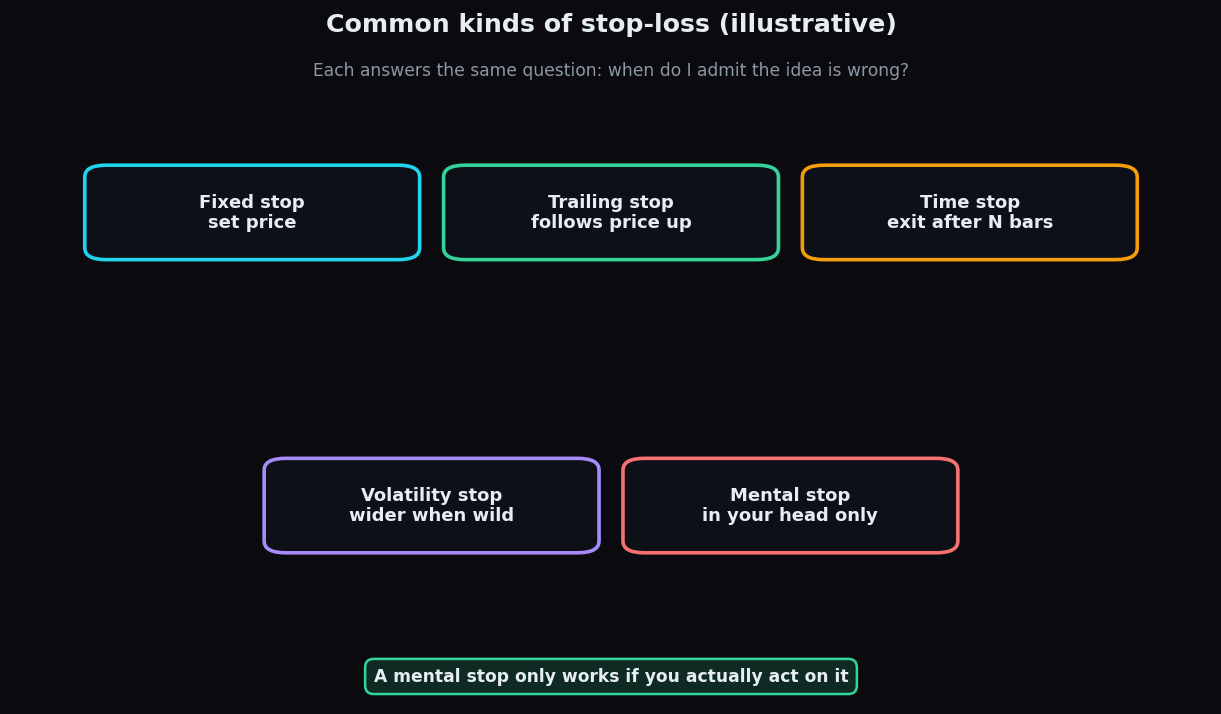
- Fixed stop: a set price that does not move. Simplest to follow; the example above is a fixed stop at 95.
- Trailing stop: it follows price as the position moves in your favour, locking in more of the gain while never moving backwards. If price climbs from 100 to 120, a trailing stop might ratchet up behind it.
- Time stop: exit after a set period if the idea has not worked, on the logic that a thesis which needs to work quickly but has not is probably wrong.
- Volatility stop: placed wider when the market is wild and tighter when it is calm, so normal noise does not knock you out prematurely.
- Mental stop: a level you hold in your head rather than pre-entering. It only works if you have the discipline to actually act — and under stress, many people do not.
A worked example with round numbers
Suppose you enter at 100 and decide the idea is wrong at 95, so your risk is 5 per unit. Say you hold 200 units. If price hits 95, the exit triggers and the loss is 200 × 5 = 1,000. Painful, but defined and known in advance.
Now imagine the same trade with no stop. Price keeps sliding — 90, then 85, then 80. At 80 the loss is 200 × 20 = 4,000, four times worse, and by now denial and hope are running the show. The stop did not predict the drop; it simply capped how much a single wrong idea could cost. That link between the exit distance and the size you hold is exactly why sizing and stops are two halves of one plan, as covered in our companion pieces on risk.
The honest catch
Stops are essential, but they are not free and not perfect:
- Whipsaws. A stop placed too tight gets hit by normal noise, you exit, and then price goes exactly where you thought. This is genuinely maddening and unavoidable — a stop trades some of these small false exits for protection against one big disaster.
- Gaps jump over stops. A stop level is not a guarantee of that exit price. If bad news gaps a stock from 100 to 88 overnight, your exit fills near 88, not 95. Stops limit typical losses, not overnight shocks.
- Placement is a real skill. Too tight and you get whipsawed; too wide and the loss is large when it triggers. There is no perfect universal setting — it depends on the instrument's normal movement, which is why volatility-based stops exist.
The takeaway is not that stops are flawless. It is that trading without any exit plan quietly assumes you will never be badly wrong — and the market eventually punishes that assumption.
Good risk habits are easier to keep when you can watch a rules-based approach prove itself over time. TrueTrend publishes a transparent, updated performance scoreboard so you can study the discipline in action before trusting any method with real money.
Key takeaways
- A stop-loss is a pre-set exit level that caps a loss and removes the decision from an emotional moment.
- It matters because losses are asymmetric — a 50% loss needs a 100% gain to recover.
- Common types include fixed, trailing, time, volatility, and mental stops; each defines when an idea is wrong.
- A stop caps the damage but does not predict direction, and gaps can fill worse than the level.
- Placement is a skill: too tight invites whipsaws, too wide means a bigger loss when triggered.
See these concepts on live market data — free
Create a free TrueTrend account to watch daily support/resistance levels, market regime, and option-positioning charts on NIFTY, BankNifty and 12 more instruments. Every level we publish is scored on a public scoreboard — misses included. No card required.
Free forever tier · daily levels with published hit-rates across every instrument. Descriptive market structure, not investment advice.
Not ready for an account? Get the daily levels by email.
One short email each market day — the indices' call wall, put wall, gamma flip and max pain, and how the last session's levels scored. Free, no account, unsubscribe anytime.
Descriptive market structure, not investment advice. We never share your email.