What Is an IPO? How Companies Go Public Explained
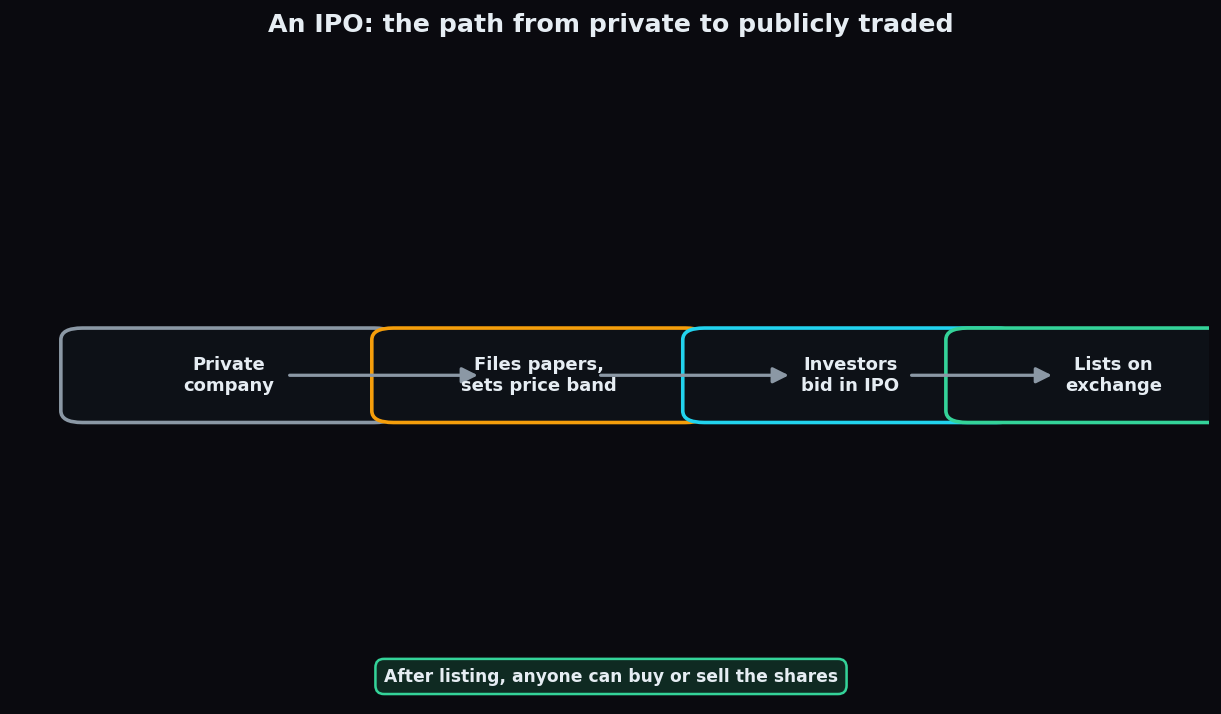
You have probably seen the headlines: a well-known company is “going public,” its IPO is “oversubscribed,” and on listing day the stock either pops or flops. For a beginner it can sound like a special, almost mystical event. It is not. An IPO is just the first time a private company sells its shares to the general public — the moment ordinary people like you can buy a piece of it. This post explains the whole journey, plainly, from private business to a ticker you can trade.
What IPO means
IPO stands for Initial Public Offering. Break the words down: initial (the first time), public (open to everyone, not just insiders), offering (offering shares for sale). Put together: the first time a company offers its shares to the public at large.
Before the IPO, the company is private. Its shares are held by a small circle — founders, early employees, and a few big investors — and you cannot simply buy in. After the IPO, the company is public: its shares are listed on a stock exchange, and anyone with a trading account can buy or sell them.
An analogy. Imagine a popular family restaurant that has only ever been owned by the family. One day they decide to let the public become part-owners by selling slices of the business. The day those slices first go on sale to everyone is the restaurant’s IPO. From then on, those ownership slices can change hands freely.
Why a company goes public
Companies do not IPO for fun — it is expensive and brings heavy scrutiny. They do it mainly to:
- Raise money. Selling new shares brings in cash the company can use to expand, repay debt, or invest.
- Let early backers cash out. Founders and early investors can finally sell some of their long-held stake to new public buyers.
- Gain visibility and trust. Being listed, audited, and watched can raise a company’s profile with customers and lenders.
In return, the company accepts strict rules: regular financial disclosures, audits, and answering to thousands of new shareholders. Going public trades privacy for capital.
The process, step by step
The path from private to public follows a fairly standard route.
- Preparation and filing. The company hires investment banks to manage the sale and files a detailed document with the regulator describing its business, finances, and risks. This is the homework the public gets to read before deciding.
- Setting a price band. Rather than guessing one exact price, the company announces a price band — a small range, say 95 to 100 rupees per share — within which investors can bid.
- The bidding window. For a few days, investors place orders for how many shares they want and at what price inside the band. If far more shares are requested than are available, the IPO is oversubscribed, and not everyone gets a full allotment.
- Allotment and the issue price. A final issue price is fixed (often the top of the band when demand is strong), shares are allotted to bidders, and the money is collected.
- Listing day. The shares begin trading on the exchange. From this point, the price is set by ordinary supply and demand, just like any other stock.
The price band and listing day
Two numbers confuse beginners most: the issue price (what IPO bidders paid) and the listing price (where the stock actually opens for trading on day one). They are often not the same.
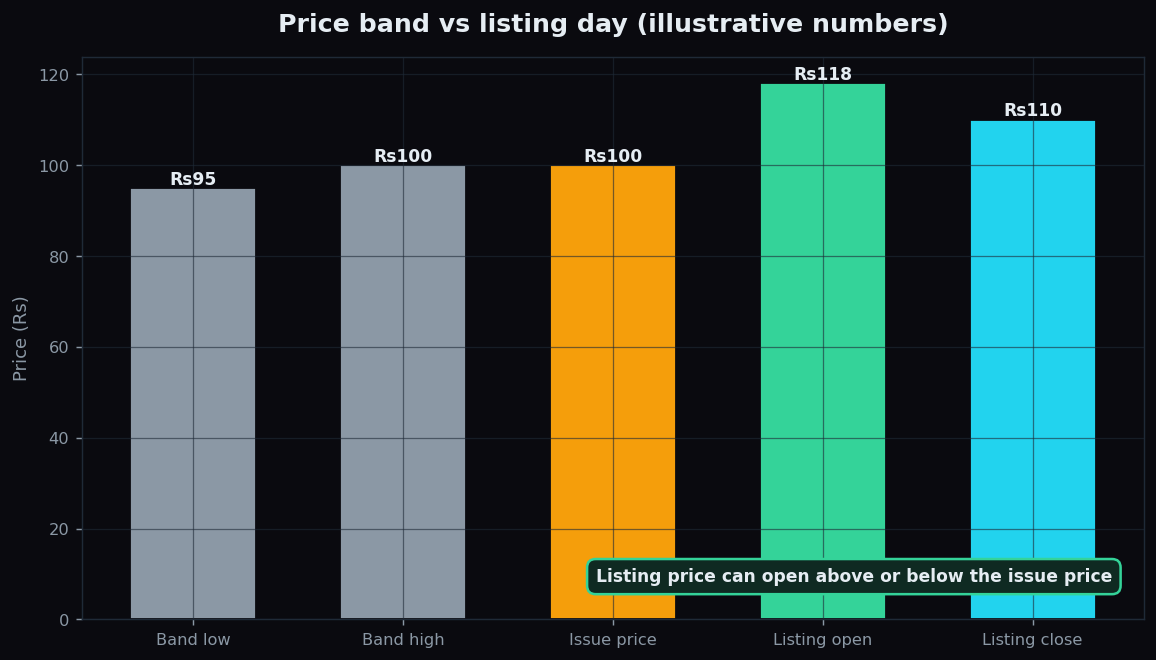
Work through the chart with round numbers. Suppose the band was 95 to 100, and strong demand set the issue price at 100. On listing day, all the excitement and fresh public demand might open the stock at 118 — an 18% “listing gain” over the issue price — before settling back to 110 by the close. Whoever got an allotment at 100 sees a paper gain; whoever buys at 118 on the open is paying the market’s mood, not the issue price.
The opposite happens too. If demand was weaker than the hype suggested, the same stock could open below 100 — a “discount” listing — leaving early bidders underwater on day one. Listing day is famously unpredictable, driven by short-term demand rather than the company’s long-term worth.
Why IPOs matter
- Access. An IPO is the gateway that lets the public own companies that were previously off-limits.
- Information. The filing document is a rare, detailed look inside a business — useful reading whether or not you ever buy.
- A live lesson in supply and demand. Oversubscription and listing-day swings show the auction mechanics of markets in fast-forward.
The honest catch
IPOs carry a glow of opportunity, but they deserve sober eyes. The company and its bankers naturally want the highest price the market will bear, so the deck is not tilted in the new buyer’s favour. There is little price history to study — a freshly listed stock has no track record as a public company. Listing-day pops are exciting but inconsistent; plenty of IPOs trade below their issue price within months once the initial buzz fades. Oversubscription reflects hype as much as quality, and hype is a poor guide to long-term value. None of this makes IPOs bad; it simply means a new listing is a beginning to study, not a finish line to celebrate.
A new listing is just a stock taking its first breath in the open market — the same supply-and-demand forces then take over. TrueTrend is built to help everyday learners read that market structure and context in plain language. You can start free and learn at your own pace.
Key takeaways
- An IPO (Initial Public Offering) is the first time a private company sells shares to the public and lists on an exchange.
- Companies go public mainly to raise money, let early backers cash out, and gain visibility — in exchange for strict disclosure rules.
- The process runs: file papers → set a price band → investors bid → fix the issue price and allot → list and trade.
- The issue price (what bidders paid) and the listing price (day-one open) are often different; listing can be above or below the issue price.
- Oversubscription means demand exceeded supply — a sign of hype, not a guarantee of value.
- A new listing has no public track record; treat it as a business to study, not a sure thing.
See these concepts on live market data — free
Create a free TrueTrend account to watch daily support/resistance levels, market regime, and option-positioning charts on NIFTY, BankNifty and 12 more instruments. Every level we publish is scored on a public scoreboard — misses included. No card required.
Free forever tier · daily levels with published hit-rates across every instrument. Descriptive market structure, not investment advice.
Not ready for an account? Get the daily levels by email.
One short email each market day — the indices' call wall, put wall, gamma flip and max pain, and how the last session's levels scored. Free, no account, unsubscribe anytime.
Descriptive market structure, not investment advice. We never share your email.