Does the Opening Hour Decide the Day? What Our Data Shows
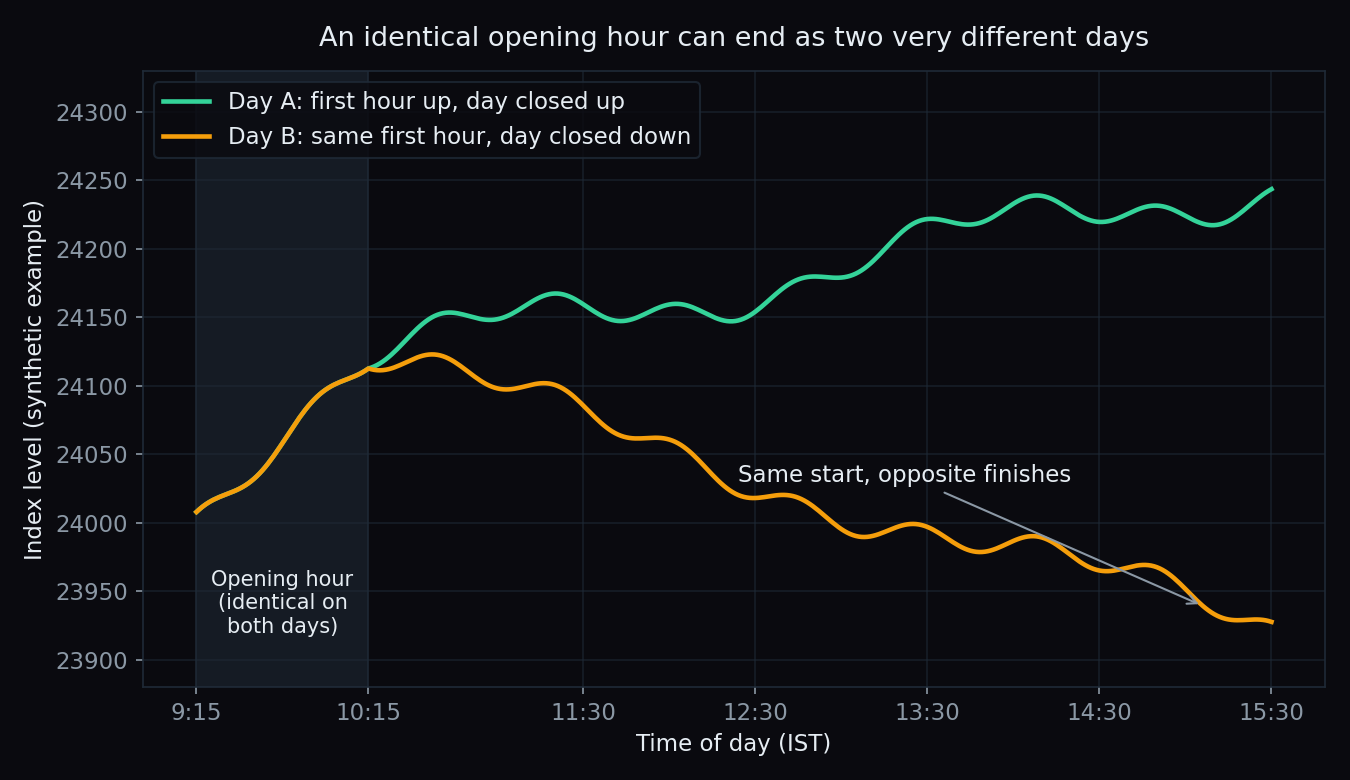
Walk into any trading room at 10:30 in the morning and someone will tell you the day is already decided. It is one of the oldest pieces of intraday folklore in Indian markets: the first hour sets the trend, and the remaining five hours simply follow. We wanted to see how that story stands next to measured data — so we put it beside 90 scored sessions each on Nifty and Bank Nifty from our public scoreboard.
What "the opening hour" actually is
The National Stock Exchange (NSE) opens for regular trading at 9:15 am IST. Before that, a short pre-open session (9:00 to 9:08 am) collects orders and discovers a single opening price. The "opening hour" is the first hour of regular trading, 9:15 to 10:15 am.
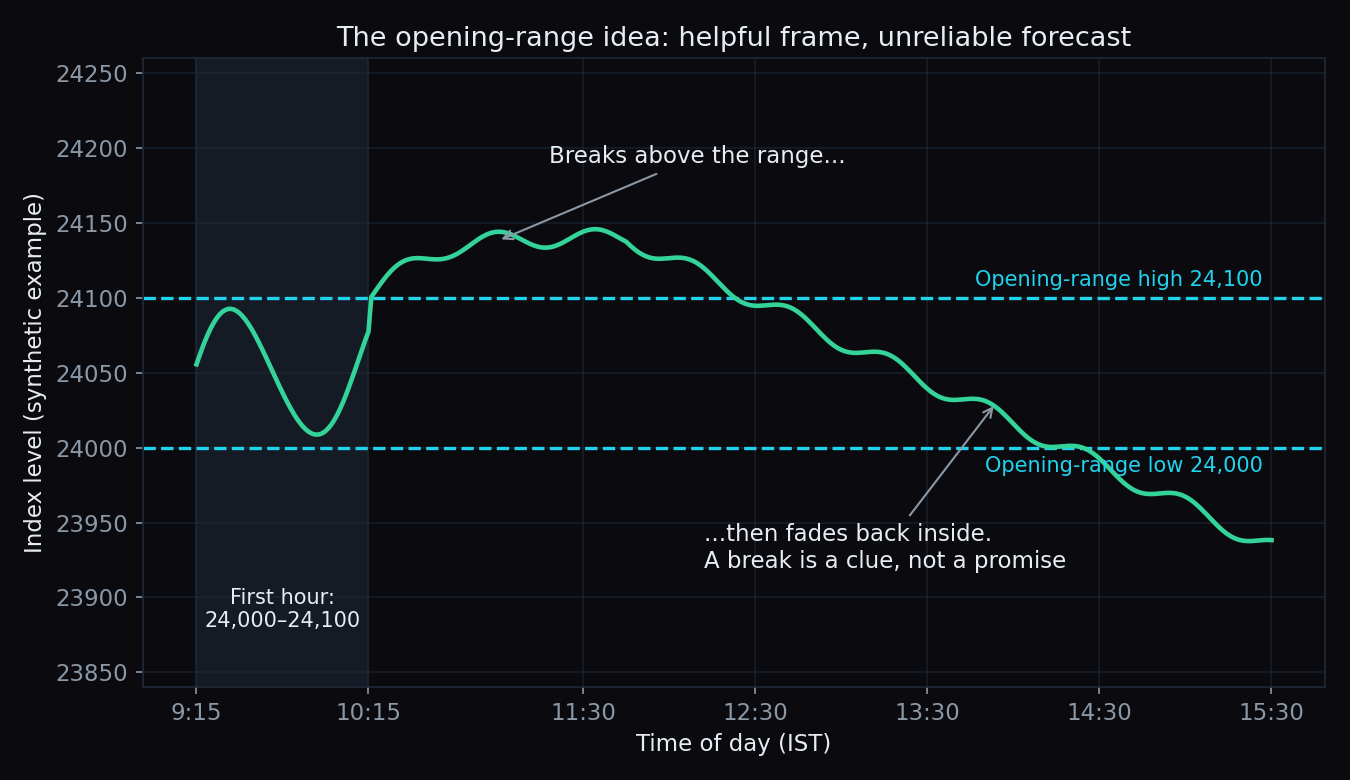
Traders often mark the highest and lowest prices of this hour and call the band between them the opening range. The folklore rule says: a later move above that range means an up day is coming, and a move below it means a down day.
Why the first hour is so loud
The first hour compresses a whole night of information into sixty minutes. The US close, Asian markets, GIFT Nifty, crude oil, overnight news — every reaction that built up while our market was shut arrives at once, along with all the orders queued before the bell. Volumes and price swings are usually the biggest of the day.
Think of it like the first over of a cricket match. A good first over tells you something real — how the pitch behaves, how much the ball is swinging. But nobody hands over the trophy after one over. Loud is not the same as decisive.
The folklore, tested with simple round numbers
Take an index that opens at 24,050. In its first hour it trades between 24,000 and 24,100 — an opening range 100 points tall. The rule says a move above 24,100 should lead to an up day, and a move below 24,000 to a down day.
On a genuine trend day, the rule looks brilliant: price clears 24,100 at 10:40 and closes near 24,300. But on a range day — and a large share of sessions are range days — price pokes 40 points above 24,100, stalls, and slides back inside the range by lunch. The rule gave a clear signal, and the signal was simply wrong. The frustrating part: you only learn which kind of day you were in at 3:30 pm, when the answer is no longer useful.
So the first hour, on its own, cannot be graded in advance — the same strong open can end as two opposite days. That raised a better question for us: is there anything about a session that can be written down before 9:15 and checked honestly at the close?
What our 90 scored sessions show
Every morning, before the opening bell, our system publishes a small set of positioning levels for each instrument, read from the NSE option chain. Every evening it scores, in public, whether those levels held. Two of those levels matter here:
- Call wall — the strike where the largest number of call option contracts sit open. (A strike is the fixed price an option contract refers to; open interest is the count of contracts still alive.) Heavy positioning there often behaves like a ceiling.
- Put wall — the same idea with put options, often behaving like a floor.
As of 18 September 2026, across the last 90 scored sessions on our public scoreboard:
- Nifty's call wall held 15 of the 20 times price touched it — 75% (n=20 touches).
- Nifty's put wall held 20 of 32 touches — 62.5% (n=32).
- Bank Nifty's call wall held 9 of 14 touches — 64.3% (n=14); its put wall held 10 of 15 — 66.7% (n=15).
Notice what these numbers do not care about: the clock. The walls were published before 9:15. Whether price reached one at 9:40 or at 2:40, it stalled at a heavy wall roughly two times out of three. In our data, the most dependable structure of a session was drawn on the map before the day began — not by the direction of the first sixty minutes. (We looked at wall behaviour in more depth in do option walls actually hold?)
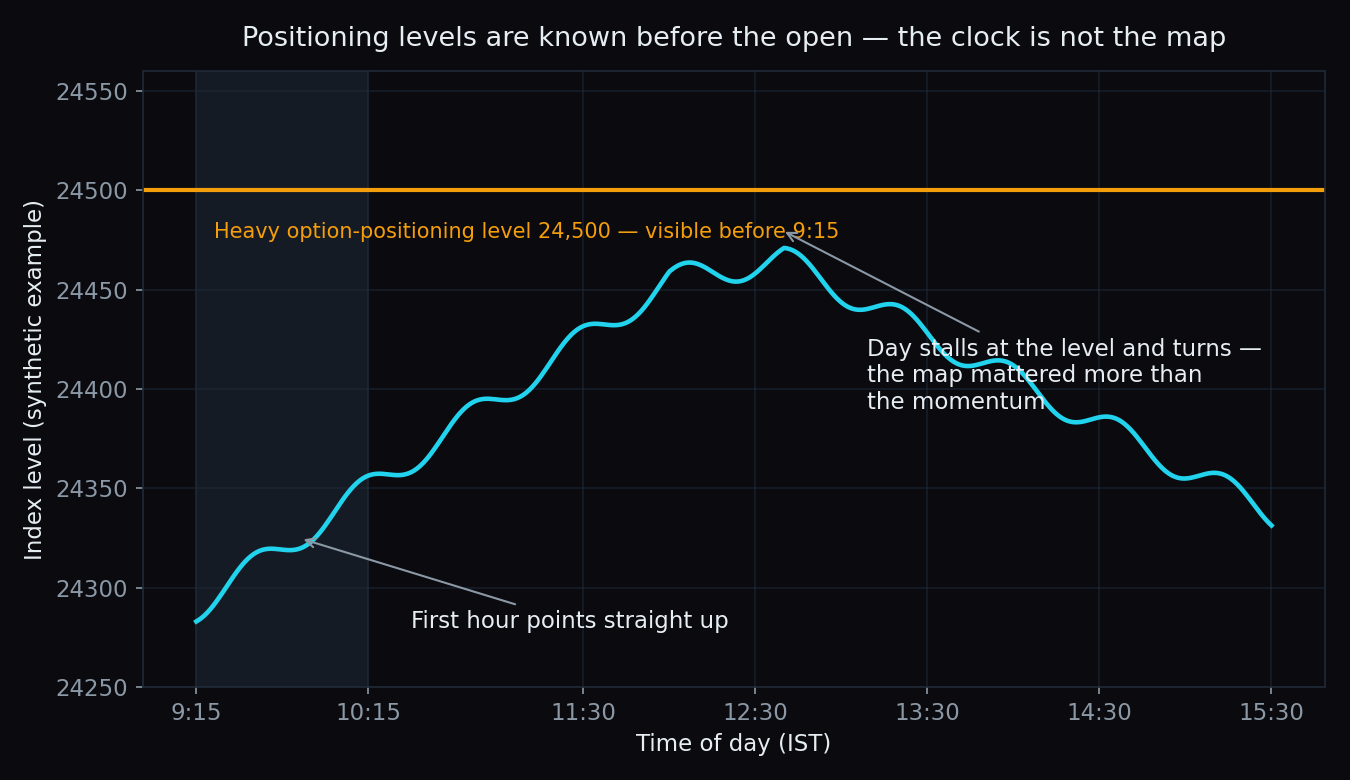
For contrast, consider the most famous "already decided" level of all: max pain, the strike where option holders as a group would lose the most. In our scored sessions the day's close landed within one strike of the morning's max-pain level in just 37 of 90 Nifty sessions (41.1%) and 13 of 90 Bank Nifty sessions (14.4%) — worse than a coin flip on both. Folklore levels fail quietly all the time; you only notice when someone keeps score.
One honest limit: our scoreboard does not grade "first-hour direction" as a signal, so we cannot quote a hit-rate for the folklore itself. What the scored sessions do show is that real, checkable day structure existed before the opening bell — which is more than the folklore can claim for itself.
The honest catch
Key takeaway: a level that holds two times out of three still fails one time in three. Touch counts are small (n=14 to 32), the percentages drift as new sessions are scored, and none of this forecasts tomorrow. The value is not prediction — it is knowing where the day's pressure points sit, and being honest about how often they hold.
So, does the opening hour decide the day?
As a verdict, no. The same first hour can end as two opposite days, and nothing in the opening range tells you which one you are in. As information, yes: the first hour shows how the market digested the overnight gap, hints at how wide the day's range might be, and — most usefully — shows where price sits relative to the levels that were mapped before the bell. Treat 10:15 not as the end of the story, but as the end of the first chapter.
Want the map before the bell? TrueTrend turns live option positioning on Nifty, Bank Nifty and F&O stocks into one clear, at-a-glance morning read — and then scores its own levels in public every evening. Create a free account and see today's map.
See these concepts on live market data — free
Create a free TrueTrend account to watch daily support/resistance levels, market regime, and option-positioning charts on NIFTY, BankNifty and 12 more instruments. Every level we publish is scored on a public scoreboard — misses included. No card required.
Free forever tier · daily levels with published hit-rates across every instrument. Descriptive market structure, not investment advice.
Not ready for an account? Get the daily levels by email.
One short email each market day — the indices' call wall, put wall, gamma flip and max pain, and how the last session's levels scored. Free, no account, unsubscribe anytime.
Descriptive market structure, not investment advice. We never share your email.