Market Order vs Limit Order: The Difference
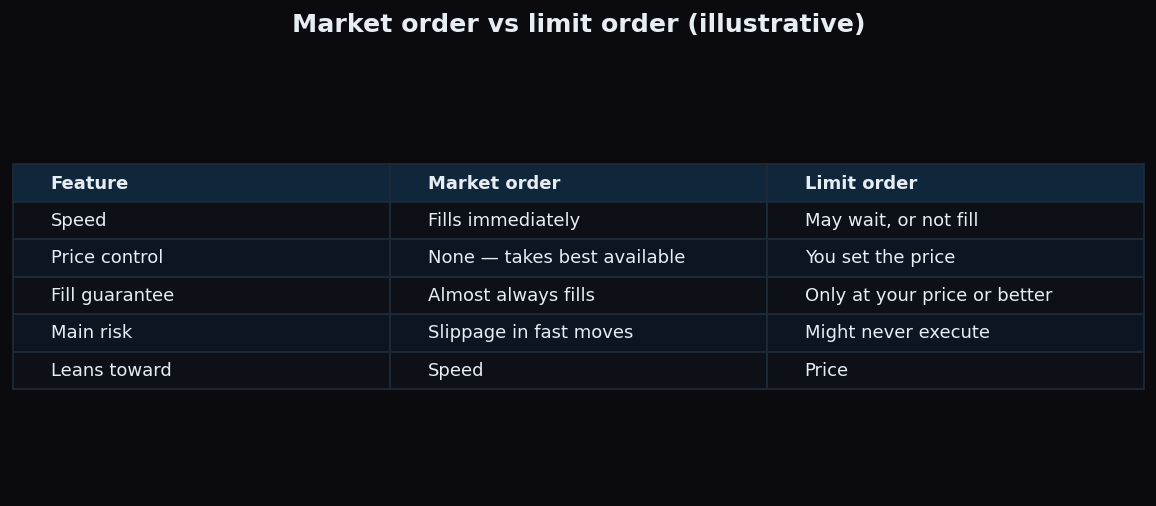
When you finally place an order in the market, your trading app asks a question that quietly decides a lot: market order or limit order? The two sound interchangeable, but they make opposite trade-offs. One prizes speed; the other prizes price. Pick the wrong one at the wrong moment and you can pay more than you meant to — or never get filled at all. Here is the difference, in plain language.
The core idea: speed versus price control
Every order you send is really answering one question: do you care more about getting done now, or about getting done at your price? You usually cannot have both at once.
- A market order says: “Execute immediately at whatever the best available price is.” It chases speed and accepts whatever price the market offers.
- A limit order says: “Execute only at my chosen price or better — otherwise wait.” It chases price control and accepts that it might not fill.
Market order: speed first
A market order is the “just get me in (or out) right now” button. It does not specify a price. Instead it sweeps the order book, taking the best prices currently on offer until your whole quantity is filled. Because it asks for no special price, it almost always executes within a fraction of a second.
The analogy is hailing whatever taxi is at the front of the rank. You will get a ride immediately — but you take the fare on the meter, whatever it happens to be. You traded price certainty for speed.
The catch is slippage: the difference between the price you expected and the price you actually got. To understand why slippage happens, recall that a share has a bid (best buyer price) and an ask (best seller price), with a gap called the spread between them — explained in our guide to the bid, ask and spread. A market buy pays the ask, not the friendly “last price” on the ticker. And if your order is large or the market is moving fast, you eat through several price levels, each one worse than the last.
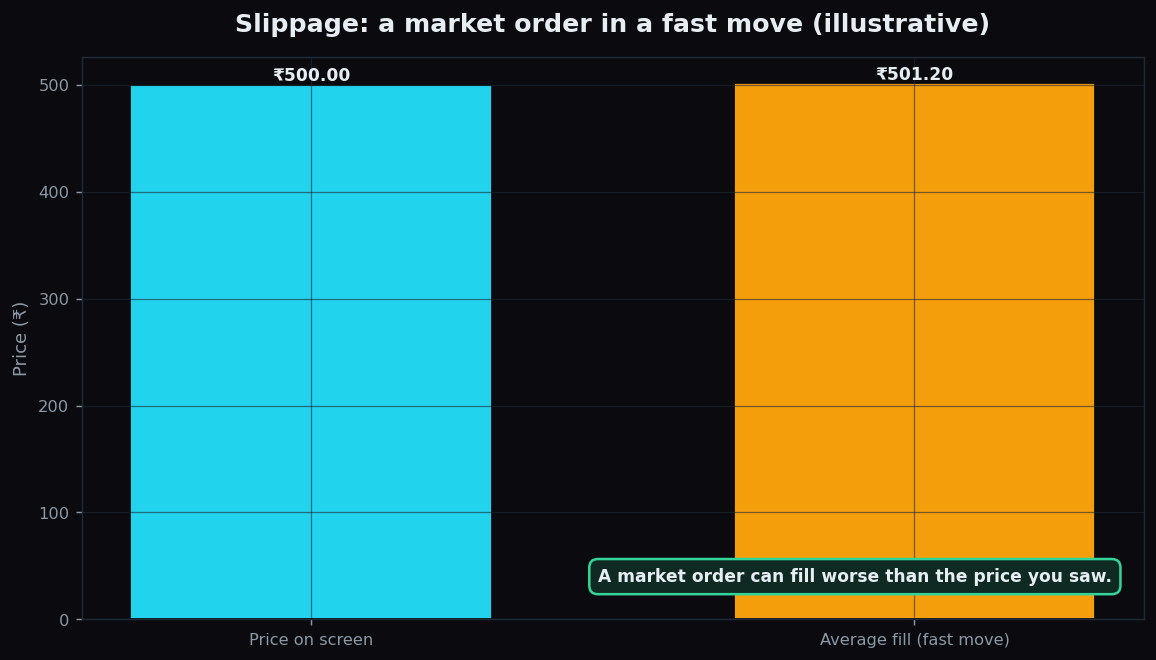
A worked example of slippage
Say a share shows 500 on screen and you fire off a market order during a burst of news. The few shares at 500 get taken instantly, then the next available are at 500.50, then 501, then 501.50. By the time your full order is filled, your average price is about 501.20. You wanted 500; you paid 501.20. That 1.20 per share is slippage — the price of demanding speed in a fast-moving market.
Limit order: price first
A limit order flips the priority. You name the worst price you are willing to accept, and the order will only fill at that price or better. A limit to buy at 500 will never pay more than 500. A limit to sell at 520 will never accept less than 520.
The analogy here is booking a cab at a price you set in advance: you will not be charged a rupee more — but if no driver accepts your fare, you simply do not get a ride. That is the trade-off. A limit order protects your price but gives up the guarantee of getting filled.
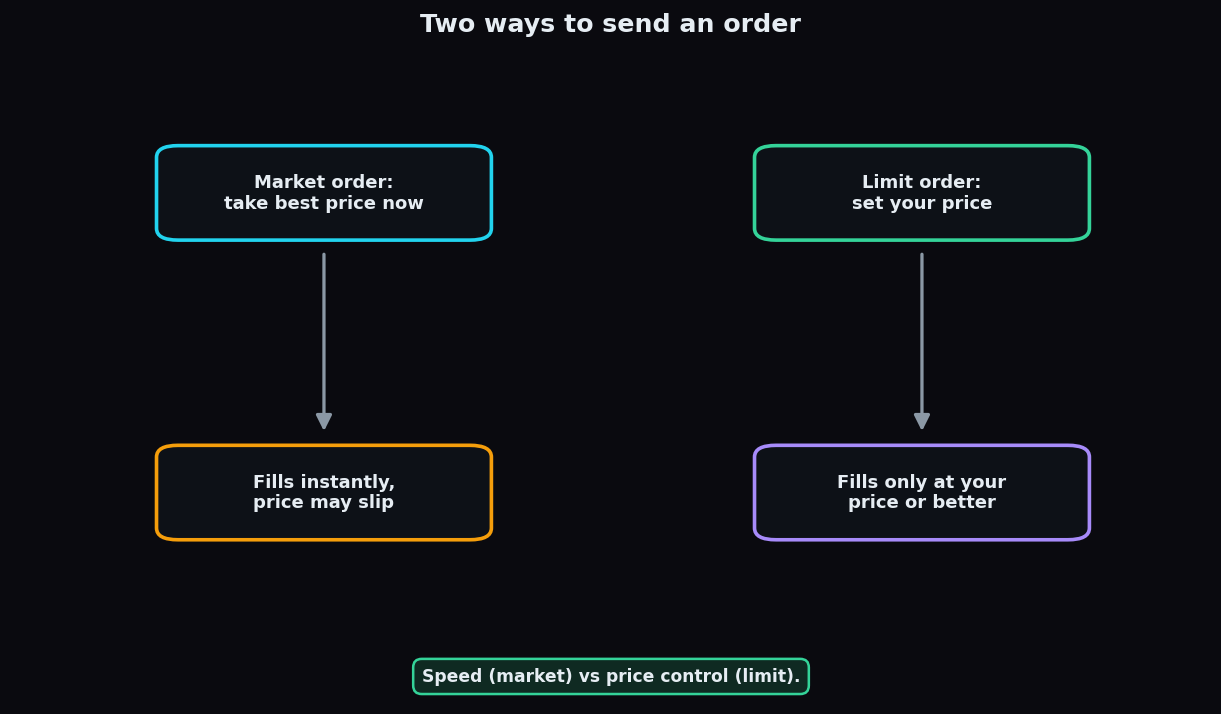
When a limit order fills — and when it does not
Imagine the share is trading at 502 and you place a limit order to buy at 500. Nothing happens immediately, because no one is selling that low yet. Your order waits in the book. If the price later dips to 500 and a seller meets you there, you fill at 500 — exactly as planned. But if the price never falls that far and instead climbs to 510, your order simply sits unfilled. You protected your price perfectly and got no shares at all. That is the limit order's honest weakness.
Which behaves better, and when
Neither order type is “better” — they suit different situations. As a rough map of how each tends to behave:
- Speed matters most, in a deep liquid stock: a market order fills instantly with minimal slippage because the spread is tiny.
- Price matters most, or the stock is thin: a limit order protects you from a wide spread and from slippage, at the cost of maybe not filling.
- Fast-moving or news-driven moments: market orders can slip badly; a limit order caps the damage but may miss the move entirely.
This is a description of mechanics, not a suggestion about what to do — the right choice depends entirely on your own situation and goals.
The honest catch
- Market orders trade price for certainty. You will almost always fill, but never at a price you control — slippage is the cost.
- Limit orders trade certainty for price. You control the price, but the order can sit unfilled and you can miss the move completely.
- Liquidity changes the stakes. In thin stocks a market order's slippage can be brutal, which is exactly where limit orders earn their keep.
- A partial fill is possible. A limit order can fill only part of your quantity if there is not enough volume at your price.
The difference between speed and price control is the kind of market plumbing that quietly shapes every result. TrueTrend explains these mechanics in clear, beginner-friendly guides and transparent dashboards, so you understand exactly how an order behaves before you ever send one. Start free and learn the fundamentals.
Key takeaways
- A market order prioritises speed: it fills almost instantly at the best available price, but risks slippage.
- A limit order prioritises price: it fills only at your chosen price or better, but may never execute.
- Slippage example: a market buy at a screen price of 500 can fill at an average of 501.20 in a fast move.
- Limit example: a buy limit at 500 waits unfilled if the price climbs to 510 instead of dipping.
- Neither is “better” — the choice is a trade-off between certainty of execution and certainty of price.
See these concepts on live market data — free
Create a free TrueTrend account to watch daily support/resistance levels, market regime, and option-positioning charts on NIFTY, BankNifty and 12 more instruments. Every level we publish is scored on a public scoreboard — misses included. No card required.
Free forever tier · daily levels with published hit-rates across every instrument. Descriptive market structure, not investment advice.
Not ready for an account? Get the daily levels by email.
One short email each market day — the indices' call wall, put wall, gamma flip and max pain, and how the last session's levels scored. Free, no account, unsubscribe anytime.
Descriptive market structure, not investment advice. We never share your email.