Options Explained: Calls and Puts for Beginners
An option is a contract that gives you a right — but never an obligation — to buy or sell an asset at a fixed price within a set time. That single word, right, is what separates options from almost every other market instrument. You hold a choice, not a duty, and choices have value. If you have ever paid a small booking fee to reserve the option of cancelling a trip later, you already understand the bargain at the heart of every option.
The two flavours: calls and puts
Every option is one of two kinds. A call is the right to buy the underlying at a fixed price. A put is the right to sell the underlying at a fixed price. That fixed price is called the strike price, and the date the right expires is the expiry. Master those two words — call and put — and you have the foundation of the entire options world.
For the right itself you pay a fee called the premium. The premium is what the option buyer pays the option seller, up front, the moment the contract is created. It is yours to lose, and it is the most you can lose as a buyer — a crucial point we will return to.
Calls: the right to buy
Buy a call when you want to benefit if a price rises, without committing the full cost of owning the asset today. Picture a token you can hand over later to buy something at a frozen price, no matter how expensive it has become in the meantime.
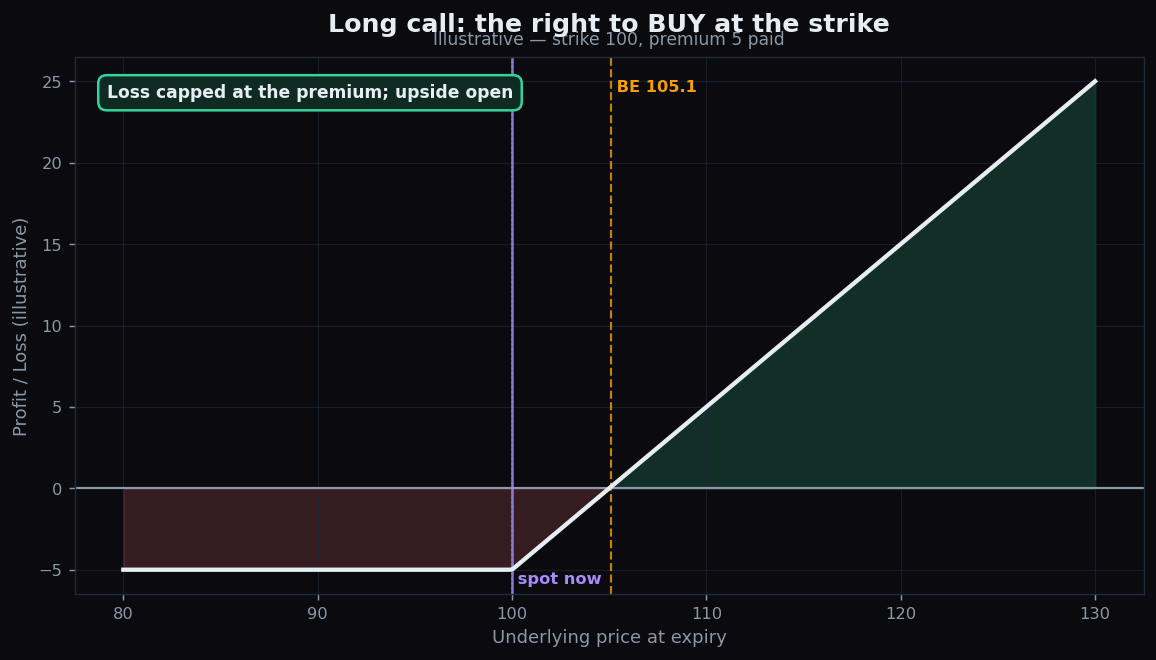
Here is a worked example with round numbers. A stock trades at 100. You buy a call with a strike of 100 for a premium of 5.
- If the stock rises to 120, your right to buy at 100 is worth 20. Subtract your 5 premium, and you keep 15 per share.
- If the stock stays at 100 or falls to 90, you simply let the option lapse. Your loss is only the 5 you paid.
Notice the shape: your downside is capped at the premium, while your upside grows as the stock climbs. That is the signature payoff of a long call.
The point where you start making money is the breakeven: strike plus premium, or 100 + 5 = 105. Below 105 you are still recovering your premium; above 105 you are in profit. This is an illustration of the mechanics, not a recommendation to trade.
Puts: the right to sell
A put is the mirror image. Buy a put when you want to benefit if a price falls, or to protect something you already own — like an insurance policy on your holdings. The put gives you the right to sell at the strike even if the market price collapses below it.
Same numbers, opposite direction. The stock trades at 100. You buy a put with a strike of 100 for a premium of 5.
- If the stock falls to 80, your right to sell at 100 is worth 20. Minus the 5 premium, you keep 15 per share.
- If the stock rises to 110, you let the put lapse and lose only the 5 premium.
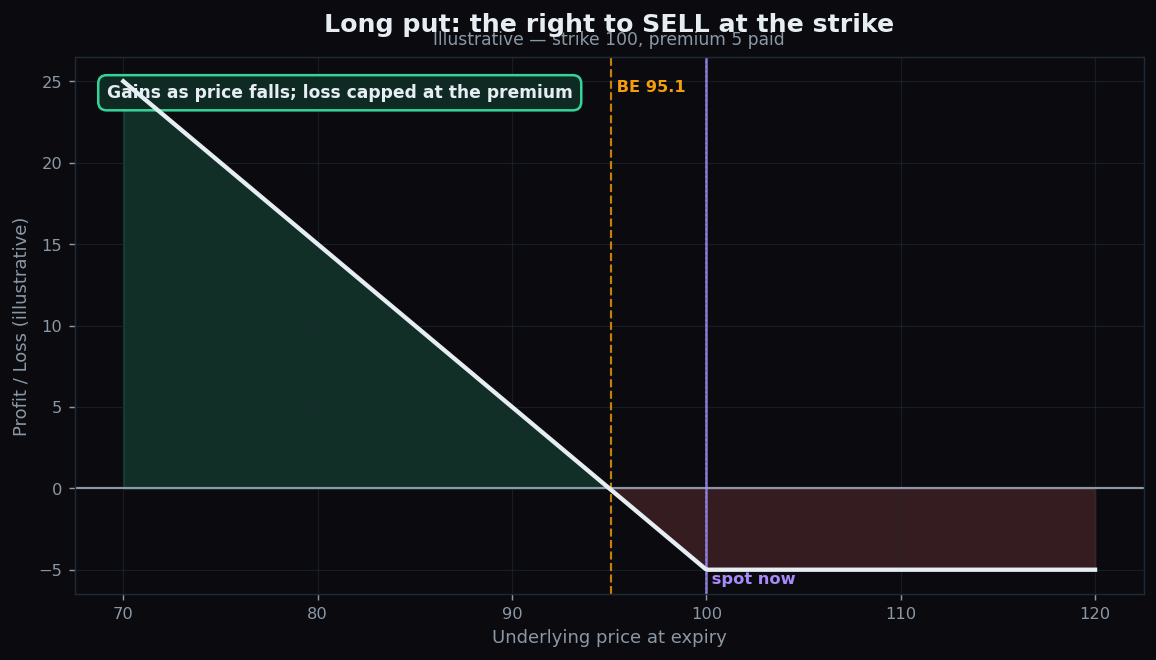
The breakeven for a put is strike minus premium: 100 − 5 = 95. The stock must fall below 95 before the put turns a profit. Again, loss is capped at the premium; the gain grows as the price drops toward zero.
Why the right matters so much
The magic of buying an option is the lopsided deal: a known, limited cost paired with a much larger potential payoff. You can never lose more than the premium, yet you keep exposure to a big move. That asymmetry is why options attract so much attention.
It helps to name the moneyness terms you will hear constantly. An option is in-the-money when exercising it would pay off — a call with the stock above its strike, or a put with the stock below its strike. It is out-of-the-money when exercising would not pay — the opposite cases. And it is at-the-money when the stock sits right at the strike. These labels describe where the option stands relative to the current price.
The honest catch
That limited-loss promise hides a sharp truth: the most common outcome for an option buyer is losing the entire premium. Options expire, and if the move you hoped for does not arrive in time, the right becomes worthless. You can be right about direction and still lose because you were wrong about timing.
Two forces work against a buyer every day. The first is time decay — an option steadily loses value as expiry nears, because there is less time left for a favourable move. The second is volatility: if the market becomes calmer than expected, the option you bought can lose value even if the stock has not moved against you. Beginners often focus only on direction and are blindsided by these two.
There is also another side to every option. For every buyer paying a premium, a seller collects it — and the seller's risk profile is very different. If you want to understand that opposite perspective, our explainer on call writing versus put writing for option sellers walks through it. To see how the size of an expected move is baked into the premium, the piece on the expected move hidden in option prices is a natural next read.
Options reward those who understand the mechanics before risking a rupee. TrueTrend turns live option-market structure into plain-language context made for learners. Create a free account and explore how calls and puts behave.
Key takeaways
- An option is a right, not an obligation — you choose whether to use it.
- A call is the right to buy at the strike; a put is the right to sell at the strike.
- You pay a premium for the right, and as a buyer that premium is the most you can lose.
- Breakeven is strike + premium for a call and strike − premium for a put.
- Time decay and falling volatility work against buyers — being right on direction is not enough.
See these concepts on live market data — free
Create a free TrueTrend account to watch daily support/resistance levels, market regime, and option-positioning charts on NIFTY, BankNifty and 12 more instruments. Every level we publish is scored on a public scoreboard — misses included. No card required.
Free forever tier · daily levels with published hit-rates across every instrument. Descriptive market structure, not investment advice.
Not ready for an account? Get the daily levels by email.
One short email each market day — the indices' call wall, put wall, gamma flip and max pain, and how the last session's levels scored. Free, no account, unsubscribe anytime.
Descriptive market structure, not investment advice. We never share your email.