What Is a Stock Exchange? NSE and BSE Explained
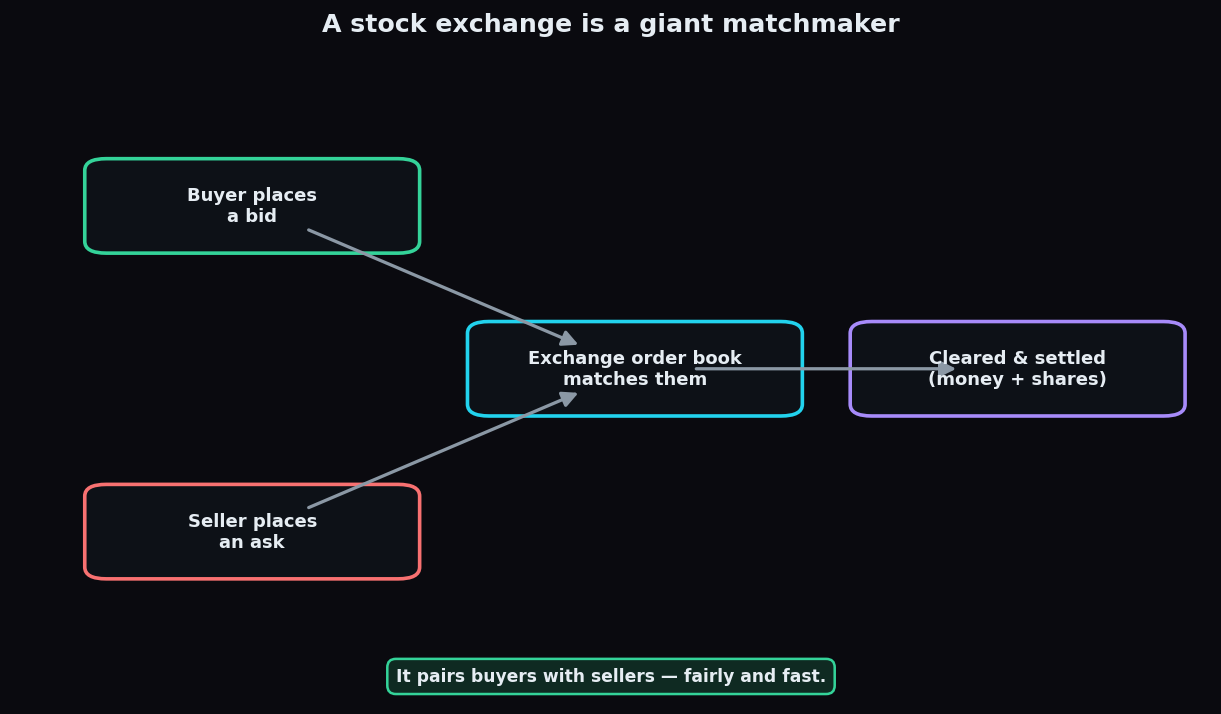
You have decided to buy a share. Somewhere out there, a complete stranger has decided to sell the same share. Neither of you knows the other exists. How do the two of you ever meet, agree on a price, and swap money for ownership safely — in a fraction of a second? The answer is a stock exchange. It is the giant, electronic matchmaker that stands in the middle of every trade.
What a stock exchange is
A stock exchange is an organised marketplace where buyers and sellers of shares come together to trade. It does not own the shares or set their prices. Instead, it provides the meeting place, the rulebook, and the technology so that millions of buy and sell requests can be matched fairly and quickly.
Think of a huge vegetable mandi. The mandi does not grow the vegetables or decide what a kilo of tomatoes is worth. It simply gives farmers and buyers a common, trusted place to meet, with weighing scales everyone agrees on and rules nobody can bend. A stock exchange does the same job for shares — only it is fully electronic and settles in milliseconds.
How the matching actually works
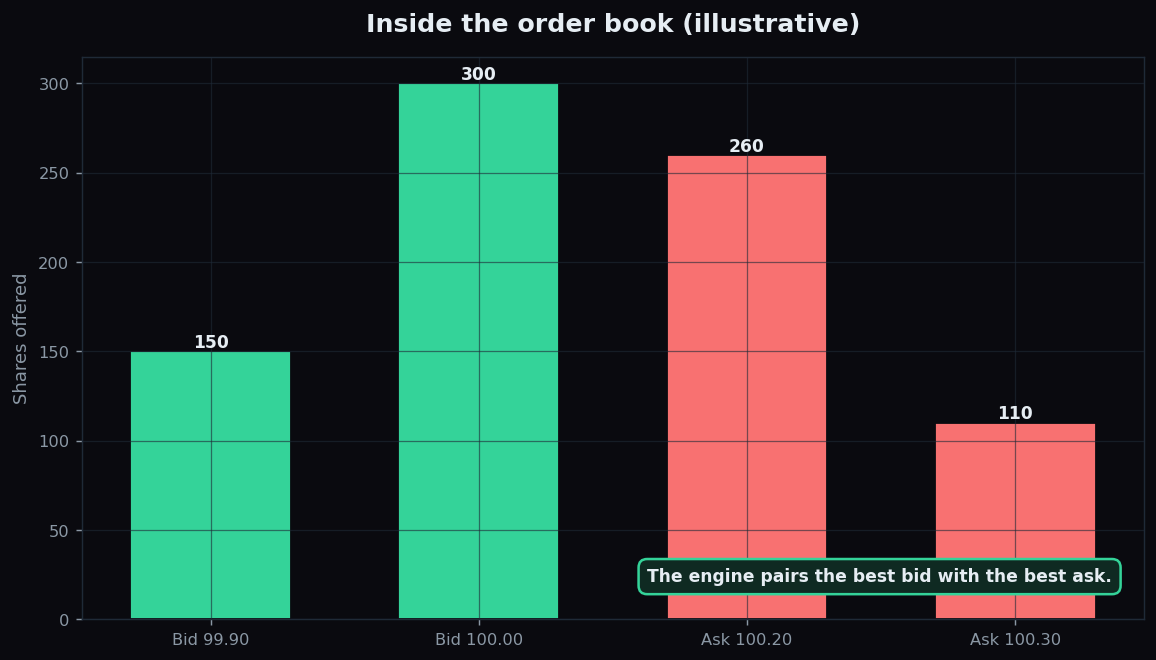
When you place an order, it goes into a digital list called the order book. The order book holds two queues. On one side are all the bids — the prices buyers are willing to pay. On the other are all the asks (also called offers) — the prices sellers want to receive. Each is sorted by how attractive it is.
The exchange's job is to find matches. Its matching engine constantly pairs the highest bid with the lowest ask. The moment a buyer is willing to pay at least what a seller is asking, a trade happens automatically — no haggling, no phone calls. It all runs on a strict rule of price first, then time: the best price gets matched first, and among equal prices, whoever arrived earliest goes first.
A quick worked example
Suppose the order book for a share looks like this. The highest bid is someone willing to pay 100.00. The lowest ask is someone willing to sell at 100.20. Right now nothing matches — the buyer will not stretch to 100.20, and the seller will not drop to 100.00.
Now a new buyer arrives and is happy to pay 100.20. The engine instantly pairs them with the seller asking 100.20. A trade prints at 100.20, both orders leave the book, and the next-best prices move up to become the new best bid and ask. This happens thousands of times a second, which is why share prices flicker constantly through the day.
Clearing and settlement: the safety net
Matching is only half the story. After two strangers agree on a trade, someone has to make sure the buyer actually pays and the seller actually delivers the shares. This back-office process is called clearing and settlement, and it is handled by a separate clearing corporation that sits behind the exchange.
The clearing corporation steps in as the guarantor for both sides. Even if your counterparty vanishes, the system ensures you still get your shares or your money. In India this happens on a T+1 cycle — the trade is fully settled one working day after it is struck. That guarantee is what lets you trade with complete strangers without a moment's worry about whether they will honour the deal.
NSE and BSE: India's two big exchanges
India has two main stock exchanges, and most well-known companies are listed on both.
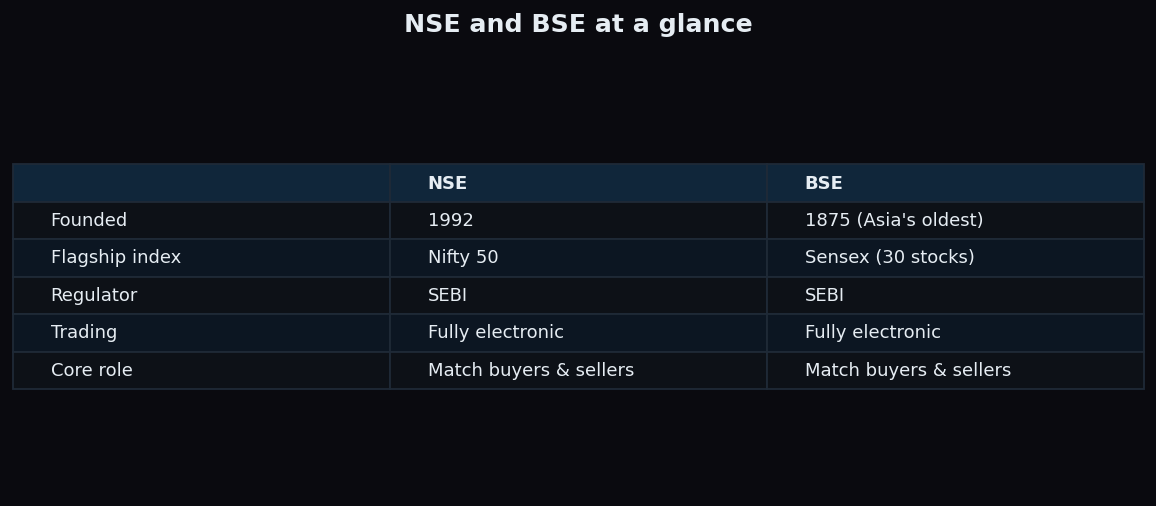
- The BSE (Bombay Stock Exchange) is the older of the two, founded in 1875 — the oldest stock exchange in Asia. Its flagship benchmark is the Sensex, an index that tracks 30 large, established companies.
- The NSE (National Stock Exchange) was founded in 1992 and pioneered fully electronic, screen-based trading in India. Its flagship benchmark is the Nifty 50, which tracks 50 large companies.
An index like the Sensex or Nifty 50 is simply a basket of representative shares whose combined value is tracked as one number, so people can describe how “the market” is doing in a single figure. Both exchanges are fully electronic, and both operate under the same regulator.
Who keeps it all fair?
Sitting above the exchanges is the regulator: SEBI (the Securities and Exchange Board of India). SEBI writes the rules, supervises the exchanges and brokers, and works to protect ordinary investors from fraud and manipulation. The exchange runs the marketplace; SEBI makes sure the marketplace stays honest.
The honest catch
An exchange makes trading fast and fair, but it does not make it safe from loss. A few things worth remembering:
- The exchange guarantees the trade, not the outcome. It ensures your buy or sell completes; it says nothing about whether the price goes up or down afterwards.
- You almost always trade through a broker. Individuals do not connect to the exchange directly — a registered broker routes your order on your behalf.
- Listed does not mean risk-free. Being on an exchange is not a quality stamp; weak companies are listed too.
- Liquidity varies. Big companies match instantly; thinly traded ones can have a wide gap between bid and ask, as our explainer on the bid, ask and spread shows.
The market runs on structure — order books, matching, settlement — not on hunches. TrueTrend translates that structure into clear, beginner-friendly explainers and transparent, data-checked dashboards so you can understand the machine before you step into it. Create a free account to start exploring.
Key takeaways
- A stock exchange is an electronic marketplace that matches share buyers with sellers fairly and fast.
- Orders sit in an order book of bids and asks; the matching engine pairs the highest bid with the lowest ask on a price-then-time rule.
- Clearing and settlement (on a T+1 cycle in India) guarantees both sides honour the trade.
- India's two big exchanges are the BSE (Sensex) and the NSE (Nifty 50), both overseen by SEBI.
- The exchange guarantees the trade completes — never that the price will move in your favour.
See these concepts on live market data — free
Create a free TrueTrend account to watch daily support/resistance levels, market regime, and option-positioning charts on NIFTY, BankNifty and 12 more instruments. Every level we publish is scored on a public scoreboard — misses included. No card required.
Free forever tier · daily levels with published hit-rates across every instrument. Descriptive market structure, not investment advice.
Not ready for an account? Get the daily levels by email.
One short email each market day — the indices' call wall, put wall, gamma flip and max pain, and how the last session's levels scored. Free, no account, unsubscribe anytime.
Descriptive market structure, not investment advice. We never share your email.