What Is a Stock? Shares and Ownership Explained
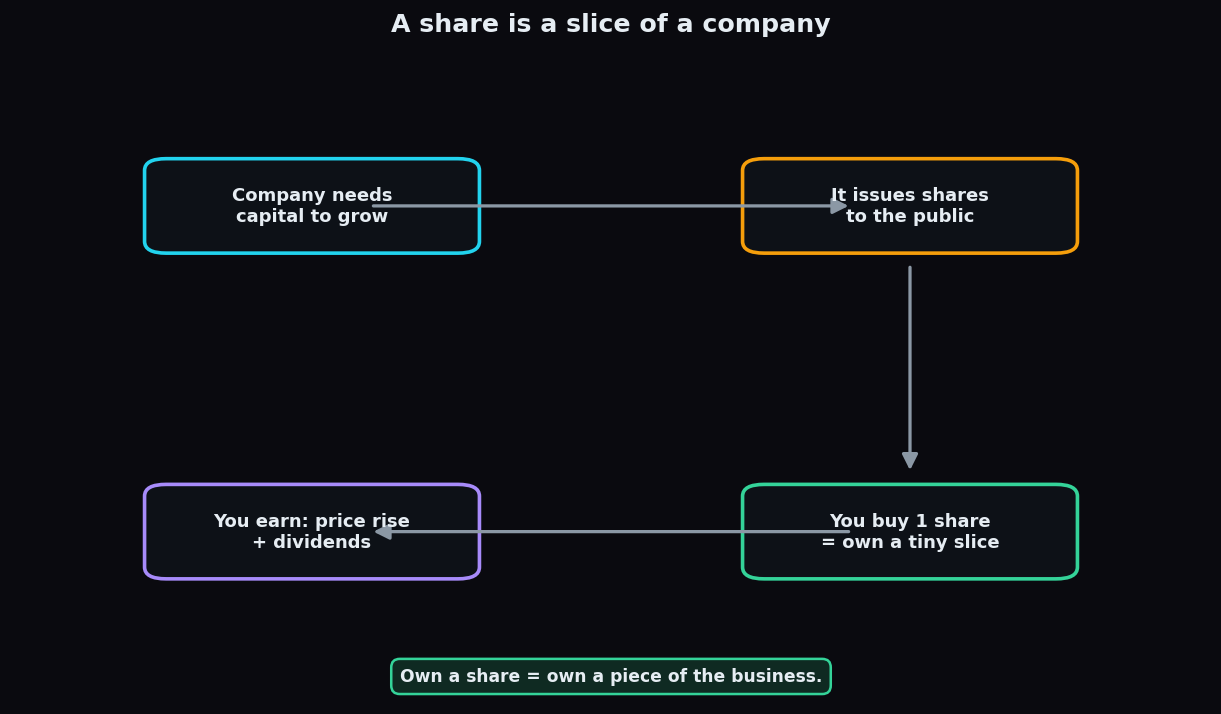
You hear it every day on the news: “the stock went up,” “she owns shares,” “the market is rallying.” But strip away the jargon and a stock is a wonderfully simple idea. It is a slice of ownership in a real company. Buy one share and, legally, you own a tiny piece of that business — its factories, its brand, its future profits, all of it, in proportion to how much you hold.
What a stock really is
The words stock and share are used almost interchangeably. A share is a single unit of ownership in a company. Stock is the general word for those ownership units. If a company is divided into, say, one crore (10 million) shares and you hold 100 of them, you own one hundred-thousandth of the whole company.
Here is the everyday analogy. Imagine a popular pizza shop is cut into 1,000 equal slices of ownership. Buy one slice and you own one-thousandth of the shop. You did not bake the pizzas or sign the rent agreement, but you are part-owner. If the shop does well, your slice becomes more valuable and you get a cut of the profits. That slice is exactly what a share is.
Why companies issue shares
A growing company needs money — to build a factory, hire people, or expand into new cities. It has two broad choices. It can borrow the money (take a loan it must repay with interest), or it can sell ownership by issuing shares to the public. When a company sells shares to ordinary investors for the first time, that event is called an IPO (Initial Public Offering).
By issuing shares, the company raises cash without taking on debt. In return, it gives up a portion of ownership and future profits to the new shareholders. Thousands of strangers each contribute a small amount, and together they fund something big. In exchange, each becomes a part-owner with a genuine, if tiny, claim on the business.
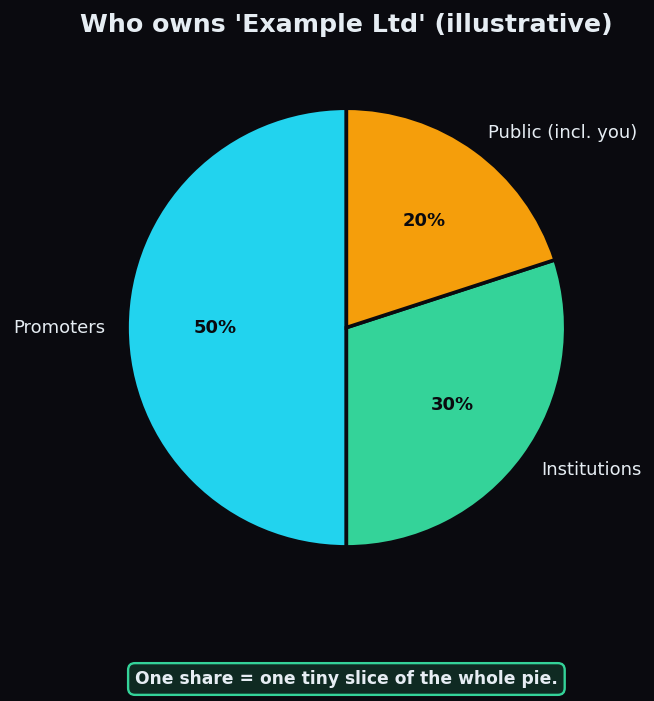
The pie above shows an illustrative ownership split. Promoters are the founders or the family that started and runs the company. Institutions are large professional investors like mutual funds and insurance companies. The rest is held by the general public — people like you. Every one of those slices is made of shares.
How owning a stock can pay you
As a part-owner, there are two distinct ways you can profit. It helps to keep them separate in your head.
1. The price can rise (capital gain)
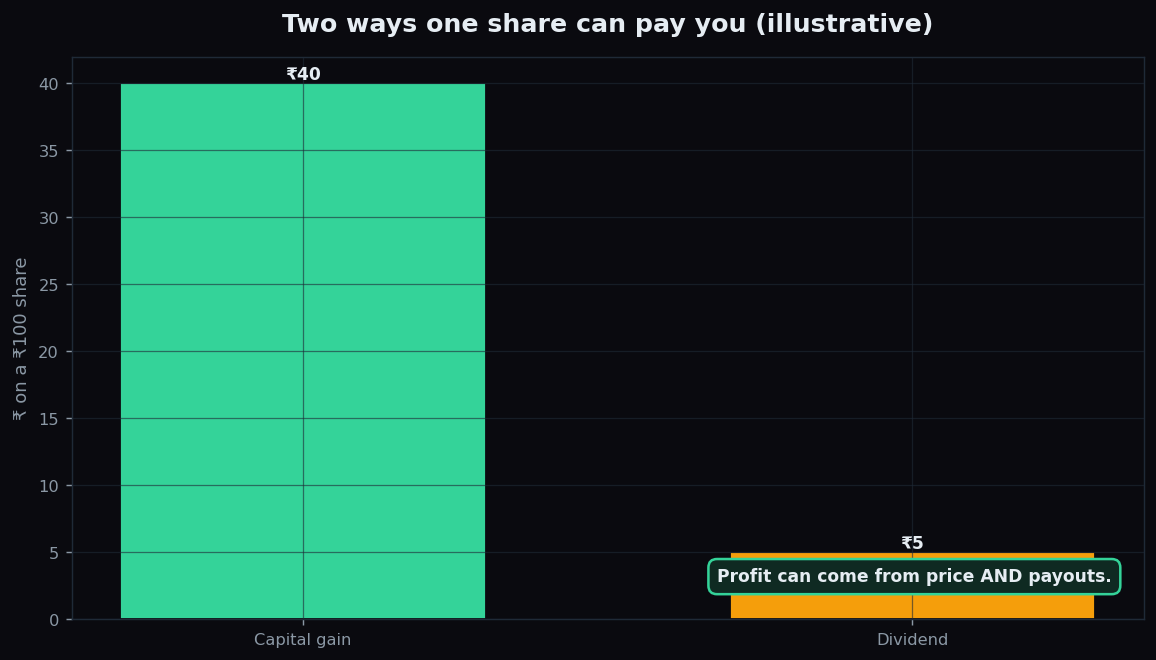
If the business grows and more people want to own a piece of it, the price of each share tends to rise. The increase in a share's price is called a capital gain. Say you become part-owner at a share price of 100, and a few years later the same share trades at 140. That 40 of extra value per share is a capital gain — though it is only real money once you actually sell. Prices fall too, which would be a capital loss.
2. The company can share profits (dividends)
When a company earns a profit, it can keep that money to reinvest, or it can hand some back to its owners as a dividend — a cash payment per share. If a company pays a dividend of 5 per share and you own 100 shares, you receive 500, simply for being an owner. Not every company pays dividends; younger, fast-growing firms often reinvest everything instead.
Putting the two together
Imagine you become part-owner of one share at 100. Over a year, the company pays a 5 dividend, and the share price climbs to 140. Your slice is now worth 40 more than you paid, and you have also pocketed 5 in cash. Your total return for that year is 40 + 5 = 45 on a 100 share. Both pieces matter, and they come from the same single idea: you owned a slice of a real, profit-making business.
The honest catch
Ownership cuts both ways. The same slice that rises when the business thrives also falls when it struggles. A few things every new owner should sit with:
- Prices fall as well as rise. A share is not a fixed deposit. Its value swings with the company's fortunes and the mood of the whole market, sometimes sharply.
- Dividends are not promised. A company can cut or skip a dividend in a tough year. Past payments do not guarantee future ones.
- One share is a tiny vote. You are a real owner, but a small one. Big decisions are driven by large shareholders.
- A company can fail. If the business goes bankrupt, shareholders are last in line to be paid — sometimes the slice becomes worth nothing.
None of this is a reason to fear stocks; it is simply the honest other side of ownership. The value comes from owning a piece of something productive, and that always carries risk alongside the reward. To see where shares are actually bought and sold, our explainer on stock exchanges like the NSE and BSE picks up the story.
Understanding what you own is the real foundation of investing. TrueTrend turns dense market structure into plain, beginner-friendly explainers and transparent, data-checked dashboards, so you can learn how the market behaves before risking a rupee. Start free and explore at your own pace.
Key takeaways
- A stock (or share) is a slice of ownership in a real company.
- Companies issue shares to raise money for growth without taking on debt.
- Owners can profit two ways: a rising share price (capital gain) and profit payouts (dividends).
- On a 100 share, a 40 price rise plus a 5 dividend is a 45 total return — but only the dividend is cash in hand until you sell.
- Ownership cuts both ways: prices fall too, dividends are not promised, and a failing company can wipe out a share's value.
See these concepts on live market data — free
Create a free TrueTrend account to watch daily support/resistance levels, market regime, and option-positioning charts on NIFTY, BankNifty and 12 more instruments. Every level we publish is scored on a public scoreboard — misses included. No card required.
Free forever tier · daily levels with published hit-rates across every instrument. Descriptive market structure, not investment advice.
Not ready for an account? Get the daily levels by email.
One short email each market day — the indices' call wall, put wall, gamma flip and max pain, and how the last session's levels scored. Free, no account, unsubscribe anytime.
Descriptive market structure, not investment advice. We never share your email.