What Is an ETF? Exchange Traded Funds Explained
Imagine you could buy a single share that, in one click, gave you a tiny slice of fifty different companies at once. You would not have to research each one, place fifty orders, or track fifty holdings. That single, tradable basket is essentially what an ETF — an Exchange Traded Fund — is. It bundles many investments together and then lists that bundle on the stock exchange so you can buy or sell it like an ordinary share. This post explains what an ETF is, how it tracks an index, and the honest trade-offs.
What an ETF actually is
Break the name into three words. Fund means a pool of money from many investors used to buy a collection of assets — usually stocks, but sometimes bonds, gold, or other things. Exchange Traded means units of that fund are listed on a stock exchange and change hands throughout the trading day at live prices. Put together, an ETF is a basket of investments that trades like a single stock.
Most ETFs are built to track an index. An index is just a defined list of securities measured together — for example, a benchmark of the 50 largest companies on an exchange. If the ETF tracks that index, it simply holds those same 50 companies in roughly the same proportions. When the index rises 1%, a well-run tracking ETF rises about 1% too. It is not trying to beat the market; it is trying to be the market, cheaply.
One unit, a whole basket
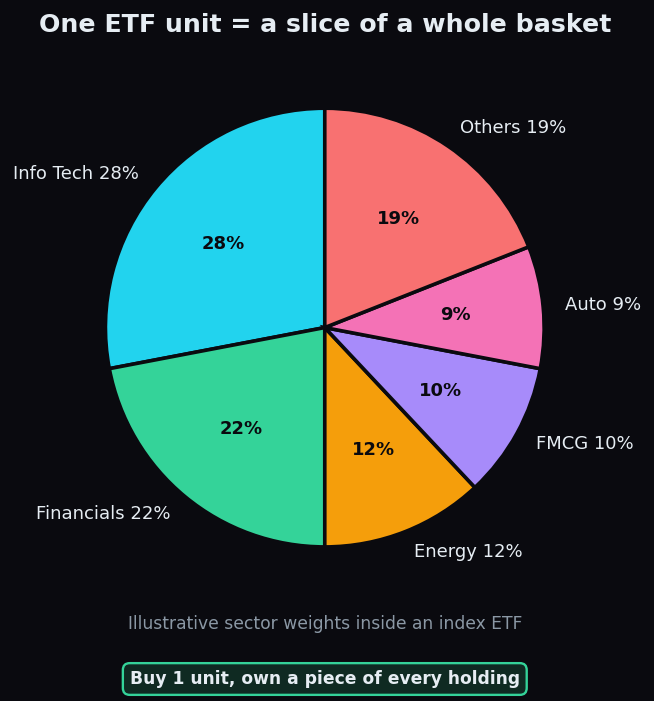
The pie above shows what sits inside one illustrative index ETF: a mix of sectors, each taking up a slice. When you buy a single unit, you own a proportional sliver of every holding in that pie. Buy one unit and you indirectly own a little information technology, a little financials, a little energy, and so on — in the same weights the fund holds them.
This is the core benefit: instant diversification. Diversification means spreading money across many holdings so that one company stumbling does not sink you. Buying fifty stocks individually would take fifty decisions, fifty brokerages, and a lot of tracking. One ETF unit does it in a single, low-cost trade.
An everyday analogy
Think of a fixed thali at a restaurant. Instead of ordering rice, dal, sabzi, roti, and dessert separately — five decisions, five prices — you order one thali and get a balanced plate at one price. An ETF is the thali of investing: one order, a balanced basket, decided by whoever designed the menu (the index). If you dislike a single item, you cannot remove it — you take the plate as served. That is the trade-off for the convenience.
How an ETF tracks an index
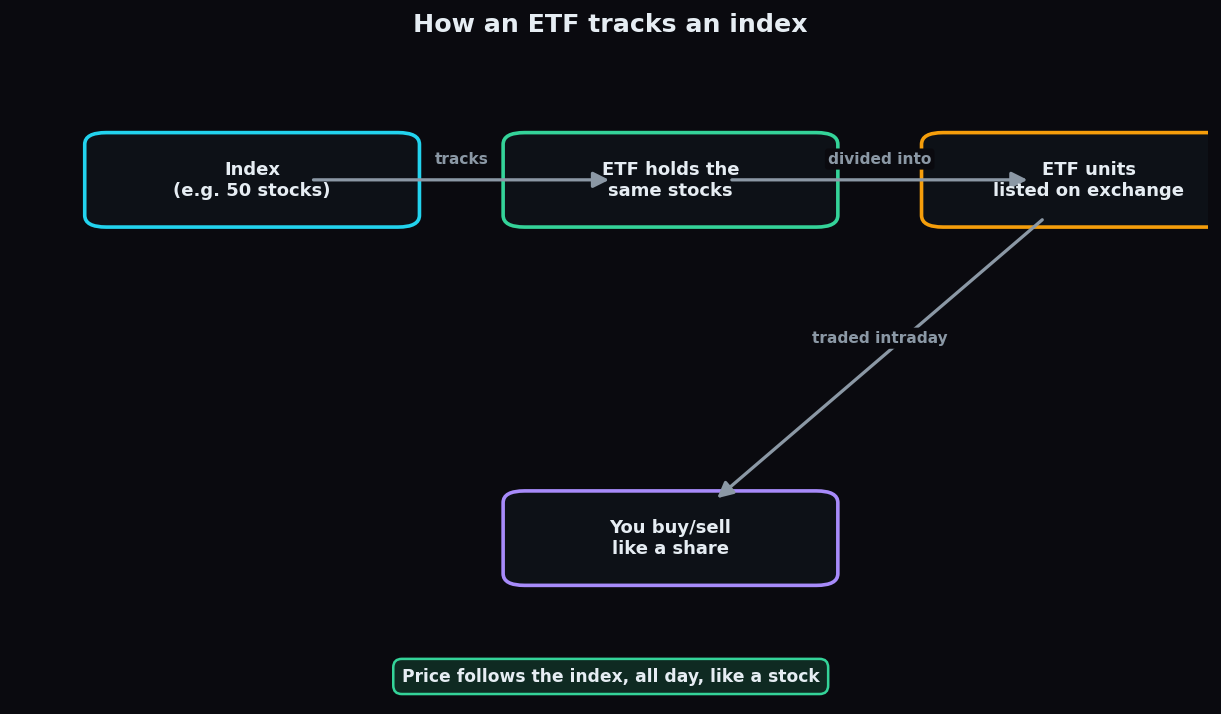
The flow above shows the chain. First there is the index — a rulebook listing which stocks belong and in what weight. The fund buys those same stocks to mirror the index. The fund is then divided into many small units that are listed on the exchange. Finally, you buy or sell those units through a normal brokerage account, at live prices, any time the market is open.
Because units trade on the exchange, an ETF has a market price that ticks up and down all day. Large professional participants continuously create and redeem units in the background, which keeps the ETF's traded price hugging the value of the basket it holds. You do not need to manage any of that — you just see a price that closely follows the index.
A worked example with round numbers
Suppose an index sits at a level of 20,000, and an ETF is designed so one unit is priced at roughly 1/100th of that level — about Rs 200 per unit.
- You buy 10 units at Rs 200 each, spending Rs 2,000.
- The index climbs 5%, from 20,000 to 21,000.
- The ETF, tracking it, moves about 5% too — each unit is now near Rs 210.
- Your 10 units are worth about Rs 2,100, mirroring the index gain, minus a small yearly fund cost.
That small yearly cost is the expense ratio — the fee, expressed as a percentage of your holding per year, that the fund charges to run itself. Index ETFs are popular partly because this fee is usually very low. These are round, illustrative numbers to show the mechanics, not a prediction or a recommendation.
ETF versus a regular mutual fund
Both pool money and hold a basket, so how do they differ? The clearest difference is how you trade them. A traditional mutual fund is priced once a day after the market closes, and you buy or redeem at that single end-of-day value. An ETF trades continuously on the exchange, so its price moves in real time and you can transact whenever the market is open. If you want to understand that once-a-day pricing in depth, our companion piece on mutual funds and NAV walks through it. Many index ETFs also carry low ongoing costs, which is a big part of their appeal.
The honest catch
ETFs are convenient, not magic. A few things to keep clear-eyed about:
- You get the whole basket, weak parts included. A tracking ETF holds every stock in its index, including the laggards. You cannot cherry-pick.
- It falls with its market. If the index drops 20%, the ETF drops about 20%. Diversification spreads risk within a market; it does not remove market risk.
- Tracking is close, not perfect. Fees and mechanics create a small tracking difference — the tiny gap between the ETF and the index it copies.
- Trading costs and liquidity vary. Because you trade on the exchange, a thinly traded ETF can have a wider gap between buy and sell prices. Some ETFs are far more actively traded than others.
- “ETF” is a wrapper, not a guarantee of safety. There are ETFs on niche, volatile, or leveraged themes that behave nothing like a broad index fund. The label alone tells you the structure, not the risk.
Understanding what sits inside a basket — and how its parts behave — is exactly the kind of structural thinking TrueTrend is built to teach. You can open a free account to explore market concepts as plain-English education, with no tips and no pressure.
Key takeaways
- An ETF is a basket of investments that trades on the exchange like a single stock — one unit, many holdings.
- Most ETFs track an index, aiming to match it rather than beat it, usually at a low yearly cost (the expense ratio).
- The big benefit is instant diversification in one low-cost trade; the trade-off is that you take the whole basket as designed.
- ETFs trade at live prices all day, unlike a regular mutual fund priced once after close.
- An ETF still falls with its market and tracks its index only closely, not perfectly — and the “ETF” label describes structure, not safety.
See these concepts on live market data — free
Create a free TrueTrend account to watch daily support/resistance levels, market regime, and option-positioning charts on NIFTY, BankNifty and 12 more instruments. Every level we publish is scored on a public scoreboard — misses included. No card required.
Free forever tier · daily levels with published hit-rates across every instrument. Descriptive market structure, not investment advice.
Not ready for an account? Get the daily levels by email.
One short email each market day — the indices' call wall, put wall, gamma flip and max pain, and how the last session's levels scored. Free, no account, unsubscribe anytime.
Descriptive market structure, not investment advice. We never share your email.