Grey Market Premium (GMP): What It Means and Why It Misleads
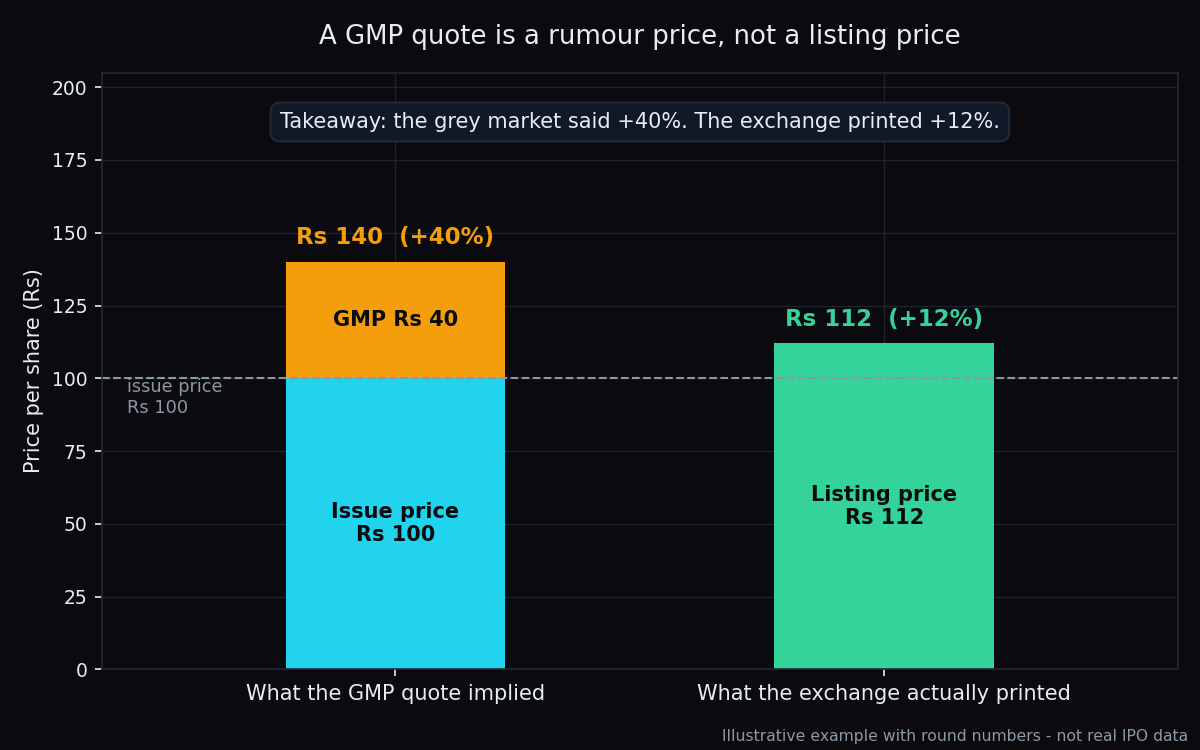
In the week before an IPO lists, one number gets quoted everywhere: “GMP Rs 40”. On a Rs 100 issue it reads like a promise of a 40% pop on listing day. It is not a promise, it is not a forecast, and it does not come from any exchange. It is a price someone said, over the phone, in a market that keeps no records.
This post explains what grey market premium actually is, walks through the arithmetic with round numbers, and lays out five concrete reasons the number misleads people — including the one that matters most: nobody keeps score of how often it is right.
What is grey market premium?
Start with the words. An IPO is a company offering its shares to the public for the first time at a fixed issue price. A few days after applications close, those shares begin trading on NSE or BSE. That first traded price is the listing price.
The grey market is an unofficial, off-exchange market where people deal in those shares — or in the applications themselves — during the gap between the offer closing and the shares listing. It is not illegal in the way a black market is, but it is entirely outside the exchange and outside the regulator’s market infrastructure. Nothing is recorded, nothing is cleared, and no rulebook covers it.
The grey market premium (GMP) is simply the extra amount, per share, that someone in that market says they would pay above the issue price. GMP Rs 40 on a Rs 100 issue means a dealer is quoting Rs 140 per share.
You will also meet two related terms. A kostak rate is a fixed amount paid to take over an entire application, whether or not shares are allotted. A “subject to sauda” deal only takes effect if that application actually receives an allotment. Both are informal arrangements between private parties, not regulated products, and neither has an official price feed.
An everyday analogy: the concert ticket
A concert prices its tickets at Rs 1,000 and is full within an hour. In a fan group, three people say they would happily pay Rs 1,400 for a spare. That Rs 400 is a grey market premium.
It tells you something real: a few enthusiastic people are keen. It does not tell you what a ticket will change hands for on the night. Three eager messages in a group of forty is not the same as a market. If half those fans lose interest by the weekend, the Rs 400 evaporates and nobody publishes a correction.
An IPO GMP is that group chat, for a company.
A worked example with round numbers
Here is the entire calculation behind every “expected listing price” headline you have read:
- Issue price: Rs 100
- GMP quoted two days before listing: Rs 40
- Implied listing price = 100 + 40 = Rs 140, an implied gain of 40%
That is it. There is no model, no data set and no adjustment for anything. The “prediction” is one addition sum performed on a rumour.
Now suppose the share opens at Rs 112 on listing day. The real gain was 12%, not 40%. The GMP was not slightly off — it overstated the move by more than three times.
Why the number swings so much
Follow a single IPO through the week before it lists and you will often see the quote wander from Rs 62 to Rs 20 and back up to Rs 47 — for the same company, with no new information about the business in between.
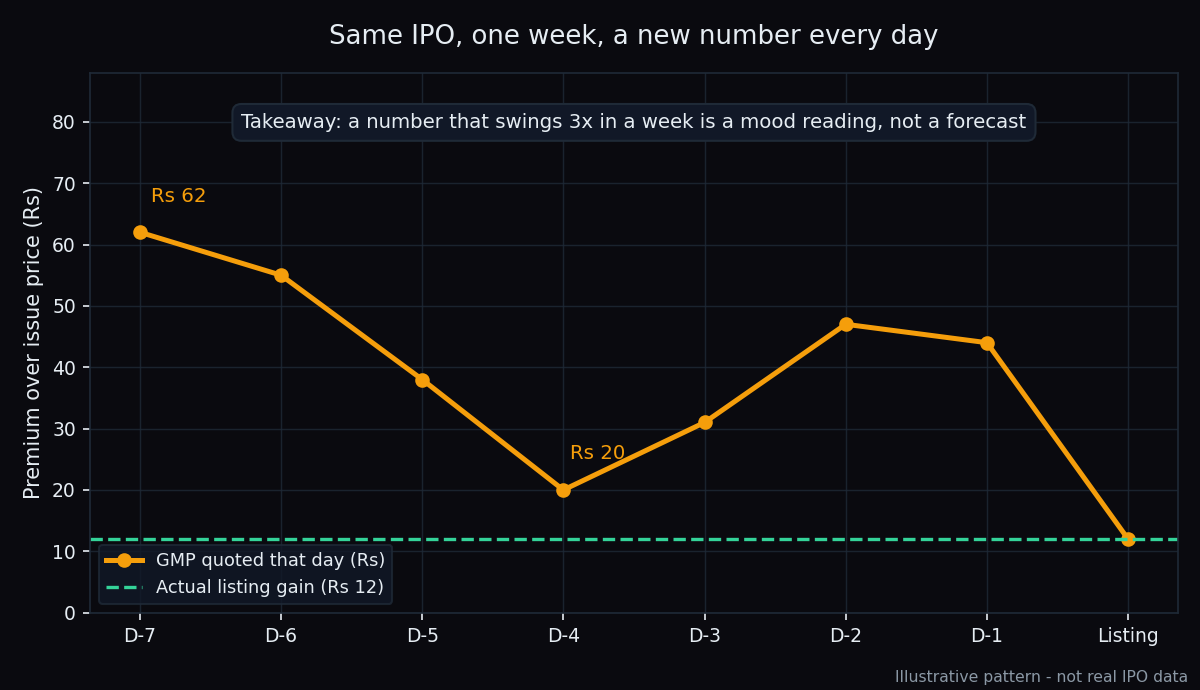
Three things drive that wobble, and none of them is company news:
- The market is tiny. A handful of deals can set the quote for the whole country. In a thin market, one enthusiastic participant moves the price — the same way a wide bid-ask spread shows you that few people are willing to deal.
- Subscription figures feed the mood. When an issue is heavily oversubscribed on day two, quotes jump. That is sentiment reacting to sentiment, not a fresh valuation.
- Broad market mood leaks in. A weak week on Nifty pulls listing expectations down across every pending IPO at once.
Five reasons GMP is unreliable
1. There is no official source
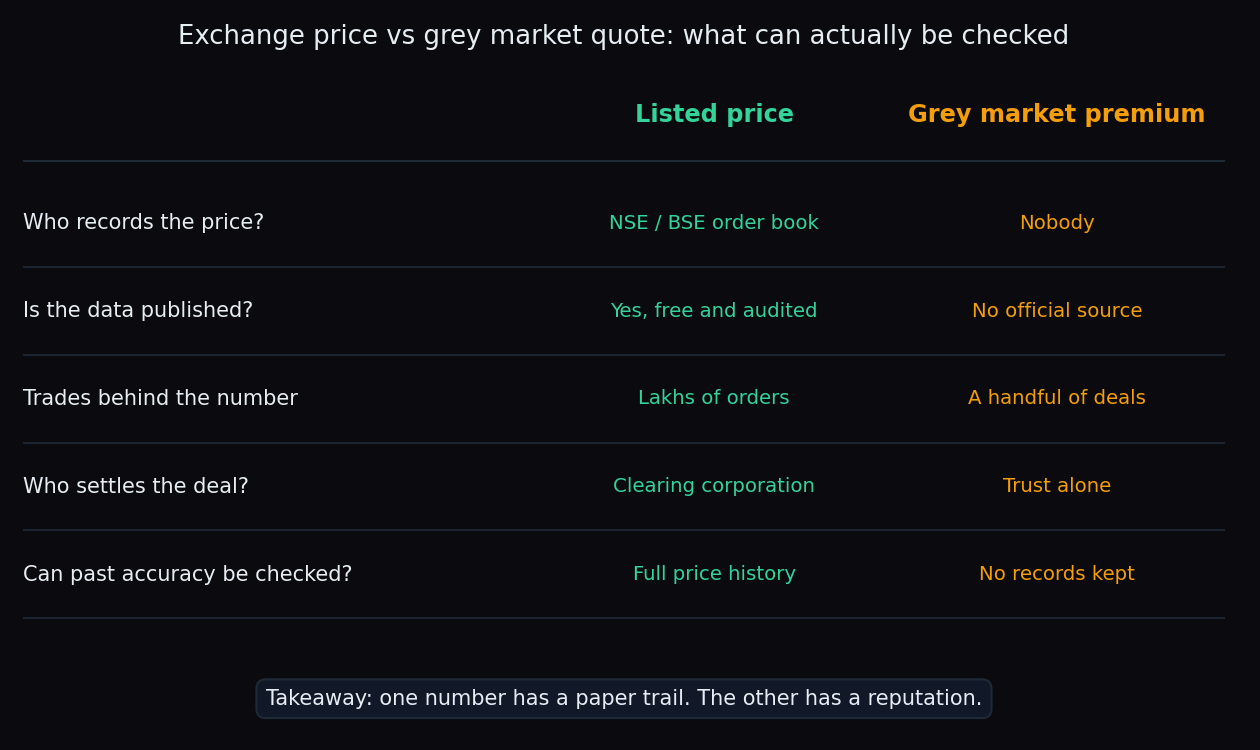
Neither the exchanges nor the regulator publishes GMP. Every website that shows you a GMP table got it by calling a few dealers. Two sites can print two different numbers for the same IPO on the same morning, and both are “correct” in that someone did say them.
2. It is a quote, not a completed trade
An exchange price is the record of a deal that actually happened, at a size you can see. A GMP is what someone says they would accept. Nobody can tell you how many shares changed hands at that level — or whether any did.
3. The people quoting it are not neutral
The dealers who set the quote also have positions in the outcome, and a high quoted premium attracts more applications, which supports the quote. A number produced by interested parties, with no audit and no disclosure of size, is a marketing figure as much as a price.
4. Nothing stands behind the deal
On an exchange, a clearing corporation sits between the two sides so the deal settles even if one party walks away. In the grey market there is no clearing corporation, no contract note and no grievance process. If the other side changes their mind, you have a phone number and goodwill. SEBI has cautioned investors about unofficial pre-listing dealings more than once — check the latest SEBI press releases and the exchange investor-caution notices for the current wording.
5. Nobody keeps score
This is the one that should bother you most. Because no GMP quote is ever recorded, there is no audited history of GMP against actual listing prices. So no one — including the sites that publish it daily — can tell you how often it has been right, by how much it typically misses, or whether it is any better than assuming a flat listing. A number with no track record is not evidence. It is a claim.
What a checkable number looks like
The honest alternative is not a better crystal ball. It is a number published with its sample size and its misses attached, so you can judge it yourself.
That is the standard we hold our own work to. On the public scoreboard where those hit-rates are published, the Nifty call wall has held on 76% of the 21 occasions price touched it, while Nifty max pain has closed within one strike on only 40% of 90 sessions. That second number is worse than a coin flip, and it is on the page anyway, with its n next to it. You can disagree with what it means; you cannot disagree about what happened.
Ask the same two questions of any number, ours or anyone’s: how many observations is this based on? and where are the times it was wrong? GMP cannot answer either.
How to read a GMP headline without being fooled
None of this means you should pretend GMP does not exist. It means reading it for what it is — a thermometer for the mood of a small, unofficial group — and not as a price forecast. Three habits help:
- Read it as a range, not a figure. If the quote moved from Rs 62 to Rs 20 in four days, the honest summary is “somewhere between very hot and lukewarm”, not “Rs 40”.
- Note who is quoting and when. A GMP without a source and a timestamp is a rumour with a decimal point.
- Weigh it against things you can check. Subscription data is published by the exchanges. Anchor investor allocations appear in exchange filings. The company’s financials, risk factors and use of proceeds are in the offer document. All of those have names attached; the GMP does not.
Grey market premium is not a forecast of the listing price. It is one small, unrecorded group’s mood, quoted second-hand, with no sample size and no history of accuracy. Treat the arithmetic behind “expected listing price” for exactly what it is: the issue price plus a rumour.
The honest limits of this post
We cannot show you a study of GMP accuracy, because the raw material for one does not exist — that absence is the argument, not a gap in our research. The numbers used above are illustrative round figures chosen to explain the mechanics, not measurements of any particular IPO. And grey market practices vary by dealer and region; the terminology here is the common Indian usage, not a standard defined anywhere official.
TrueTrend was built for the opposite habit: every signal we show carries its sample size and its misses in public, and the same positioning view is laid out at a glance across Nifty, Bank Nifty and F&O names. If you would rather read structure than rumours, create a free TrueTrend account.
See these concepts on live market data — free
Create a free TrueTrend account to watch daily support/resistance levels, market regime, and option-positioning charts on NIFTY, BankNifty and 12 more instruments. Every level we publish is scored on a public scoreboard — misses included. No card required.
Free forever tier · daily levels with published hit-rates across every instrument. Descriptive market structure, not investment advice.
Not ready for an account? Get the daily levels by email.
One short email each market day — the indices' call wall, put wall, gamma flip and max pain, and how the last session's levels scored. Free, no account, unsubscribe anytime.
Descriptive market structure, not investment advice. We never share your email.