SPAN and Exposure Margin: What Option Writers Deposit and Why
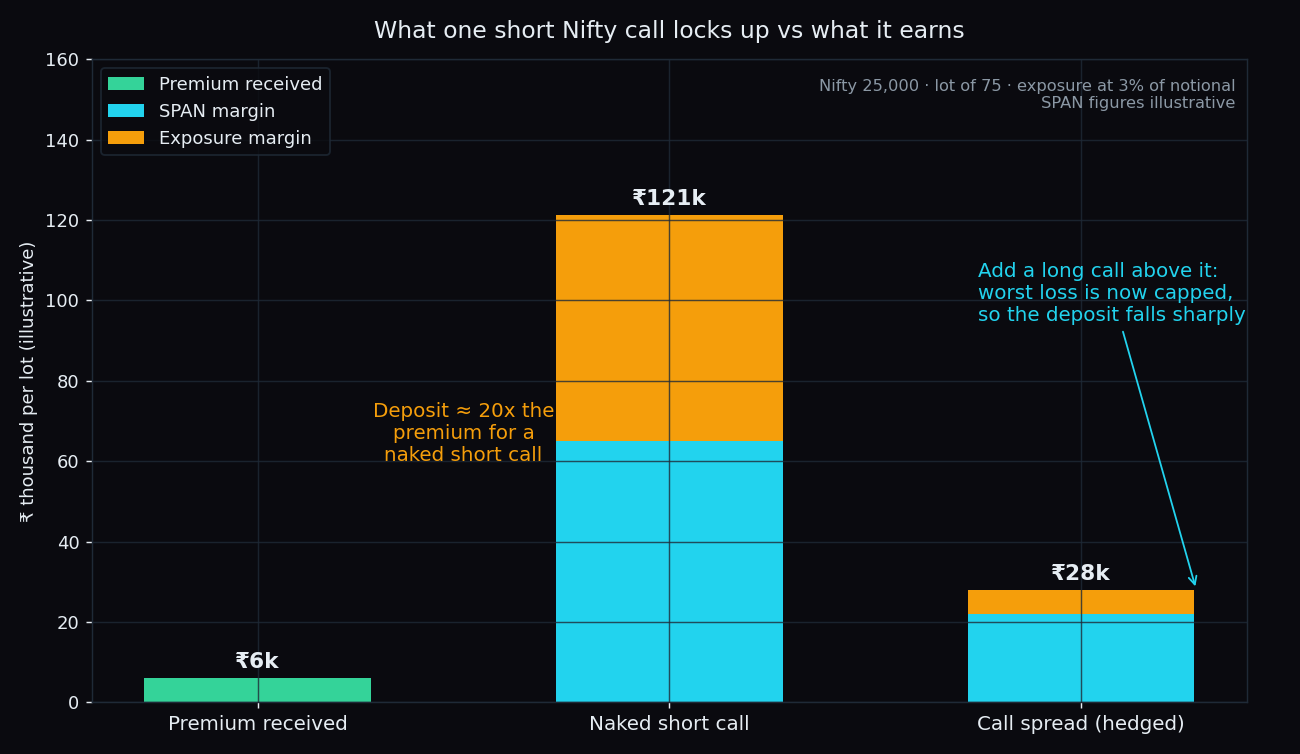
Write one Nifty call and you might collect ₹6,000 in premium. To keep that position open, your broker will block something closer to ₹1,20,000 in your account. That deposit is roughly twenty times what the trade earns, and beginners are often startled by it. The blocked amount is made of two parts, SPAN margin and exposure margin. This post explains what each one is, how the exchange decides the size, why it changes during the day, and why a hedge can shrink it dramatically.
First, the words
An option writer is the person who creates an option and takes the premium. The premium is the price of the option. The option holder is the person who paid that premium and owns the right. Margin is money the exchange requires you to keep blocked as a safety deposit while a risky position is open. The clearing corporation (for NSE, that is NSE Clearing) is the institution that stands between every writer and every holder and promises that each side gets paid. Margin is how it keeps that promise. If margin itself is new to you, our explainer on margin and leverage is the place to start.
Why the writer pays a deposit and the holder does not
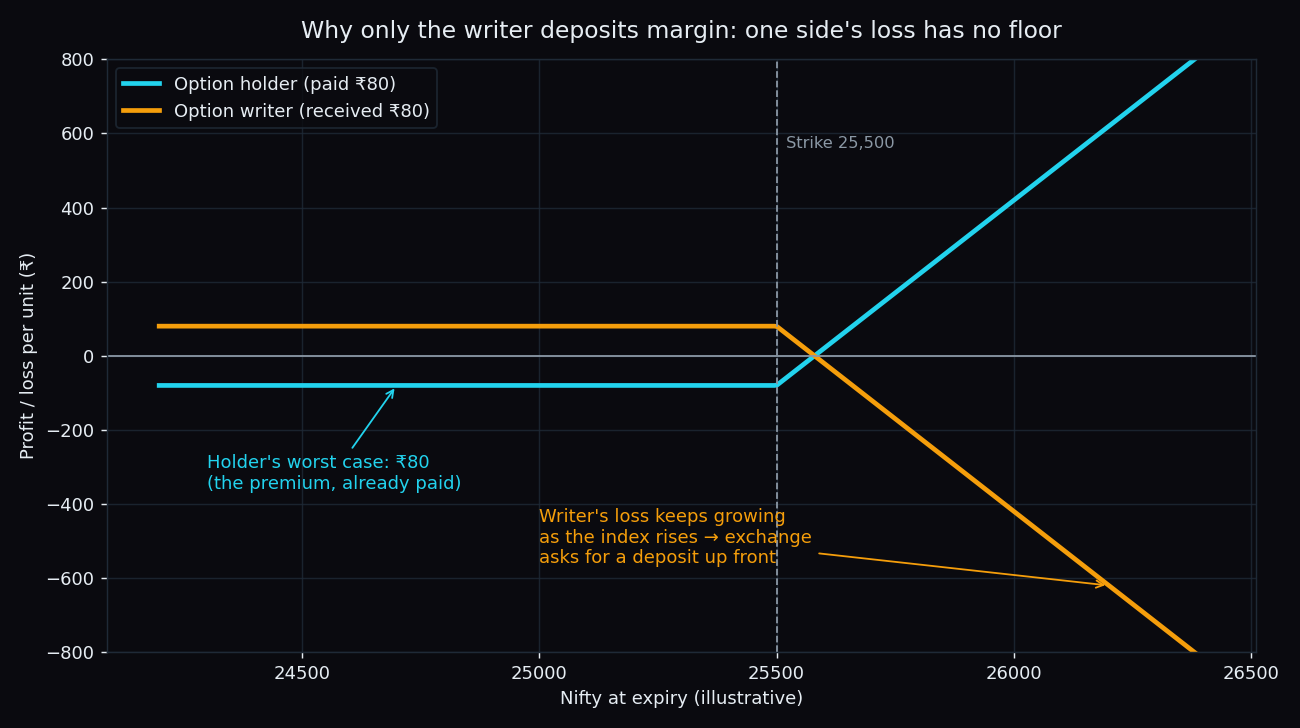
Look at what can go wrong for each side. The holder paid ₹80 per unit for the call. The very worst outcome is that the option expires worthless and the ₹80 is gone. That money has already left the account, so there is nothing more to secure. The writer took the ₹80, but if the index runs far above the strike, the writer owes the difference, and there is no ceiling on how large that difference can get. The clearing corporation therefore asks the writer, and only the writer, for a deposit before the trade is even allowed.
The landlord analogy
Think of a landlord renting out a flat. The landlord asks for a security deposit sized to the damage a tenant could plausibly cause in a bad month. That is SPAN margin: a careful estimate of the worst realistic one-day loss. Then the landlord adds a fixed extra cushion, say one more month of rent, simply because estimates can be wrong. That flat extra is exposure margin. You must hand over both before you get the keys, and if the flat gets riskier to rent, the landlord can ask for more.
SPAN margin: the worst realistic day
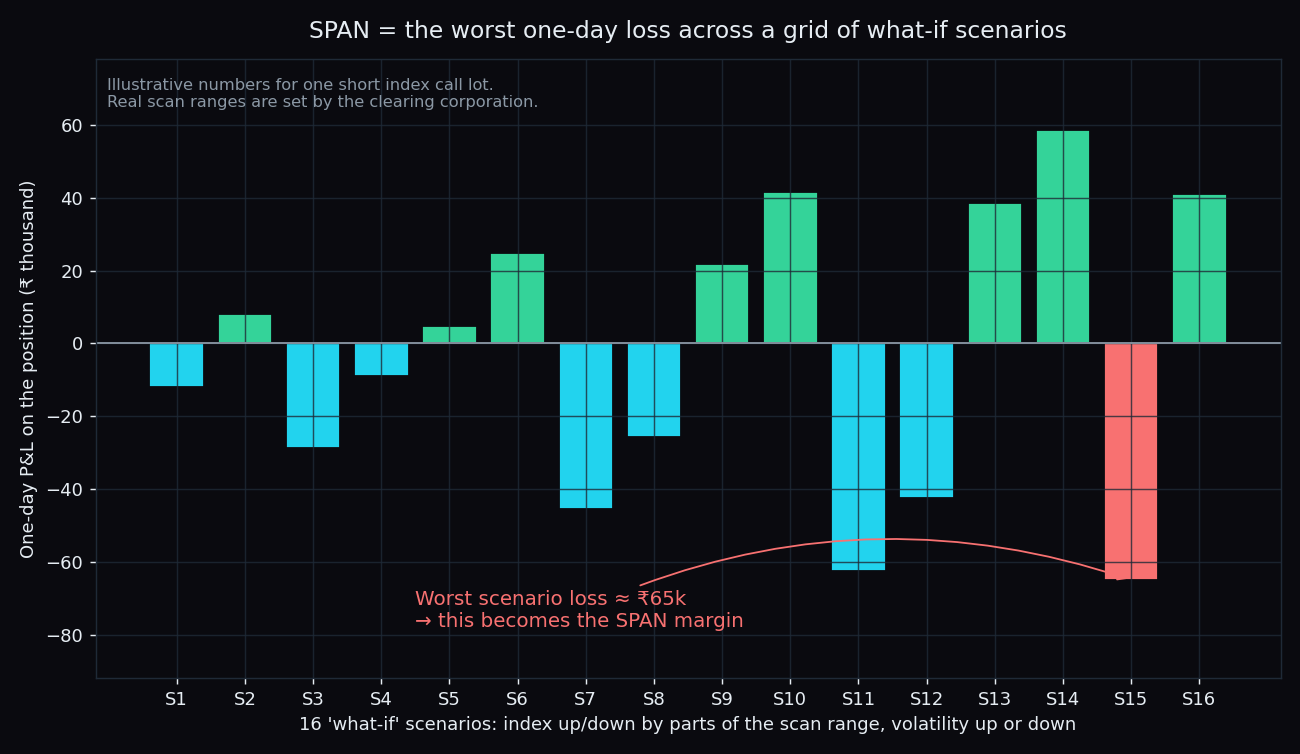
SPAN stands for Standard Portfolio Analysis of Risk. It is a method built by the Chicago Mercantile Exchange in 1988 and used by clearing houses around the world, including NSE Clearing. It does not use a flat percentage. Instead it runs your whole F&O portfolio through a grid of “what-if” scenarios and asks: in the worst of these, how much would you lose by tomorrow?
The grid has 16 scenarios. The index is moved up and down by fractions of a price scan range (a move the clearing corporation considers plausible in one day, based on recent volatility), while implied volatility is nudged up or down at the same time. Two extra scenarios test a very large move but count only part of that loss, because such moves are rare. The single largest loss across the grid becomes your SPAN margin.
Three things follow from this design:
- It is portfolio-based. If one position gains when another loses, SPAN nets them within the same scenario. A hedged position gets a much smaller number than the sum of its parts.
- It rises with volatility. When markets get jumpy the price scan range widens, so the same short option suddenly needs more margin, even if the index has not moved.
- Short options have a floor. A deep out-of-the-money option might show almost no loss in the grid, so SPAN adds a short option minimum charge to make sure no written option is ever nearly free to hold.
Exposure margin: the flat cushion on top
Exposure margin ignores scenarios entirely. It is a fixed percentage of the position's notional value, which means the full value of what the contract controls: index level times lot size. For index contracts the rate has typically been around 3% of notional; for single-stock contracts it is higher and depends on how volatile the stock has been. NSE Clearing publishes the current rates, and they can be revised. Exposure margin is charged on futures and on written options, not on options you hold.
Since 2018 the rules have required both SPAN and exposure margin to be collected upfront, before the position is taken, in the F&O segment. The premium you receive as a writer is credited to your account, so it partly offsets what gets blocked.
Key idea: SPAN is a smart estimate of the worst plausible one-day loss on your whole portfolio. Exposure margin is a flat safety cushion added on top. Together they make up the initial margin an option writer must deposit.
A worked example with round numbers
Suppose Nifty is at 25,000 and you write one lot of the 25,500 call, receiving ₹80 per unit. We use a lot size of 75 here for easy arithmetic; the exchange changes lot sizes from time to time. All figures below are illustrative, not live quotes.
- Premium received: 80 × 75 = ₹6,000.
- Notional value: 25,000 × 75 = ₹18,75,000.
- Exposure margin at 3% of notional = ₹56,250.
- SPAN margin (the worst scenario in the grid) = say ₹65,000.
- Total deposit: 65,000 + 56,250 = ₹1,21,250, about 20 times the premium.
Now change one thing. Alongside the short 25,500 call, you also hold a long 25,800 call that cost ₹30 per unit. This is a call spread. Your worst possible loss is now capped: (300 − 50) × 75 = ₹18,750. SPAN sees that every scenario above 25,800 is fully covered by the long call, so the worst-case number collapses, and the exposure charge on the pair is far smaller too. The total deposit might fall to around ₹28,000. Same short option, roughly a quarter of the margin, because the risk to the clearing corporation is now bounded.
Why the number changes during the day
Margin is not set once at order time and forgotten. The clearing corporation recomputes SPAN several times each trading day, and brokers pass those updates straight through to your account. Three forces move it:
- Price. If the index moves toward your short strike, the option gains value, your mark-to-market loss grows, and the scenarios get uglier.
- Volatility. A sharp rise in implied volatility widens the scan range and inflates the premium on your written option at the same time.
- Rule-based add-ons. Since 20 November 2024, SEBI requires an additional 2% extreme loss margin on short option positions on the day the contract expires, to cover the wild swings of expiry afternoons. And since 1 February 2025, the margin benefit for spreading across two different expiries is withdrawn on the expiry day of the nearer contract.
There is also a peak margin rule. The clearing corporation takes snapshots of your positions at random times during the day, and your broker must have collected enough margin to cover the highest of them. If your account falls short, the shortfall attracts a penalty that the broker passes on to you. This is why brokers block more than the bare minimum and why some square off positions without waiting for the closing bell when an account runs thin.
The honest catch
Margin is a deposit, not a limit on what you can lose. SPAN covers a plausible one-day move. A gap open after an overnight shock, or a violent expiry-day swing, can take a position well past the scan range, and the writer owes the full amount regardless of what was blocked. Margin also quietly shapes returns: a naked short call in our example earned ₹6,000 on a ₹1,21,250 deposit, so the option writer's real return is measured against that deposit, not against the premium alone. A sudden margin hike in a stressed market can force a position closed at the worst possible moment, which is why experienced writers watch their free margin as closely as the index itself. If you want to understand why option premiums balloon in exactly those moments, read our piece on option vega.
TrueTrend turns the option chain's positioning into a clear, at-a-glance read across Nifty, Bank Nifty and F&O, and it scores its own track record on a public scoreboard. If you write options and want the market structure in one view, create a free account.
See these concepts on live market data — free
Create a free TrueTrend account to watch daily support/resistance levels, market regime, and option-positioning charts on NIFTY, BankNifty and 12 more instruments. Every level we publish is scored on a public scoreboard — misses included. No card required.
Free forever tier · daily levels with published hit-rates across every instrument. Descriptive market structure, not investment advice.
Not ready for an account? Get the daily levels by email.
One short email each market day — the indices' call wall, put wall, gamma flip and max pain, and how the last session's levels scored. Free, no account, unsubscribe anytime.
Descriptive market structure, not investment advice. We never share your email.