Expiry Day in India: Nifty Tuesday vs Sensex Thursday
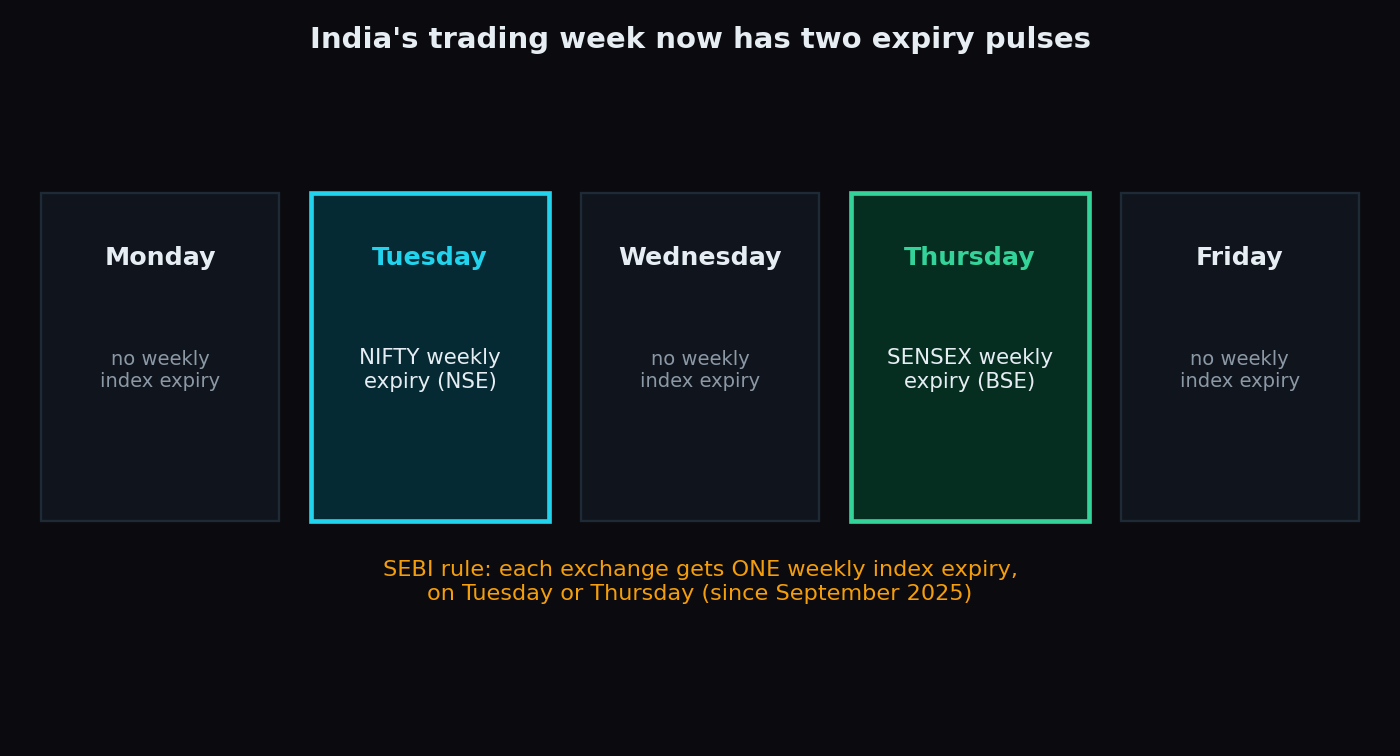
India's trading week now has two option expiry days. Nifty weekly options expire every Tuesday on the NSE. Sensex weekly options expire every Thursday on the BSE. If some sessions feel calm while others feel like the final over of a cricket match, expiry is usually the reason. This post explains what expiry day is, why India ended up with two of them, and what our own scored data says about how each one behaves.
What "expiry day" actually means
An option is a contract with a built-in deadline. It gives its owner a claim on an index level — for example, the right to the amount by which Nifty finishes above 25,000 — but only until a fixed date. That date is the expiry. After the closing bell on expiry day, the contract stops existing.
Think of an option like a movie ticket for one specific show. Before showtime it has value: you can use it or pass it on. Once the show ends, it is either used or it is waste paper. There is no "later".
A worked example with round numbers. Say you own a Nifty 25,000 call — the right to the upside above 25,000 — and today is expiry Tuesday.
- If Nifty closes at 25,150, the contract settles at 150 points of value. Index options in India are cash-settled: the difference is paid in cash, and no shares change hands.
- If Nifty closes at 24,900, the 25,000 call settles at zero. All of its remaining value disappears at the close.
New to option tables? Our explainer on how to read an option chain covers strikes, premiums and open interest step by step.
Why Tuesday and Thursday?
It was not always this tidy. By 2024, India had a weekly index expiry on almost every day of the week — Bank Nifty, FinNifty, Midcap Nifty and Bankex each had their own day alongside Nifty and Sensex. Every session was somebody's expiry, and expiry-day option activity exploded.
The regulator stepped in twice:
- October 2024: SEBI limited each exchange to one weekly index expiry. From late November 2024, the weekly contracts on Bank Nifty, FinNifty, Midcap Nifty and Bankex were discontinued (their monthly contracts continue). Only Nifty and Sensex kept weekly options.
- 2025: SEBI standardised index expiries to Tuesday or Thursday so the two exchanges stay spaced apart. NSE chose Tuesday for Nifty; BSE chose Thursday for Sensex. The change took effect from September 2025. Monthly contracts follow the same day — Nifty monthlies expire on the last Tuesday of the month, Sensex monthlies on the last Thursday.
What actually changes on expiry day
Three things make the expiring index behave differently on its day.
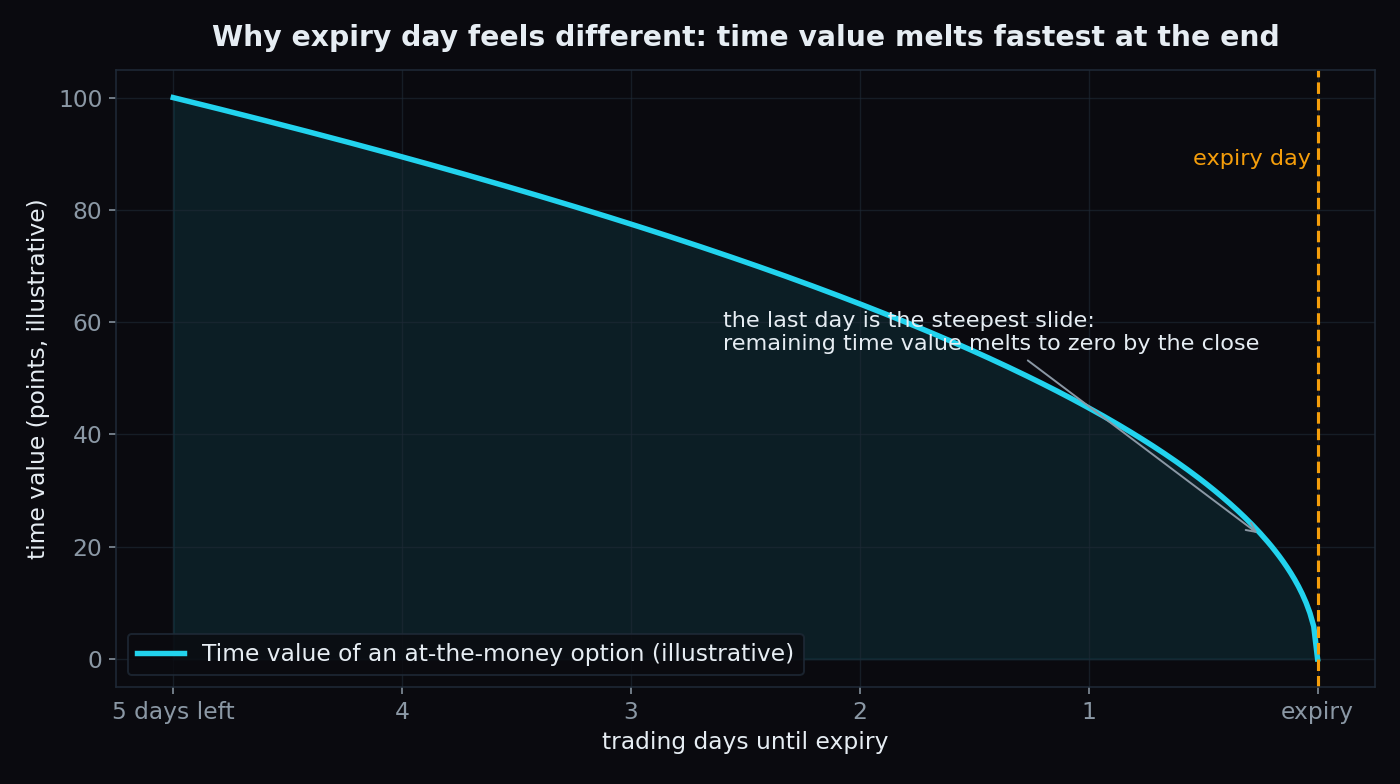
1. Time value melts to zero by the close
An option's price has two parts: real, in-the-money value, and "time value" — the extra amount people pay for what might still happen before the deadline. Time value behaves like an ice cube on a counter. It melts slowly at first, then faster, and on expiry day whatever is left melts to nothing by 15:30. This decay is called theta; we unpack it in option theta explained.
2. Prices near the money become jumpy
On expiry day, an option close to the current index level flips between "worth something" and "worth nothing" on small index moves. A 30-point wiggle in Nifty can double a near-the-money option or halve it. This sensitivity is called gamma, and it peaks in the final hours. It is why expiry afternoons can feel like the market has had too much coffee.
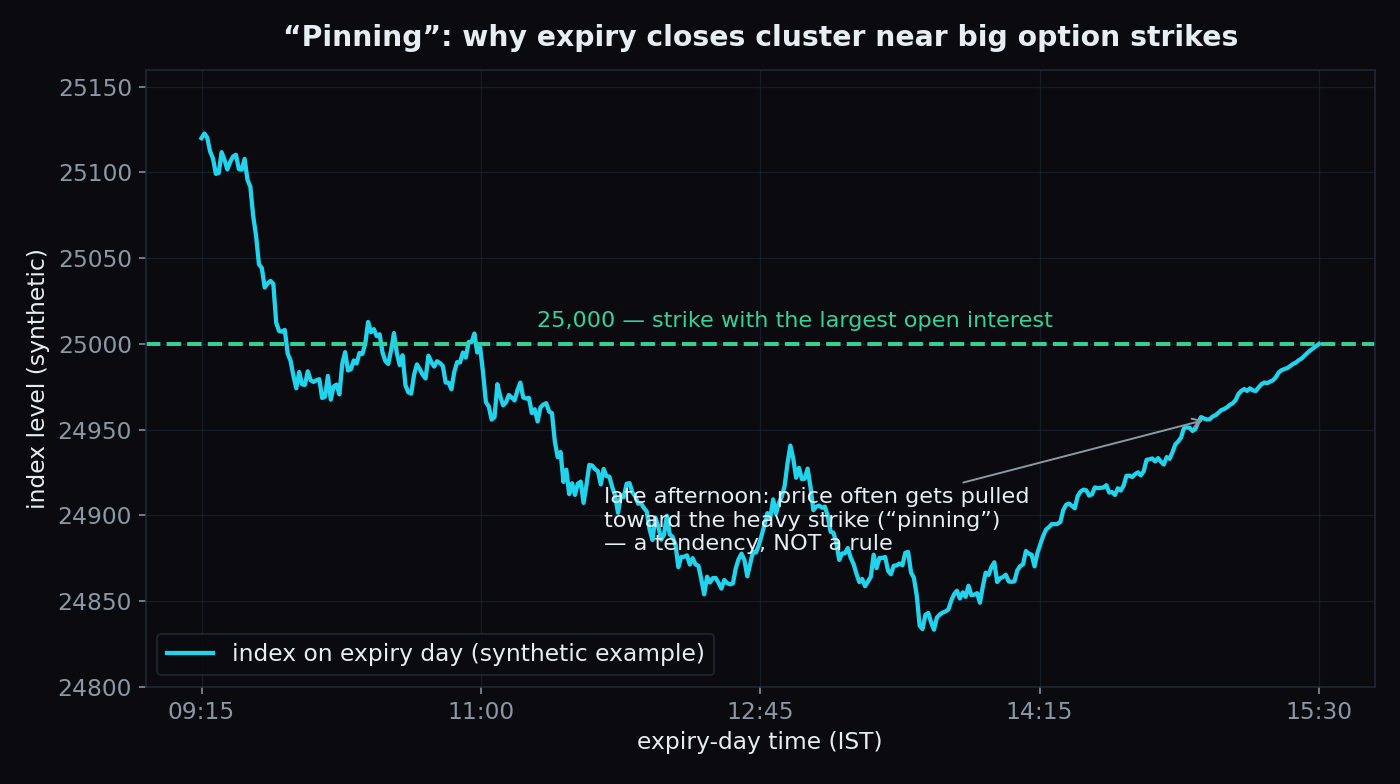
3. Heavy strikes can act like magnets
Strikes with very large open interest — the count of contracts still open — sometimes pull the index toward them late in the day, a pattern called pinning. The related idea of a single "max pain" level, the strike where option owners as a group end up worst off, is explained in max pain theory. The pull shows up in data, but it is a tendency, not a rule.
Nifty Tuesday vs Sensex Thursday: what our data shows
TrueTrend snapshots the option chain at around 09:30 IST every session, computes the day's key levels from it, and then scores those levels against how the day actually closed — counting every miss. The full method and live numbers are on our public scoreboard. As of early July 2026:
- Max-pain pinning: Nifty closed within one strike of its morning max-pain level in 40% of scored sessions (n=55). Sensex did so in only 13% of sessions (n=55).
- Option walls: Nifty's largest call-side wall held when touched 73% of the time (n=15) and its put-side wall 72% (n=18). Sensex walls held 64% (n=11) on the call side and 62% (n=13) on the put side.
Two honest notes before you read too much into the gap. First, these figures cover every scored session, not just expiry days, and the samples are still small. Second, "within one strike" is a stricter test for Sensex than for Nifty: Sensex trades at roughly 3.3 times Nifty's level, but its strikes are only twice as far apart (100 points versus 50). One Sensex strike is therefore a smaller percentage band, so Sensex has a tighter bullseye to hit.
Key takeaway: even on Nifty, the index finished within one strike of max pain in 40% of sessions (n=55) — less than half the time. Pinning is gravity, not destiny. Anyone presenting it as a certainty is not showing you their misses.
The mid-week hand-off
Because the two expiries sit two days apart, the week now has a rhythm. Tuesday is Nifty's big day. Wednesday is a hand-off: a fresh weekly Nifty contract starts its life with a full week of time value, while Sensex options enter their final stretch. Thursday belongs to Sensex. Friday and Monday are the quietest days for weekly expiry mechanics — time decay still runs, but no weekly index contract is in its last hours.
For a beginner, the practical reading is simple: expect the expiring index's options to be the most active, and the most jumpy, on their own day.
The honest catch
- Small samples. Our scored history is 55 sessions per index so far. These percentages will move as the archive grows — that is exactly why we publish them live instead of freezing a flattering number.
- All sessions, not only expiries. The pinning and wall figures above are scored every session. Expiry-day-only samples are smaller still, so treat day-specific claims with extra care.
- Rules keep changing. India's expiry calendar changed several times between 2023 and 2025 and can change again. Check the exchange circulars for current contract details.
- Magnets sometimes fail loudly. When the index breaks away from heavy strikes on expiry afternoon, option writers rushing to cover can make the move faster, not slower.
Expiry structure is much easier to follow when you can see it in one place. TrueTrend turns each morning's option positioning — walls, max pain, market regime — into a clear, at-a-glance read across Nifty, Bank Nifty and Sensex, and it scores its own hit-rates in public, misses included. Create a free account and see today's picture before the next expiry.
See these concepts on live market data — free
Create a free TrueTrend account to watch daily support/resistance levels, market regime, and option-positioning charts on NIFTY, BankNifty and 12 more instruments. Every level we publish is scored on a public scoreboard — misses included. No card required.
Free forever tier · daily levels with published hit-rates across every instrument. Descriptive market structure, not investment advice.
Not ready for an account? Get the daily levels by email.
One short email each market day — the indices' call wall, put wall, gamma flip and max pain, and how the last session's levels scored. Free, no account, unsubscribe anytime.
Descriptive market structure, not investment advice. We never share your email.