Index Rebalancing: What Happens When a Stock Enters or Exits the Nifty
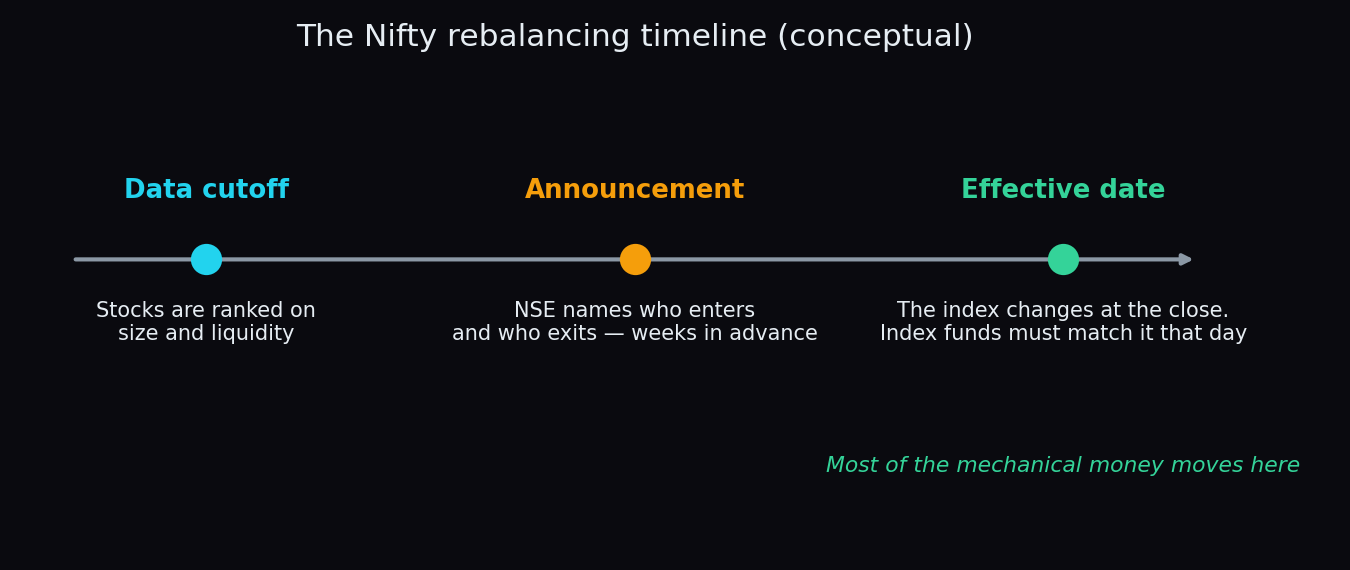
Twice a year, the Nifty 50 quietly changes its team. A stock that grew big enough gets added; one that fell behind is dropped. On the day the change takes effect, the entering stock can trade several times its normal daily volume — not because anything happened to the business, but because thousands of crores of index-fund money must move on that one date. Here is how the whole process works, in plain language.
First, a quick refresher: what is the Nifty 50?
A stock market index is a shortlist of companies used to represent the whole market. The Nifty 50 is the NSE's flagship shortlist: 50 of the largest, most traded companies in India, combined into one number you see on every news channel.
Think of it like a school's first cricket team. There are only 50 places, and the places are fixed. Nobody can join the team unless someone leaves it. And here is the twist that matters for prices: lakhs of investors do not just watch this team — they photocopy it. Index funds and ETFs hold exactly the stocks on the list, in exactly the listed weights. When the list changes, every photocopy must change too.
What is index rebalancing?
Index rebalancing (also called index reconstitution) is the periodic review where the index provider updates the list: which stocks are in, which are out, and how much weight each one gets. A stock joining the index is called an inclusion or entry; a stock removed is an exclusion or exit. The date the new list starts applying is the effective date.
Rebalancing is not a judgement about which company is "good" or "bad". It is rule-following: the index is defined as the top companies by certain measurable criteria, so when the ranking changes, the list must change with it.
Who decides, and when?
The Nifty indices are maintained by NSE Indices Limited, an NSE group company. The process is rules-based, not a committee's opinion of a stock's prospects. The main screens are:
- Size — measured by free-float market capitalisation. "Free-float" means only the shares actually available for public trading are counted, not the promoters' locked-in holdings.
- Liquidity — the stock must trade easily, with enough volume that large orders do not violently move the price. (New to the term? Start with what liquidity means in markets.)
- Eligibility rules — for the Nifty 50, the stock must also be available in the derivatives (F&O) segment, among other criteria.
The list is reviewed twice a year, and the outcome is announced a few weeks before it takes effect — so the market knows well in advance who is entering and who is leaving. On the effective date, the change applies from the close of trading.
Why one date moves real money
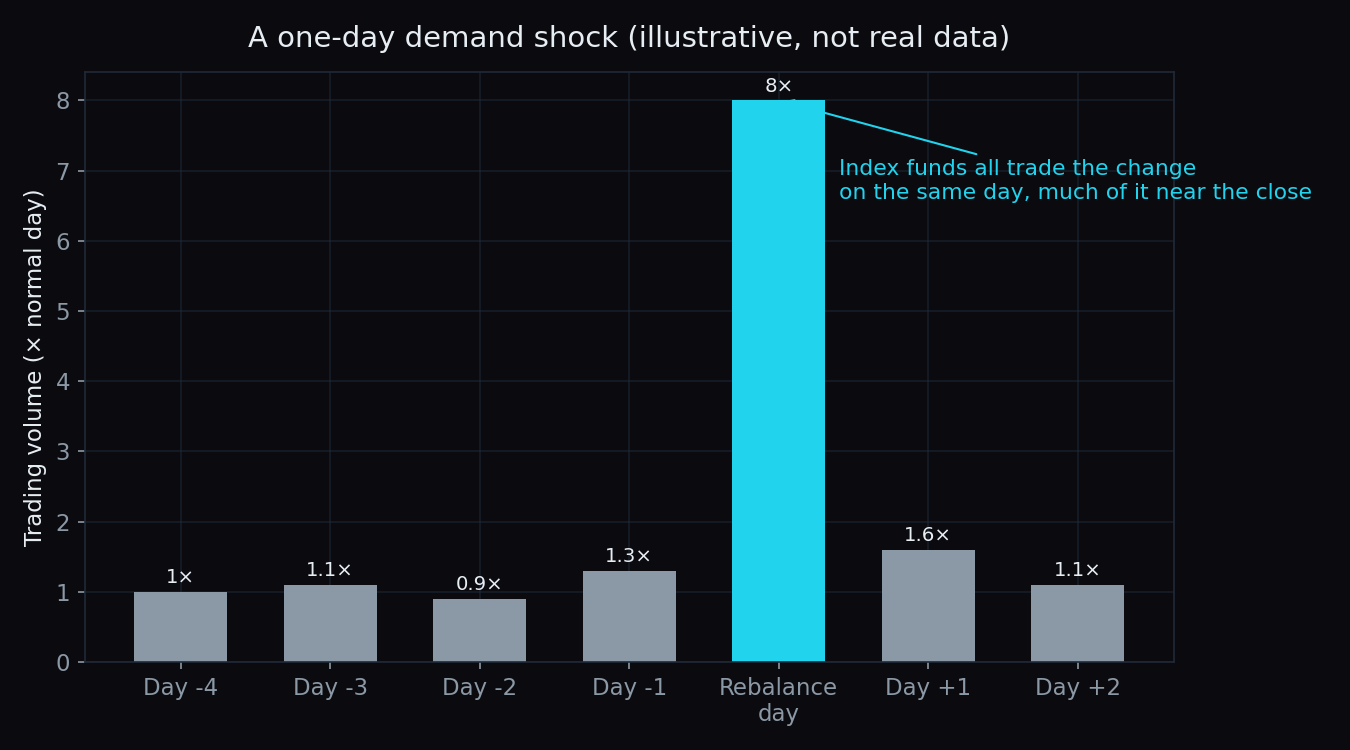
Here is where a paperwork change becomes a market event. Index funds and ETFs promise to mirror the index as closely as possible. Their job is not to have opinions; it is to match the list. So when the list changes on the effective date, every tracking fund must add the entering stock and offload the exiting one — on that day, and mostly near the close, because funds are judged against the index's closing values.
This demand is mechanical and price-insensitive. The funds are not asking "is this stock worth it at this price?" They are asking "does my portfolio match the list?" That is why volumes explode on rebalance day: a large chunk of the stock's ownership changes hands purely for tracking reasons.
A worked example in round numbers
Say index funds tracking the Nifty 50 hold ₹4,00,000 crore in total (a made-up round number to keep the maths easy). A new stock enters the index with a 1% weight.
- Every tracking fund must now hold 1% of its money in that stock.
- 1% of ₹4,00,000 crore = ₹4,000 crore of required purchases.
- If the stock normally trades ₹500 crore a day, that is eight normal days of demand landing mostly in a single session.
The exit is the mirror image: funds must offload the leaving stock's entire weight the same way. Neither flow says anything about the companies' earnings — it is the photocopiers updating their copies.
What usually happens to the price
Because the announcement comes weeks early, traders do not wait for the effective date. The classic pattern looks like this:
- After the announcement: the entering stock often drifts up, as traders position ahead of the index funds they know must purchase later.
- On the effective date: volume spikes, with heavy activity in the closing session as funds complete the switch.
- After the effective date: the one-time demand is gone, and the entering stock often cools off or gives back part of the run-up. Exiting stocks sometimes see the reverse: pressure into the date, then a relief bounce once the forced supply is done.
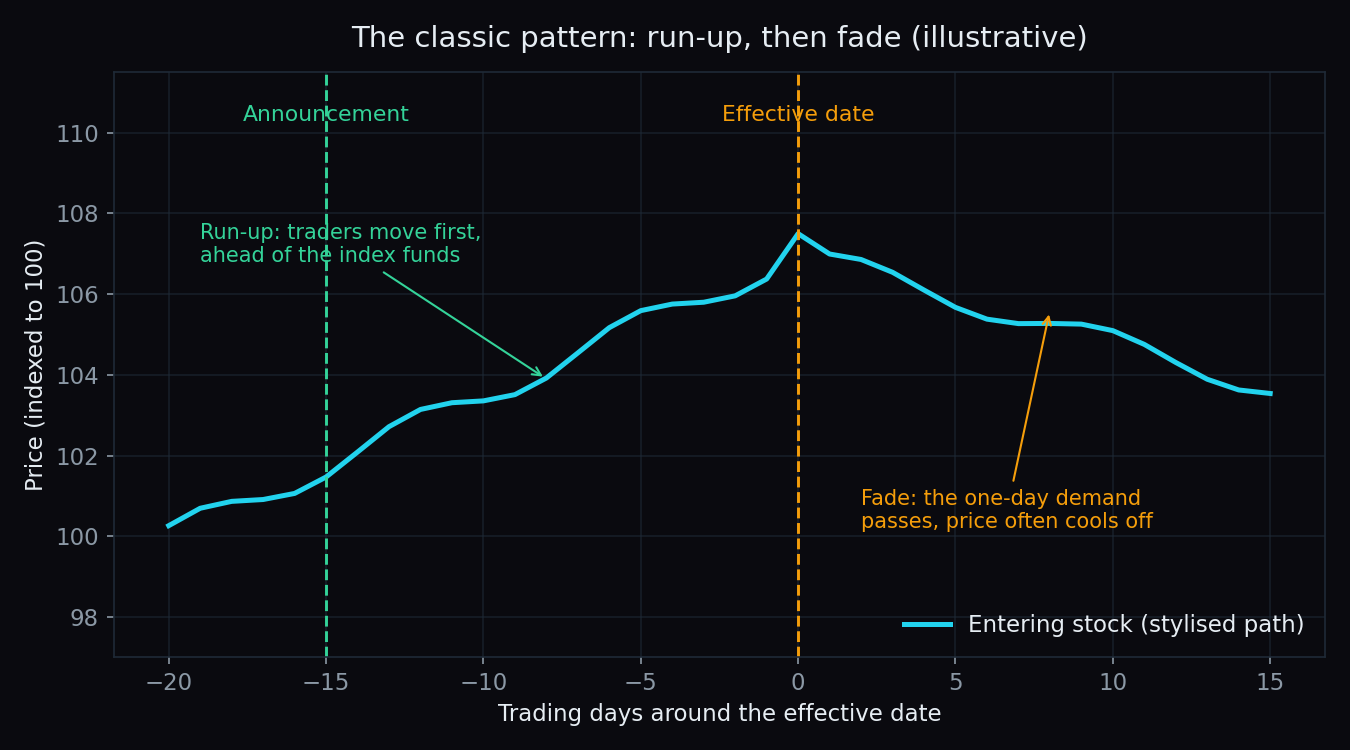
Index entry changes a stock's ownership, not its earnings. The demand around the effective date is real, but it is one-time — once every photocopy matches the new list, the flow is over.
The honest catch
Three things to keep you grounded:
- Everyone can see it coming. The rules are public and the announcement is weeks early, so the move is often priced in before the effective date. Studies of index inclusions in several markets suggest the effect has shrunk over the years as more traders anticipate it. The pattern above is a tendency, not a law — plenty of inclusions fade early or never run at all.
- Entry is not a quality medal. Stocks usually enter after a long stretch of outperformance — sometimes near their peak — and exit after a long slide, sometimes near their bottom. The index follows performance; it does not predict it.
- If you own an index fund, there is nothing to do. The fund handles the switch automatically. Rebalancing is mainly a market-structure event worth understanding, not a to-do item for long-term investors.
Rebalance weeks are exactly when the F&O tape gets noisy. TrueTrend turns Nifty, Bank Nifty and F&O positioning into one clear, at-a-glance read — and it scores its own track record in public. Create a free account to see today's picture.
See these concepts on live market data — free
Create a free TrueTrend account to watch daily support/resistance levels, market regime, and option-positioning charts on NIFTY, BankNifty and 12 more instruments. Every level we publish is scored on a public scoreboard — misses included. No card required.
Free forever tier · daily levels with published hit-rates across every instrument. Descriptive market structure, not investment advice.
Not ready for an account? Get the daily levels by email.
One short email each market day — the indices' call wall, put wall, gamma flip and max pain, and how the last session's levels scored. Free, no account, unsubscribe anytime.
Descriptive market structure, not investment advice. We never share your email.