REITs and InvITs Explained: Owning Real Estate and Infrastructure Through the Market
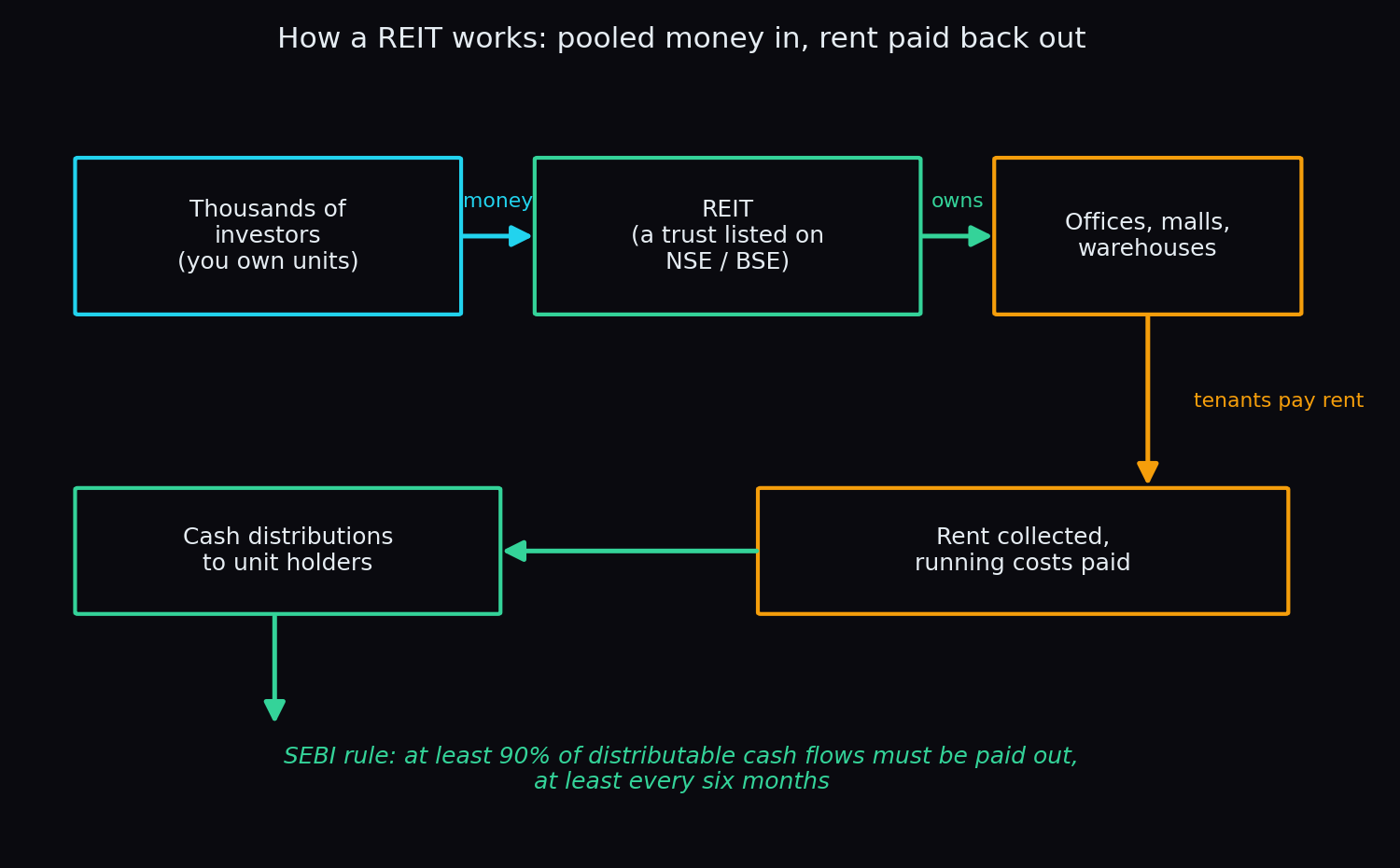
A single office tower in a big-city business district can cost more than ₹1,000 crore. A REIT unit that owns a slice of towers like that trades on the NSE for a few hundred rupees. That is the whole idea: REITs and InvITs take giant, illiquid assets — offices, malls, highways, power lines — and split their ownership into small units anyone can hold in a demat account.
What is a REIT?
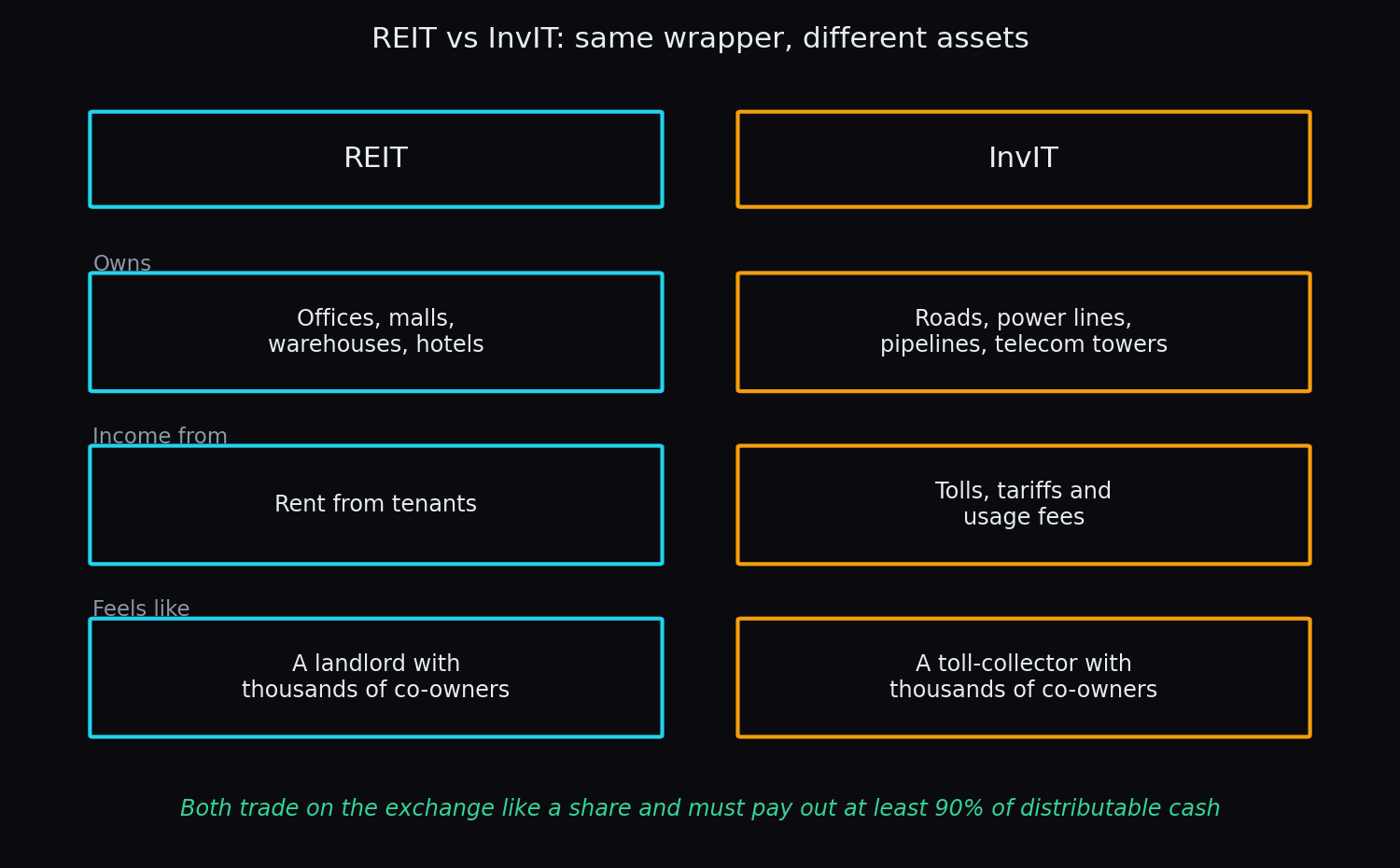
REIT stands for Real Estate Investment Trust. It is a trust, listed on the stock exchange, that owns income-producing property — mostly offices, but also malls, warehouses and hotels. Tenants pay rent to the trust. After running costs, that rent flows back to the people who hold the trust's units.
The easiest analogy: a REIT is like a mutual fund, except instead of holding shares, the fund holds buildings. You don't own one flat or one office; you own a tiny piece of a large portfolio of them, and you collect your share of the rent without ever chasing a tenant or fixing a leaking tap.
India's REIT framework came from SEBI's REIT Regulations in 2014, and the first one — Embassy Office Parks REIT — listed in 2019. Since then names like Mindspace Business Parks, Brookfield India Real Estate Trust and Nexus Select Trust (which owns malls) have joined the exchange.
What is an InvIT?
InvIT stands for Infrastructure Investment Trust. Same wrapper, different assets. Instead of offices, an InvIT owns operating infrastructure: toll roads, power transmission lines, gas pipelines, telecom towers. Instead of rent, the cash comes from tolls, tariffs and usage fees.
If a REIT makes you a part-landlord, an InvIT makes you a part toll-collector. Every truck that crosses a toll plaza, every unit of electricity that moves across a transmission line owned by the trust, feeds the pool of cash that gets paid out to unit holders. India's first listed InvIT arrived in 2017, and the space now includes power-transmission trusts like IndiGrid and road trusts built from national highway portfolios.
How do you actually earn?
Two ways, and it helps to keep them separate in your head:
- Cash distributions. This is the trust paying out its share of rent or tolls, usually every quarter. It is similar in spirit to a dividend, though the payout arrives in parts (interest, dividend, sometimes a return of your capital) that are taxed differently.
- Unit price movement. Units trade on the exchange all day, like any share or ETF. If the market values the trust's assets higher over time, the unit price can rise. It can also fall.
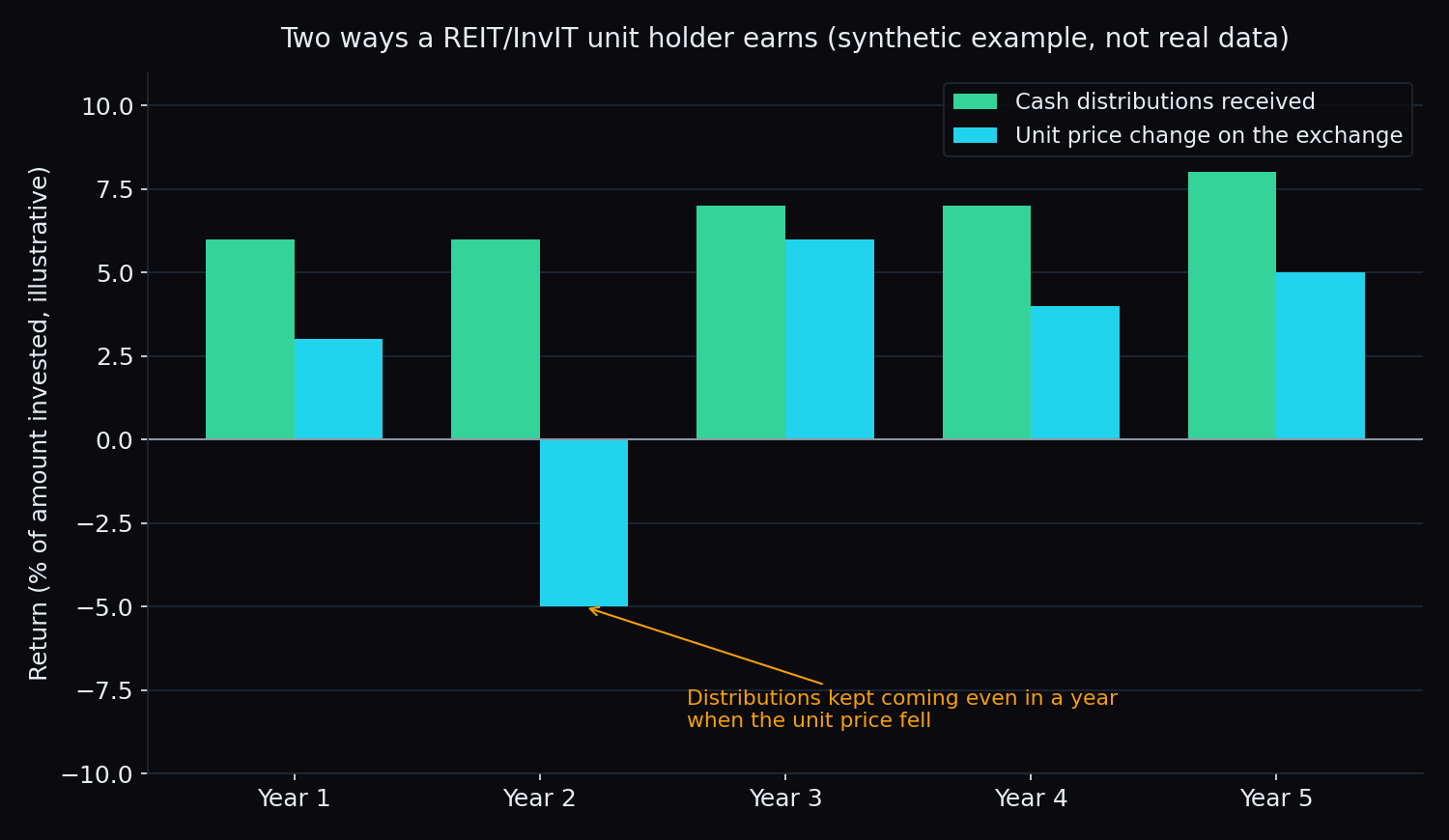
Notice the pattern in the chart above (synthetic numbers, drawn only to explain the idea): distributions tend to be the steadier leg, because rent agreements and toll concessions run for years. The unit price is the moodier leg — it moves with interest rates, occupancy news and overall market sentiment.
A worked example with simple numbers
Say you put ₹10,000 into a REIT at ₹100 per unit, so you hold 100 units. Over the year, your units' share of the rent collected works out to ₹1,000.
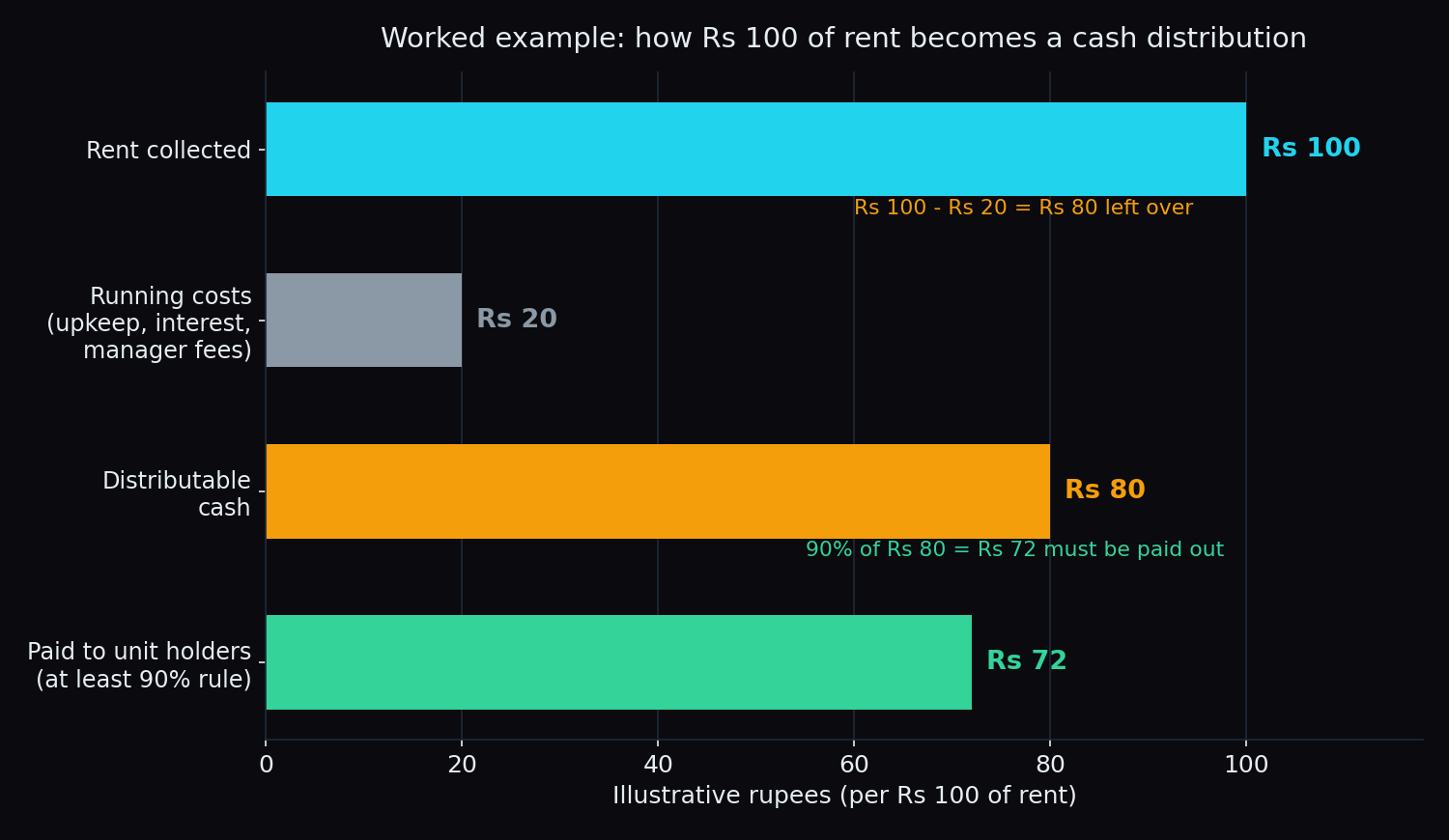
- Rent attributable to your units: ₹1,000
- Running costs (upkeep, interest on the trust's loans, manager fees): ₹200
- Distributable cash left over: ₹800
- SEBI requires at least 90% of that to be paid out: ₹720 or more reaches you
That ₹720 on your ₹10,000 is a 7.2% cash yield in this illustration. Real yields vary from trust to trust and year to year — treat the arithmetic as the lesson here, not the specific number. And remember the second leg: while you collected that cash, the unit price itself may have moved up or down.
The rules that shape these trusts
SEBI wrote guardrails into the framework, and they explain why REITs and InvITs behave differently from ordinary property companies:
- Mostly finished assets. At least 80% of a REIT's value must sit in completed, income-producing property — not under-construction projects.
- The 90% payout rule. At least 90% of distributable cash flows must be paid to unit holders, at least once every six months. The trust cannot quietly hoard the rent.
- A leverage cap. Borrowings are capped relative to asset value (with extra conditions once debt crosses lower thresholds), which limits how aggressively a trust can load up on loans.
- Small ticket size. After SEBI's 2021 reforms, units trade in lots of one — so a few hundred rupees is genuinely enough to start, versus lakhs for a real flat.
The honest catch
None of this makes REITs or InvITs a fixed deposit. The risks are real:
- Unit prices fall. When interest rates rise, the steady payouts of these trusts look less special next to bonds, and unit prices often drift down. Listed REITs have seen long stretches below their issue price.
- The income is not promised. Offices can sit vacant, tenants renegotiate, toll traffic can disappoint. Distributions shrink when the underlying cash does.
- Concessions end. Many InvIT assets are concessions — the right to collect tolls for a fixed number of years. Part of your payout can be your own capital coming back, not pure profit.
- Tax is messy. One payout can carry three or four components, each taxed its own way. The trust publishes the break-up; reading it matters.
- A shallow pool. India has only a handful of listed REITs and InvITs, so you are choosing from a short menu, and each trust is concentrated in one asset type.
Key takeaway: a REIT or InvIT converts rent and tolls into an exchange-traded cash flow. You earn from distributions and from unit price moves — the first is steadier, the second is not, and neither is promised.
Where they fit in the bigger picture
For most people, these trusts sit in the slow, income-focused corner of a portfolio — a way to add property and infrastructure exposure without the lumpiness of physical assets, alongside the equity and debt you may already hold through funds. They also respond to the same macro forces as the rest of the market: rate expectations, credit conditions and risk appetite — the same forces that show up in how interest rates move stock markets broadly.
Markets reward people who can see structure clearly. TrueTrend turns live Nifty, Bank Nifty and F&O positioning into a clear, at-a-glance read — and scores its own track record in public. Create a free account to see it.
See these concepts on live market data — free
Create a free TrueTrend account to watch daily support/resistance levels, market regime, and option-positioning charts on NIFTY, BankNifty and 12 more instruments. Every level we publish is scored on a public scoreboard — misses included. No card required.
Free forever tier · daily levels with published hit-rates across every instrument. Descriptive market structure, not investment advice.
Not ready for an account? Get the daily levels by email.
One short email each market day — the indices' call wall, put wall, gamma flip and max pain, and how the last session's levels scored. Free, no account, unsubscribe anytime.
Descriptive market structure, not investment advice. We never share your email.