STT on Expiry: What Really Happens to Your ITM Options
An option that is “in the money” at the close on expiry day does not simply vanish. The exchange exercises it for you, the cash difference lands in your account, and a small tax called STT is charged on the way out. For years that last step hid a nasty trap that could turn a winning option into a loss. Today it costs a few rupees per lot. Here is exactly what happens, step by step, with round numbers.
Three terms, defined once
- ITM (in the money): a call whose strike is below the current index level, or a put whose strike is above it. An ITM option has real cash value, called intrinsic value. The other states are at-the-money and out-of-the-money (OTM) — see option moneyness explained.
- Exercise: converting the option into its cash value. For index options such as Nifty, Bank Nifty and Sensex this is a pure cash entry — no shares change hands.
- STT (Securities Transaction Tax): a central-government tax charged on trades done on an Indian exchange. The rate depends on what you trade and which side of the trade you are on. It is one of several charges covered in the real cost of one trade.
What actually happens at 3:30 pm
Think of an ITM option on expiry day as a gift voucher with a date printed on it. You can spend it in the shop any time before closing (square off the option on the exchange). If you do nothing, the issuer does not let it rot: at closing time it credits you the voucher’s face value automatically, minus a tiny processing charge. A voucher worth nothing just disappears.
- Trading in the expiring contract stops at the close.
- The exchange works out the final settlement price. For Nifty and Bank Nifty this is the closing value of the index, which NSE calculates as the weighted average of the index over the last 30 minutes of trading — not the last tick on your screen.
- Every contract that is ITM against that settlement price is exercised automatically. No instruction from you is needed, and for index options no instruction can stop it.
- The holder receives the intrinsic value in cash: (settlement price minus strike) for a call, (strike minus settlement price) for a put, times the lot size. The option writer on the other side pays it.
- STT is charged to the holder on that exercised value. OTM contracts simply expire worthless, and there is no STT on a worthless expiry.
Where the STT lands: square-off vs exercise
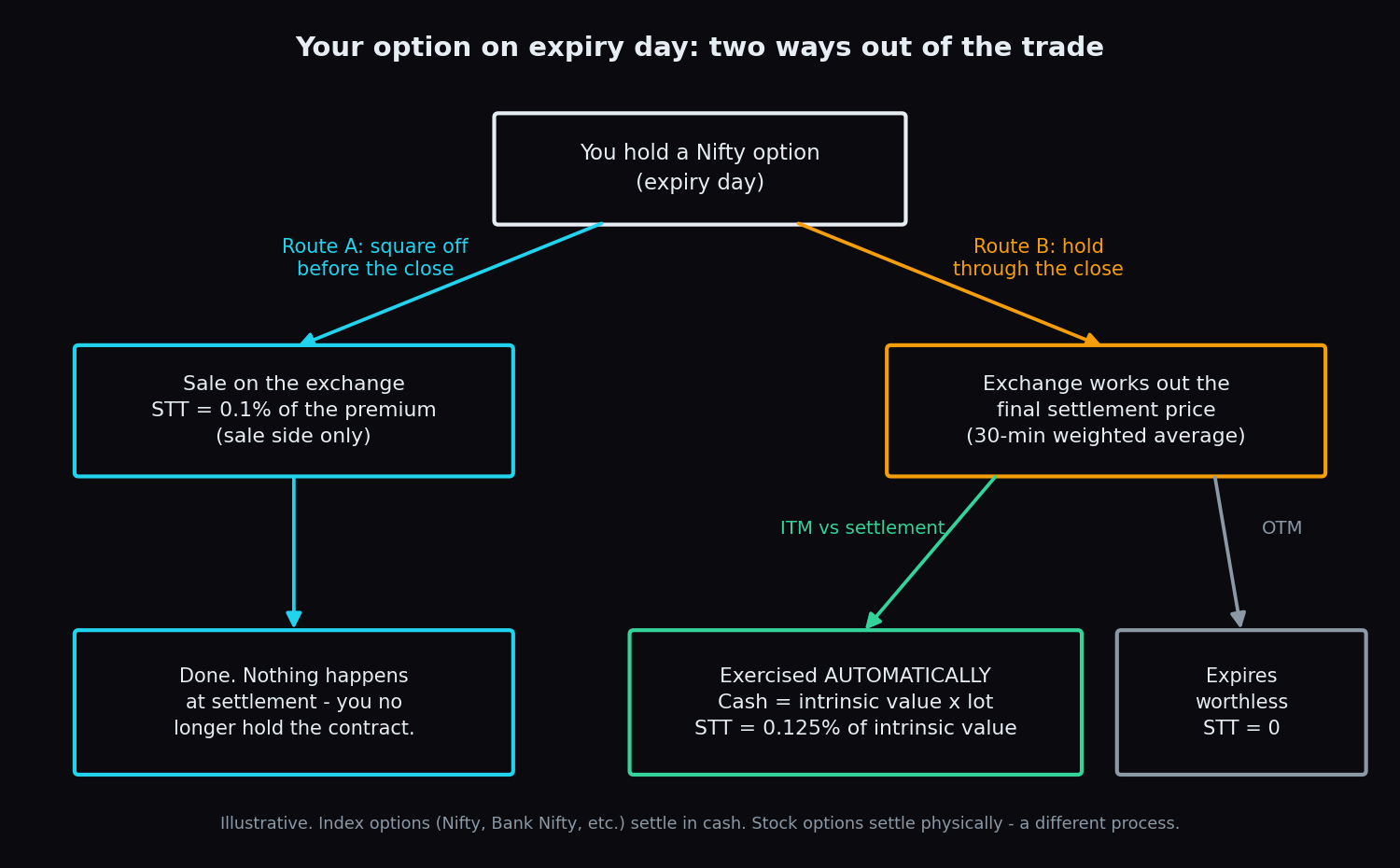
There are two ways out of an option on expiry day, and STT is charged differently on each (rates as of writing; Union Budgets change them from time to time, and your contract note is the final authority):
- Route A — square off before the close. STT on options is charged on the sale side only, on the premium. The current rate is 0.1% of the premium (it was 0.0625% until it was raised in October 2024). The purchase leg carries no STT.
- Route B — hold, and let it be exercised. An exercised option is charged STT at 0.125% of its intrinsic value, paid by the holder. Not on the premium, and not on the full index value — only on the cash you actually receive.
A worked example with round numbers
Say Nifty’s final settlement price on expiry day comes to 25,100, you hold one 25,000 call, and the lot size is 65 units (lot sizes change; check the contract specification).
- Intrinsic value = 25,100 − 25,000 = 100 points, so the contract is worth 100 × 65 = Rs 6,500 per lot.
- Route A: you square off at Rs 100 a minute before the close. Sale value Rs 6,500; STT = 0.1% × 6,500 = Rs 6.50, plus your broker’s usual brokerage and charges on that trade.
- Route B: you hold. The contract is exercised for Rs 6,500; STT = 0.125% × 6,500 = Rs 8.13.
The gap between the two routes is under Rs 2 per lot. On the tax alone, the choice barely matters any more. What does still matter is further down.
The old trap (and why traders still fear it)
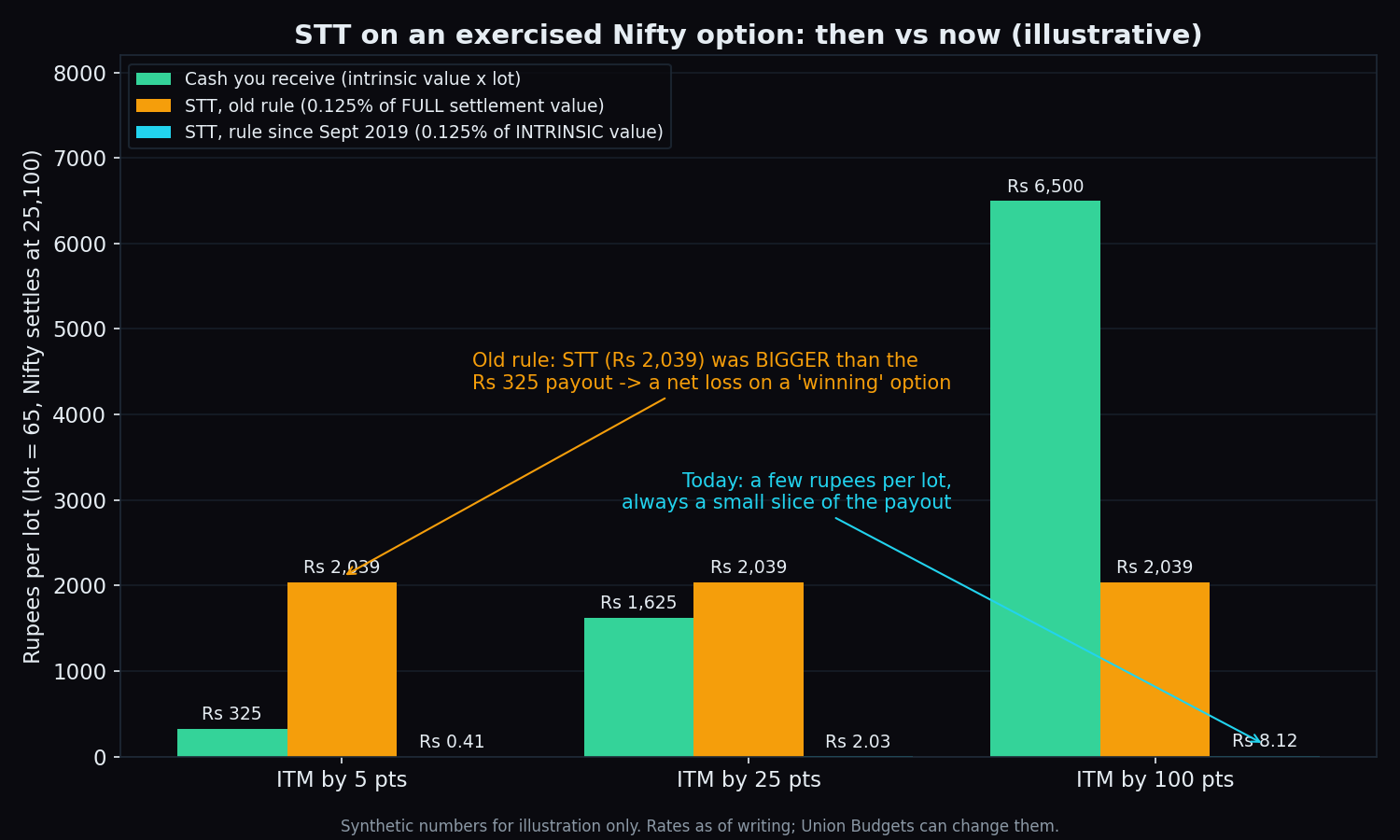
Until 31 August 2019, STT on an exercised option was charged at 0.125% of the entire settlement value of the contract — the full index level times the lot — not of the intrinsic value. Run the same example under that rule: 0.125% × 25,100 × 65 = Rs 2,039 per lot, and that figure was the same whether the option was ITM by 100 points or by 1 point.
So a call that finished just 5 points in the money was worth 5 × 65 = Rs 325, yet was charged about Rs 2,039 of STT on exercise. The “winning” option produced a net loss of roughly Rs 1,700 per lot, and across many lots that became a very large bill. That is the STT trap, and it caught real traders. Brokers responded by force-squaring-off marginally ITM positions in the last minutes, and the exchange allowed holders of close-to-the-money contracts to file “do not exercise” instructions.
The Finance (No. 2) Act, 2019 changed the base to intrinsic value from 1 September 2019. With the penalty gone, NSE moved to automatic exercise of every ITM index contract, which is the regime in force today. The fear lingers in older forum threads; the arithmetic behind it does not.
The real catch: ITM on your screen, OTM at settlement
Because index settlement uses a 30-minute weighted average, the number that decides whether your option is exercised is not the last traded level. Suppose Nifty prints 25,012 at 3:29:59 pm. Your 25,000 call looks 12 points in the money. But if the index spent most of the last half hour below 25,000, the weighted average might come to 24,996 — and at that settlement price the call is OTM. It expires worthless. No cash, no STT, and no way to change the outcome after the close.
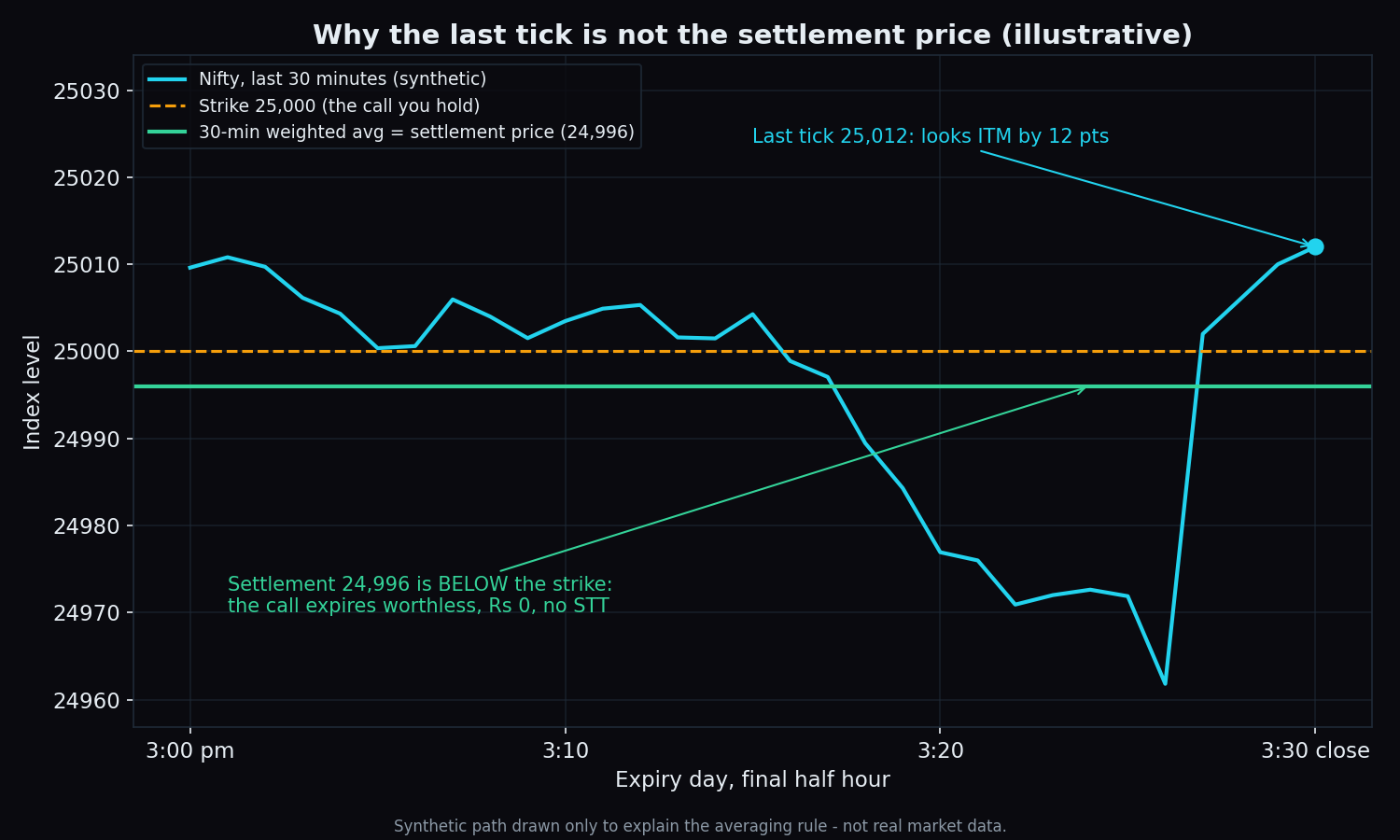
The reverse happens too: an option that looks just OTM at the last tick can settle ITM and get exercised. The closer the index sits to a strike in the final half hour, the more the averaging rule matters. A bought-and-held contract near the strike is therefore a coin whose face is revealed only after the bell — which is the most useful thing to understand about expiry, and it has nothing to do with tax.
Key takeaway: today STT on an exercised index option is 0.125% of what you receive — a few rupees per lot, not a trap. The bigger expiry-day risk is the settlement arithmetic: the final price is a 30-minute average, so a contract that is marginally ITM on the last tick can settle OTM, and vice versa.
Things that are not STT but get blamed on it
- Broker charges on exercise. Some brokers levy a flat fee per exercised contract; others charge nothing. This line often exceeds the STT itself. Check your broker’s charge sheet rather than assuming.
- The spread in the last minutes. Squaring off a deep ITM contract at 3:28 pm can mean crossing a wide bid–ask gap. That cost can dwarf the Rs 1–2 of STT difference between the two routes.
- Stock options are a different animal. ITM stock options settle physically: shares are delivered or taken, and STT applies at equity-delivery rates on the full value of those shares. The cash-settlement logic above is for index options only.
- Income tax on your profit is a separate matter entirely and is unaffected by which route you pick.
Quick reference (as of writing)
- Options squared off on the exchange: STT 0.1% of the premium, sale side only.
- Options exercised at expiry: STT 0.125% of intrinsic value, charged to the holder.
- Options expiring OTM: no STT.
- Futures: STT 0.02% of the contract value, sale side only.
- Index settlement price: the underlying index’s closing value, computed by NSE as the weighted average of the last 30 minutes. Expiry days themselves are covered in our expiry-day explainer.
Rates are set by the Union Budget and change occasionally; the contract note your broker sends you after each trade is the authority for what you were actually charged.
Expiry day is when positioning matters most, and it is hard to read from a raw option chain in real time. TrueTrend turns that structure into a clear, at-a-glance read across Nifty, Bank Nifty and the wider F&O universe, and scores its own track record in public. Create a free account to see the expiry picture laid out plainly.
See these concepts on live market data — free
Create a free TrueTrend account to watch daily support/resistance levels, market regime, and option-positioning charts on NIFTY, BankNifty and 12 more instruments. Every level we publish is scored on a public scoreboard — misses included. No card required.
Free forever tier · daily levels with published hit-rates across every instrument. Descriptive market structure, not investment advice.
Not ready for an account? Get the daily levels by email.
One short email each market day — the indices' call wall, put wall, gamma flip and max pain, and how the last session's levels scored. Free, no account, unsubscribe anytime.
Descriptive market structure, not investment advice. We never share your email.