What Is Short Selling? How It Works in India (SLB)
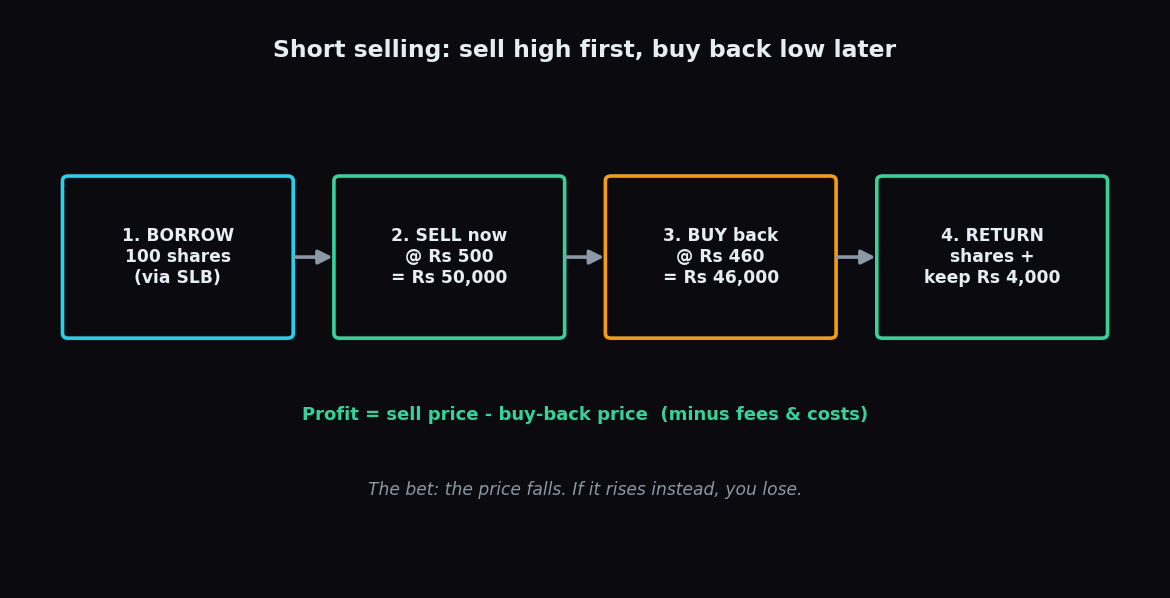
Imagine selling something for Rs 50,000 today that you don't actually own — then buying it back for Rs 46,000 next week and pocketing the Rs 4,000 difference. That is short selling: a way to try to profit when a price goes down instead of up. It sounds odd because normal investing is "buy low, sell high." Short selling just flips the order: sell high first, buy back low later.
What is short selling?
Short selling (or "going short") means selling shares you do not own, in the belief that the price will fall, so you can buy them back later at a lower price and keep the difference. To sell something you don't own, you first have to borrow it — and later return the same number of shares to whoever lent them.
Think of it like a cricket bat. A friend owns a bat worth Rs 500 that they aren't using this month. You borrow it, sell it to someone for Rs 500, and wait. If an identical bat later sells for Rs 460, you buy one, hand it back to your friend, and keep the Rs 40. You never owned a bat for long — you just rented one, sold high, and replaced it cheap. The small "rent" you pay your friend for the loan is the lending fee.
A worked example with round numbers: you short 100 shares at Rs 500, receiving Rs 50,000. The price drops and you buy the 100 shares back at Rs 460 for Rs 46,000, then return them. Your gross gain is Rs 4,000, before fees, brokerage and taxes. If instead the price had climbed to Rs 560, buying back would cost Rs 56,000 — a Rs 6,000 loss.
The rule that makes India different: no naked shorts
In India, short selling is legal and SEBI (the market regulator) permits it for all investors — retail and institutional alike. But there is one firm rule: naked short selling is not allowed. A "naked" short is selling shares you have neither bought nor arranged to borrow, with no way to deliver them. India requires that every sale can actually be settled with real shares.
That leaves two clean ways to be short in the cash (equity) market:
- Intraday short — you sell in the morning and buy back before the market closes the same day. Nothing needs to be delivered, so no borrowing is required. Retail traders can do this; the position must be squared off by day's end.
- Overnight short — to carry a short position past the close, you must deliver shares on settlement day. Since you don't own them, you have to borrow them first. That is exactly what the SLB mechanism is for.
One more distinction: large institutions must flag an order as a short sale upfront and generally cannot square off intraday the way a retail trader can. The disclosure rules are stricter the bigger you are.
SLB: how you borrow shares to short overnight
SLB stands for Securities Lending and Borrowing. It is a formal, on-exchange system where investors who own shares long term can lend them out for a fee, and short sellers can borrow them to deliver against a short sale. It is order-driven and screen-based, run through the exchanges' clearing corporations.
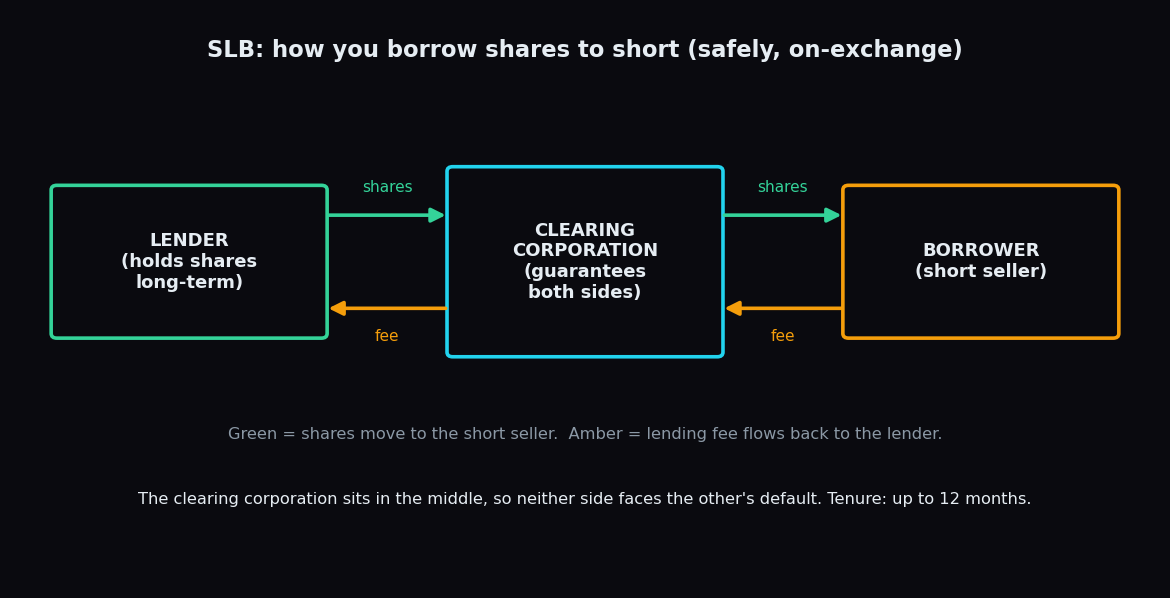
The key feature is the box in the middle. The clearing corporation acts as the central counterparty — it sits between lender and borrower and guarantees the trade. The lender never faces the borrower directly, so neither has to trust a stranger; the clearing corporation stands behind both sides. In plain terms:
- The borrower (short seller) pays a lending fee, quoted like an interest rate, decided by supply and demand for that stock.
- The lender earns that fee for parking otherwise-idle shares — and still gets them back at the end.
- Contracts are standardised, with a tenure of up to 12 months, and can be recalled or repaid early under the exchange's rules.
- Only stocks the exchanges declare SLB-eligible can be borrowed — typically the more liquid, F&O-traded names.
So the full overnight-short chain is: borrow via SLB → sell the borrowed shares → wait → buy them back → return them through SLB and pay the fee. If the stock fell, you keep the gap; if it rose, you cover the gap out of your own pocket.
The shortcut most F&O traders use
Here's a practical reality: a lot of Indian traders who want to bet on a fall never touch SLB at all. In the derivatives market you can take a bearish view without borrowing any shares, because a derivative is just a contract whose value tracks the underlying:
- Short a futures contract — you agree to deliver at today's price; if the index or stock falls, the contract gains. See futures vs options for how these differ.
- Buy a put option — a put rises in value as the underlying drops, and your loss is capped at the premium you paid. This is the same tool behind a protective put.
These routes are why index-level bearish positioning shows up in the open interest data long before it ever shows up as stock borrowing. Short selling the underlying via SLB is more common for single stocks; futures and puts dominate for Nifty and Bank Nifty.
The honest catch: the loss can be unlimited
Buying a share has a floor: the worst case is it goes to zero and you lose what you paid. Short selling is the mirror image, and the mirror is unkind. When you are short, your gain is capped (a price can only fall to zero) but your loss is unlimited (a price can, in theory, keep rising with no ceiling).
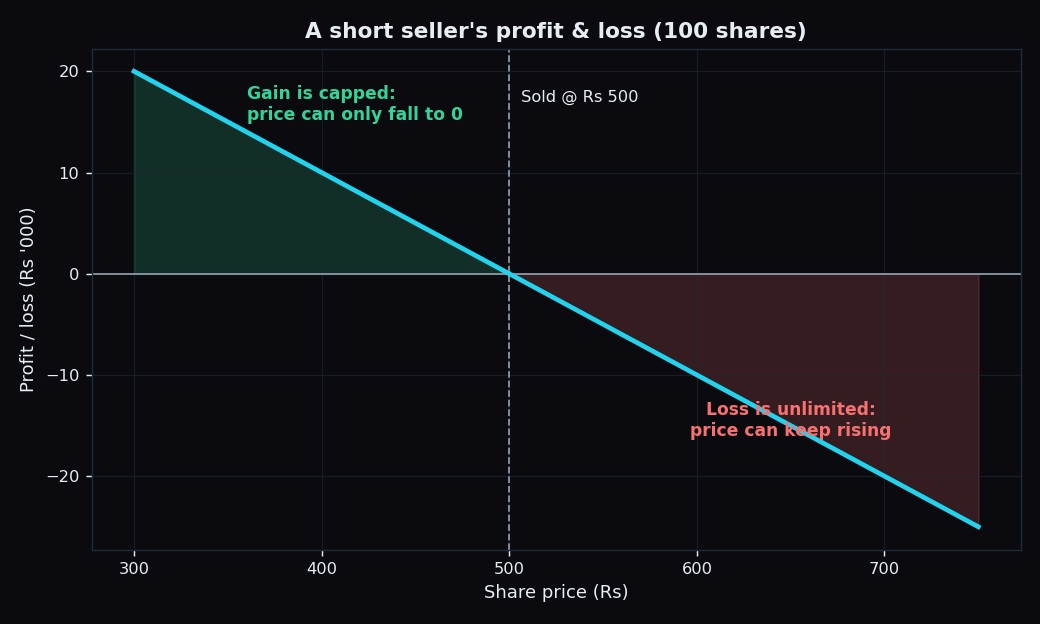
Three things can hurt a short in particular:
- Short squeeze — if a crowded short trade starts rising, many shorts rush to buy back at once, pushing the price up even faster and forcing more of them out.
- Margin calls — a rising position eats into your margin; if it runs against you, your broker can close it at an unfavourable price.
- Recall & fees — borrowed shares can be recalled, and if a stock is hard to borrow the lending fee climbs, quietly shrinking any profit.
Short selling isn't "buy in reverse." It is a borrow-first, deliver-later mechanism with capped upside and open-ended downside — which is precisely why India bans naked shorts and channels overnight shorts through the SLB system and a central counterparty.
Understanding short selling also sharpens how you read the market: heavy bearish positioning, rising put activity and shifting option walls are the footprints big players leave when they expect a fall.
TrueTrend turns that raw positioning into a clear, at-a-glance read across Nifty, Bank Nifty and F&O — where the walls sit and how the pressure is shifting — and scores its own track record in public. See the live Scoreboard or create a free account to follow the structure for yourself.
See these concepts on live market data — free
Create a free TrueTrend account to watch daily support/resistance levels, market regime, and option-positioning charts on NIFTY, BankNifty and 12 more instruments. Every level we publish is scored on a public scoreboard — misses included. No card required.
Free forever tier · daily levels with published hit-rates across every instrument. Descriptive market structure, not investment advice.
Not ready for an account? Get the daily levels by email.
One short email each market day — the indices' call wall, put wall, gamma flip and max pain, and how the last session's levels scored. Free, no account, unsubscribe anytime.
Descriptive market structure, not investment advice. We never share your email.