Cash-Secured Put Explained: A Simple Worked Example
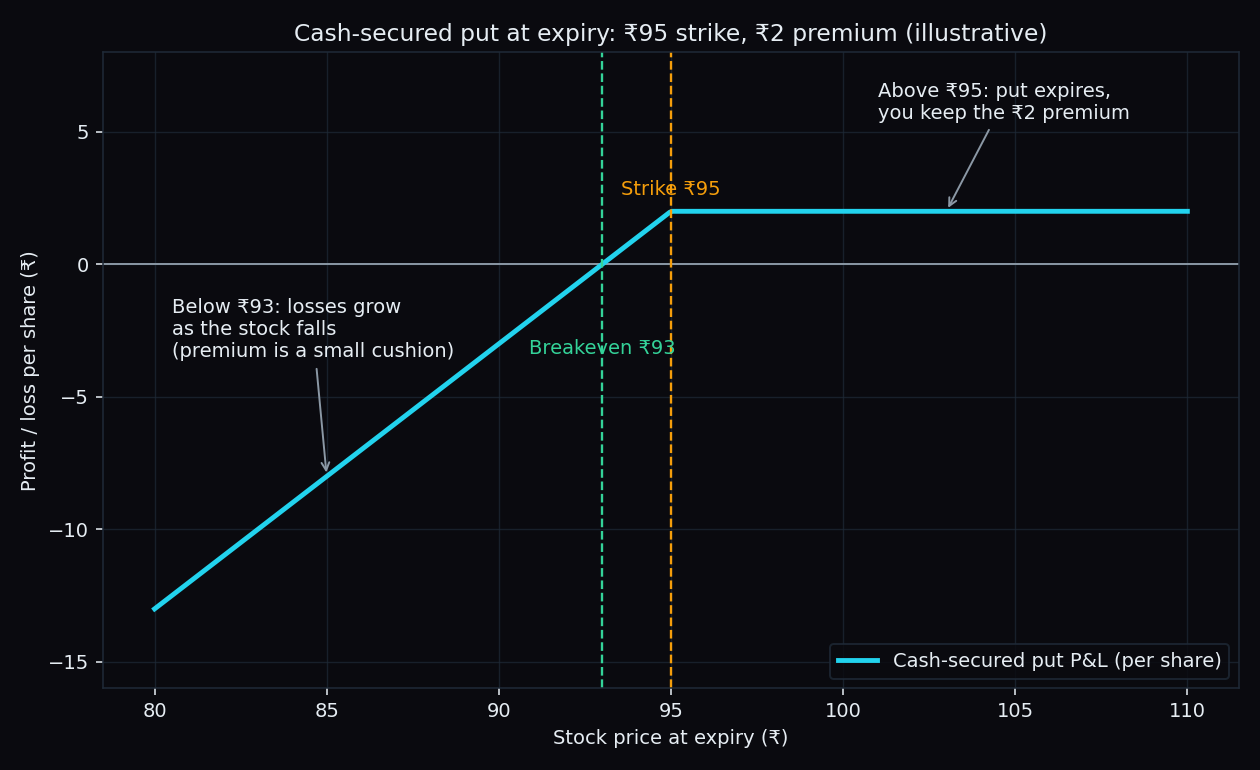
A cash-secured put is a promise to purchase a stock at a fixed price before a fixed date — made while you keep the full purchase amount parked in cash. For making that promise, you collect a small fee upfront, called the premium. If the stock stays above the agreed price, you simply keep the fee. If it falls below, you purchase the shares at the price you promised — with money you already had ready. All numbers in this post are round, made-up numbers used only to explain the idea.
The building blocks, in plain words
- Option: a contract that gives one side a right and places a duty on the other side.
- Put option: the holder of a put has the right to hand over shares at a fixed price. The writer of the put takes on the duty to purchase those shares at that price if asked.
- Strike price: the fixed price written into the contract (₹95 in our example).
- Premium: the fee the writer collects upfront for taking on that duty.
- Expiry: the date the contract ends.
- Lot: options trade in fixed bundles of shares set by the exchange, not one share at a time.
- Assignment: the moment the writer is actually asked to honour the promise and take delivery of the shares.
New to options? Start with what calls and puts are and how an option premium works — this post builds directly on both.
An everyday analogy: you are the insurer
Writing a put works a lot like writing a small insurance policy. A shareholder pays you ₹200 today, and in return you promise: “if your stock falls below ₹95 before month-end, I will take it off your hands at ₹95.” Most months, nothing happens and you keep the ₹200. Once in a while, the claim comes in — and you must pay up in full. “Cash-secured” simply means you keep the entire ₹9,500 claim amount sitting in your account the whole time: not borrowed, not deployed elsewhere. You are an insurer who can always pay the claim.
A worked example with simple numbers
Say stock XYZ trades at ₹100 and one lot is 100 shares (round numbers, purely illustrative):
- You write one put with a strike of ₹95, expiring in one month.
- You collect a premium of ₹2 per share — ₹200 for the lot.
- You set aside ₹95 × 100 = ₹9,500 in cash, untouched, until expiry.
Only two things can happen at expiry:
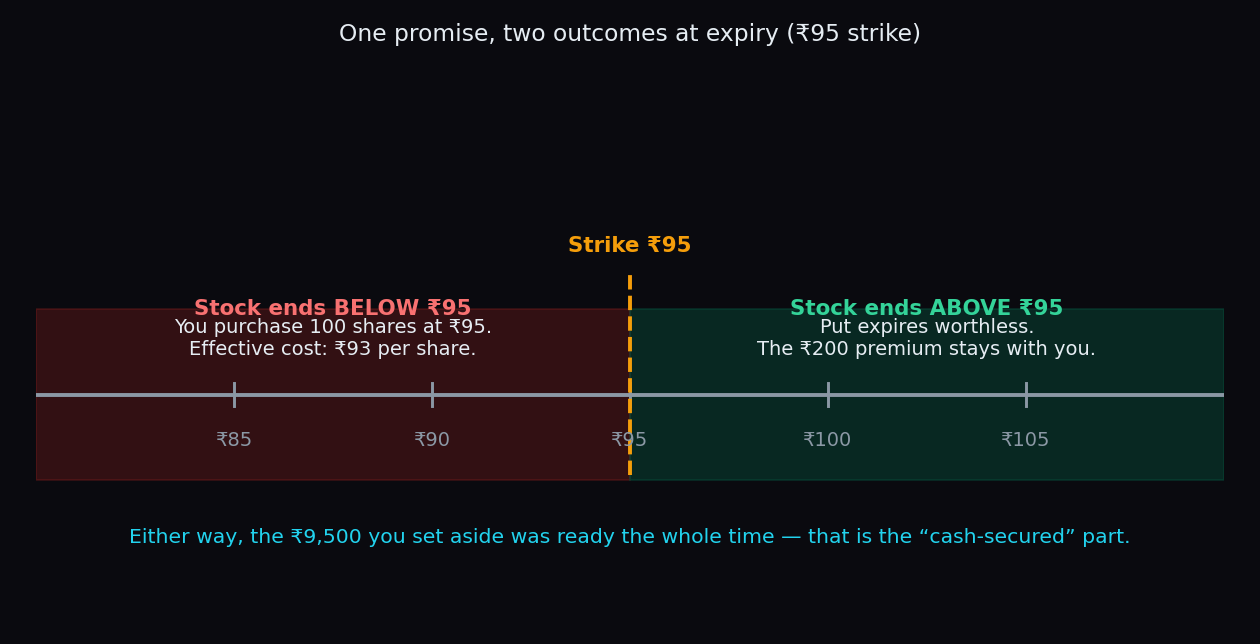
Outcome A — XYZ ends at ₹98, above the strike. The holder has no reason to hand over shares at ₹95 when the open market pays ₹98. The put expires worthless. You keep the ₹200. On the ₹9,500 you set aside for a month, that is about 2.1% — earned for waiting.
Outcome B — XYZ ends at ₹90, below the strike. You are assigned: you purchase 100 shares at ₹95, paying out the ₹9,500. Because you already collected ₹2 per share, your effective cost is ₹93 per share. The market price is ₹90, so on paper you are down ₹300 for now — but you own the stock at ₹93 instead of the ₹100 it traded at a month earlier.
That gives the simple arithmetic of the trade: breakeven = strike − premium = ₹95 − ₹2 = ₹93. Above ₹95 you keep the fee; between ₹93 and ₹95 the premium absorbs the dip; below ₹93 the losses grow one rupee for every rupee the stock falls.
Why some investors use this structure
The appeal is being paid to wait. An investor who has already concluded that ₹95 is a reasonable price for XYZ faces two outcomes, and both fit the original plan: either the stock never gets there and the premium is kept, or the stock arrives and the shares come in at an effective ₹93 — cheaper than a plain purchase order at ₹95 would have managed. It is the mirror image of the covered call, where an existing shareholder collects a fee against shares already owned.
The honest catch
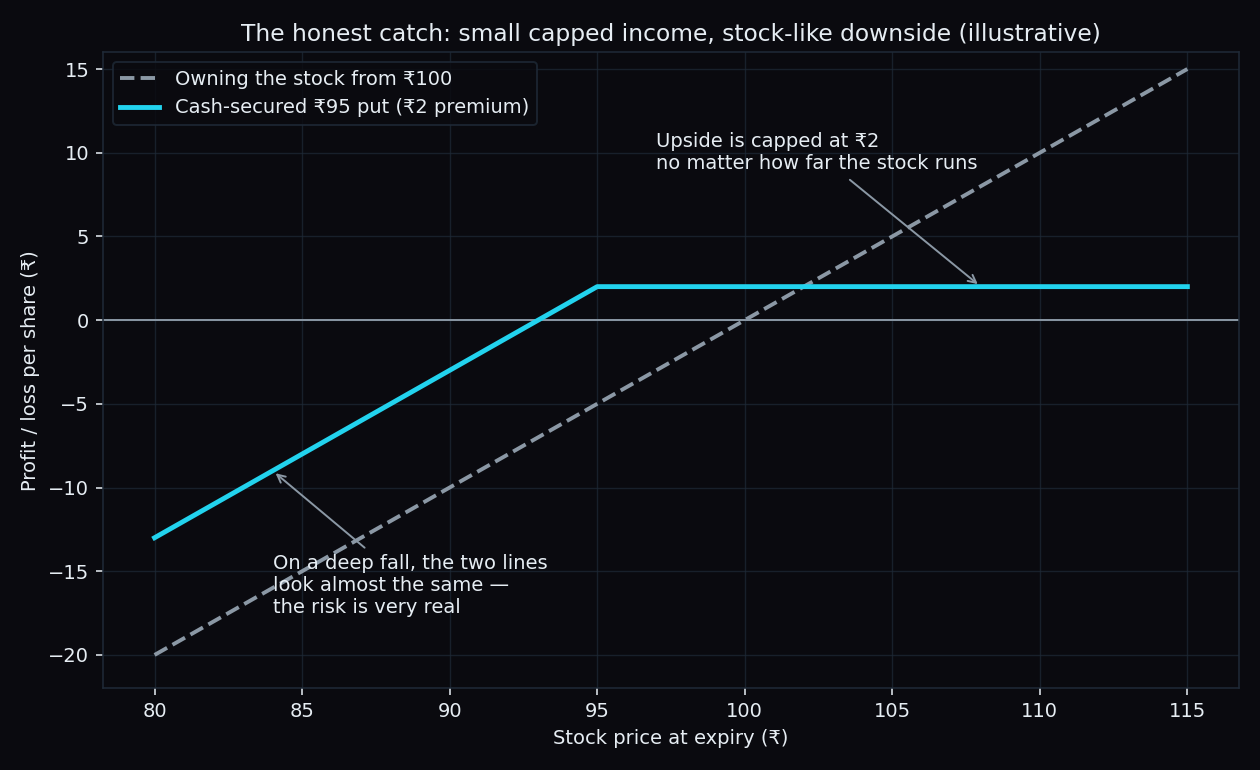
- The downside is stock-like. If XYZ crashes to ₹60, you still purchase at ₹95. That is a loss of ₹33 per share after the premium — ₹3,300 on one lot. The ₹200 fee is a thin cushion, not protection.
- The upside is capped. If XYZ runs to ₹120, you earn ₹200. Nothing more, no matter how far it climbs.
- The premium is small for a reason. Many quiet months can feel like easy income; a single bad month can hand back several quiet months of fees at once.
- India-specific: physical settlement. Stock options on the NSE are physically settled at expiry — an in-the-money short put ends in actual delivery of shares to your demat account. Index options (Nifty, Bank Nifty) settle in cash instead, so no shares change hands there.
- “Cash-secured” is self-imposed, not a rule. Brokers ask for a margin that is well below the full ₹9,500. Keeping the entire amount aside anyway is exactly what makes this version of put writing conservative — the writer who skips that step is running a different, riskier trade.
Key takeaway: a cash-secured put is not free income. It is a small fee collected for accepting a duty most people forget about until a sharp fall arrives. The structure only makes sense at strikes where the writer is genuinely comfortable ending up as a shareholder — with the full cash ready the whole time.
Related reading: option moneyness (ITM, ATM and OTM) explains when a put is likely to be exercised, and theta, the time decay in options explains why the premium melts as expiry approaches.
Put writing like this shows up in the option chain every single day — where the big put walls sit, and how often those levels actually hold. TrueTrend turns that positioning into a clear, at-a-glance read across Nifty, Bank Nifty and stock F&O — and scores its own track record in public on the live scoreboard. Create a free account to see it live.
See these concepts on live market data — free
Create a free TrueTrend account to watch daily support/resistance levels, market regime, and option-positioning charts on NIFTY, BankNifty and 12 more instruments. Every level we publish is scored on a public scoreboard — misses included. No card required.
Free forever tier · daily levels with published hit-rates across every instrument. Descriptive market structure, not investment advice.
Not ready for an account? Get the daily levels by email.
One short email each market day — the indices' call wall, put wall, gamma flip and max pain, and how the last session's levels scored. Free, no account, unsubscribe anytime.
Descriptive market structure, not investment advice. We never share your email.