Order Types in India: Stop-Loss, SL-M, Bracket, Cover & GTT
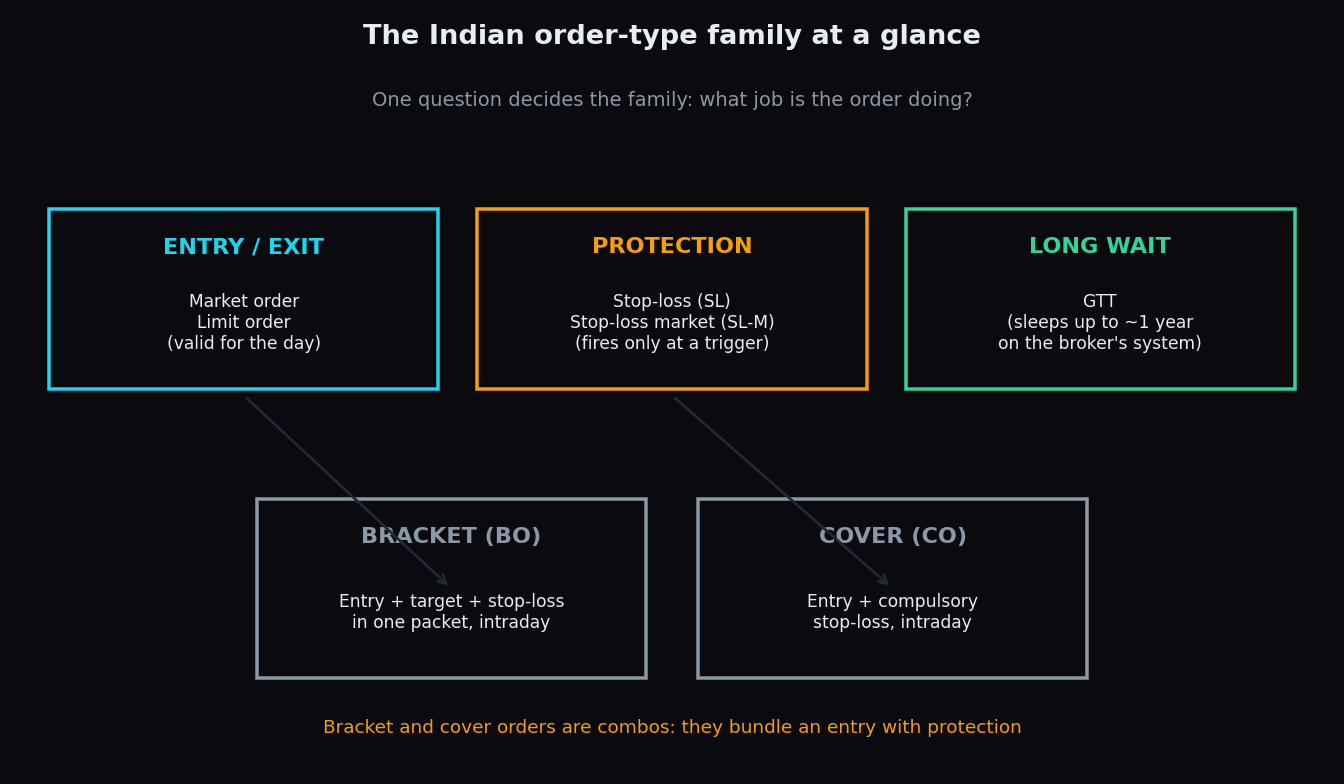
A share you hold is trading at ₹100. You would rather not keep it below ₹95 — but you cannot watch the screen all day. Every order type in this guide — stop-loss, SL-M, bracket, cover and GTT — is a different answer to that one problem: how do you leave an instruction that acts for you when you are not there?
An order is an instruction, not a wish
When you tap a button in a trading app, you are writing an instruction for the exchange's matching system. That system is a very fast, very literal robot: it does exactly what the instruction says and nothing more. The two basic instructions are the market order ("fill me now, at the best price available") and the limit order ("fill me only at my price or better"). If those two are new to you, start with market order vs limit order — everything below builds on them.
One more basic fact before the fancy stuff: a normal order lives for one trading day. If it has not filled by the 3:30 pm close, the exchange simply deletes it. Keep that in mind — it is the entire reason GTT orders exist.
Stop-loss (SL): a tripwire with a minimum price
A stop-loss order stays dormant until the price touches a level you chose in advance. That level is the trigger price. Think of it as a tripwire laid across the price chart: nothing happens until the price walks into it. (The idea itself — deciding your exit before you need it — is covered in what is a stop-loss.)
The regular stop-loss order (shown as SL, or SL-L, in most Indian apps) needs two prices from you:
- Trigger price — the level at which the sleeping order wakes up.
- Limit price — the worst price you are willing to accept once it is awake.
A worked example, with round numbers. You hold shares bought at ₹100 and place a stop-loss with trigger ₹95 and limit ₹94.50. If the price ever falls to ₹95, the tripwire fires, and an exit order at "₹94.50 or better" enters the exchange. In a calm market you exit somewhere between ₹95 and ₹94.50, and the damage is contained near ₹5 per share.
The catch: if the price is falling so fast that it jumps from ₹95 straight past ₹94.50 to ₹94, your limit is never available. The order sits there, unfilled, while the price keeps sliding. The tripwire fired — but the exit never happened.
SL-M: the same tripwire, without a minimum price
A stop-loss market order (SL-M) asks for only one price: the trigger. When the tripwire fires, the order becomes a market order and exits at the next price available — whatever that is. You get certainty of exit and uncertainty of price, which is exactly the reverse of the regular SL.
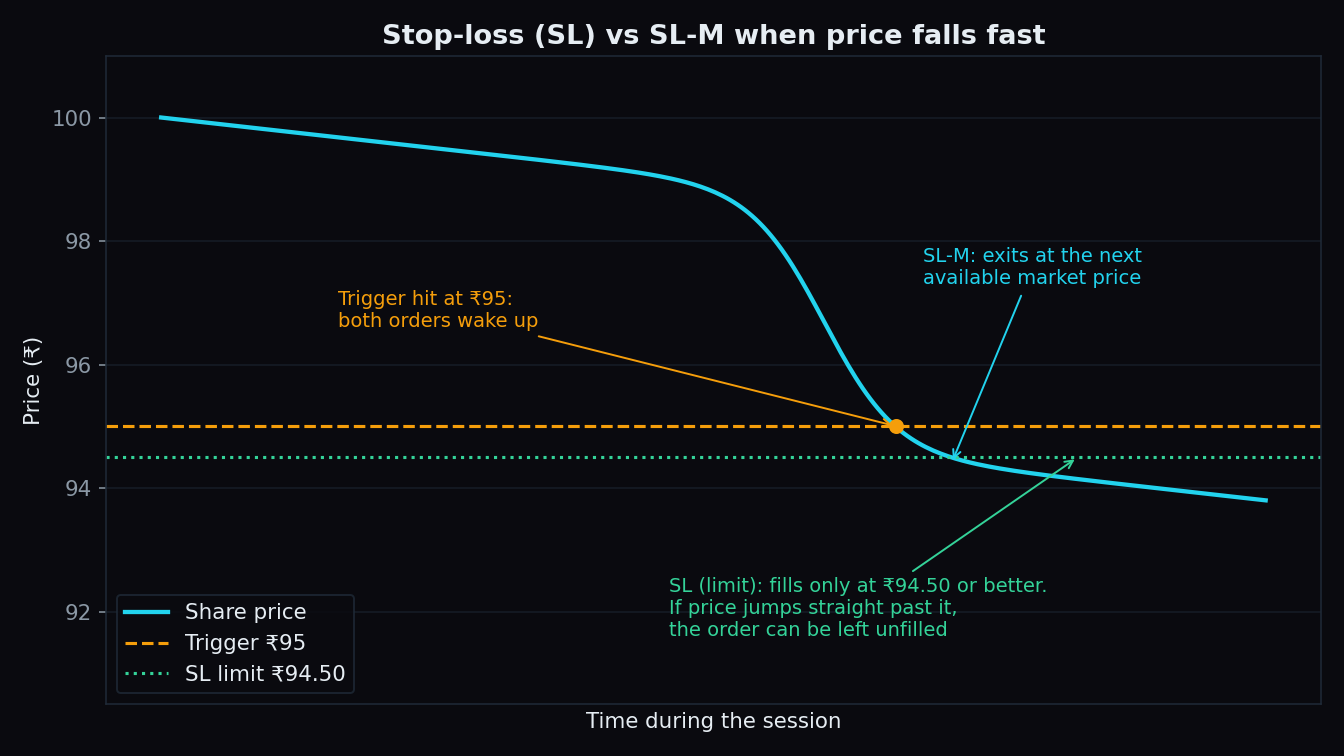
The regular SL protects your price but not your exit. The SL-M protects your exit but not your price. That trade-off is the entire choice between them.
Two cautions. In a thinly traded stock, or in a fast market, the "next available price" can sit well below your trigger — that gap is called slippage. And many brokers no longer offer SL-M on options at all, because option quotes can print extreme, momentary prices (traders call them "freak trades") and a market order can fill on one. Check what your own broker supports before assuming.
Bracket order (BO): a whole trade in one packet
A bracket order bundles three instructions into one packet: an entry order, a profit-taking leg (usually called the target leg), and a stop-loss leg. The moment the entry fills, both exit legs go live — and they are linked. If one of them fills, the other cancels automatically. Traders call this arrangement OCO: one cancels the other.
With simple numbers: entry at ₹100, profit leg at ₹106, stop leg at ₹97. The position risks about ₹3 per share while pursuing about ₹6, and both exits exist at the exchange from the second the entry fills. Nothing depends on you watching the screen.
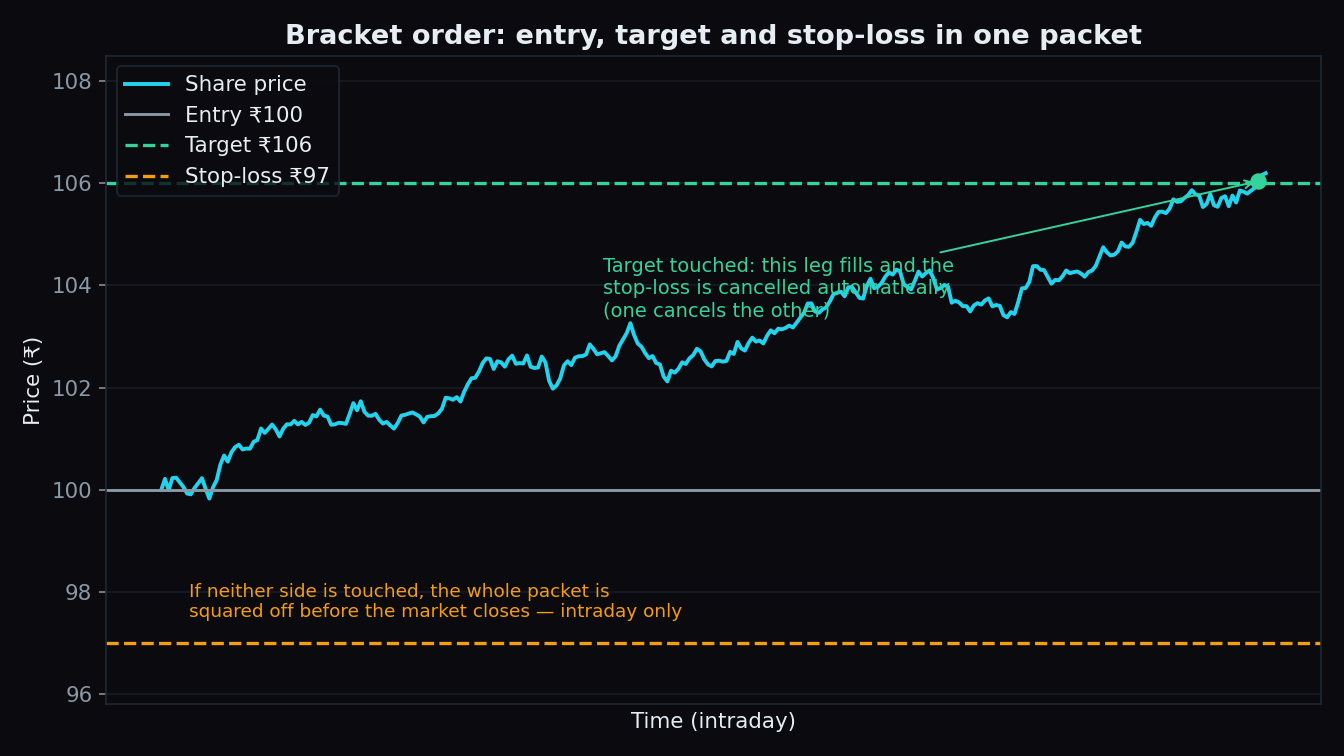
Bracket orders come with two built-in rules. They are intraday only: if neither leg is touched, the broker squares the whole packet off before the market closes. And many brokers add an optional trailing stop-loss, which drags the stop leg upward as the price rises, locking in part of the move. Availability differs widely — some brokers offer brackets on everything, some on a few segments, some not at all.
Cover order (CO): an entry that refuses to travel without a stop
A cover order is a simpler cousin of the bracket: an entry order plus a compulsory stop-loss, placed together. You cannot place the entry without the stop — the platform will not accept it. Like the bracket, it is intraday only.
Covers were once popular because brokers offered extra intraday leverage on them — the enforced stop capped the broker's risk. After SEBI standardised intraday margin rules, that advantage largely disappeared, and several brokers have retired bracket and cover orders altogether. What survives is the discipline: with a cover order, "I'll decide my stop later" is not an option the software allows.
GTT: the order that waits for weeks
GTT stands for Good Till Triggered. Remember that a normal order dies at the close of the day it was placed. A GTT is different: the instruction sits on your broker's system — not on the exchange — and stays alive for a long time, typically up to about a year depending on the broker. When the market touches your trigger price, the broker fires a limit order to the exchange on your behalf that day.
The analogy here is an alarm clock. "If this stock ever slips to ₹90, wake up and place my order at my price." You could be on holiday for a month; the alarm does not care.
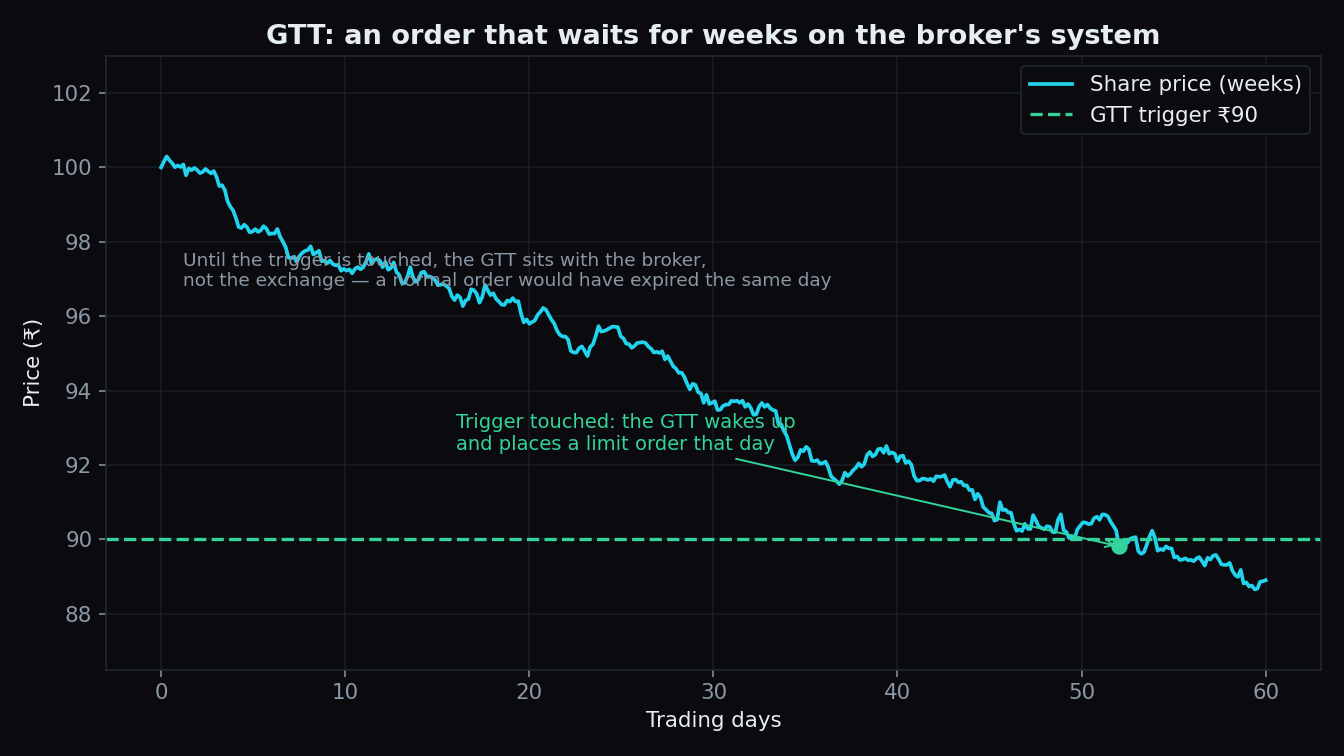
GTT has honest catches of its own. What it places on trigger is a limit order, so it can still go unfilled if the price races past your limit. Most GTTs fire once — if that order lapses unfilled, the GTT is spent until you set it again. And corporate actions such as splits and bonus issues change the price scale, so brokers usually deactivate GTTs on affected stocks — a long-forgotten trigger needs an occasional review. Many brokers also offer a two-leg OCO GTT for existing holdings: one trigger above the market and one below, and whichever is touched first fires while the other cancels.
Which order does which job?
- Market / limit — entering or exiting now, today.
- SL / SL-M — protection that lasts for the trading day.
- Bracket — a complete intraday trade with both exits defined before entry.
- Cover — an intraday entry where the stop-loss is non-negotiable.
- GTT — a price level you want acted on days or weeks from now.
A boring truth to finish with: no order type improves the idea behind the trade. A stop-loss limits the cost of being wrong; it does not make you right, and in a gap or a fast fall even the exit price is not assured. Order types are seat belts, not steering.
Order types tell the exchange what to do — they say nothing about where the market is leaning. TrueTrend turns live Nifty and Bank Nifty positioning into a clear, at-a-glance read, and it scores its own track record in public. Create a free account to see today's read.
See these concepts on live market data — free
Create a free TrueTrend account to watch daily support/resistance levels, market regime, and option-positioning charts on NIFTY, BankNifty and 12 more instruments. Every level we publish is scored on a public scoreboard — misses included. No card required.
Free forever tier · daily levels with published hit-rates across every instrument. Descriptive market structure, not investment advice.
Not ready for an account? Get the daily levels by email.
One short email each market day — the indices' call wall, put wall, gamma flip and max pain, and how the last session's levels scored. Free, no account, unsubscribe anytime.
Descriptive market structure, not investment advice. We never share your email.