Rights Issues and Buybacks: Corporate Actions Explained
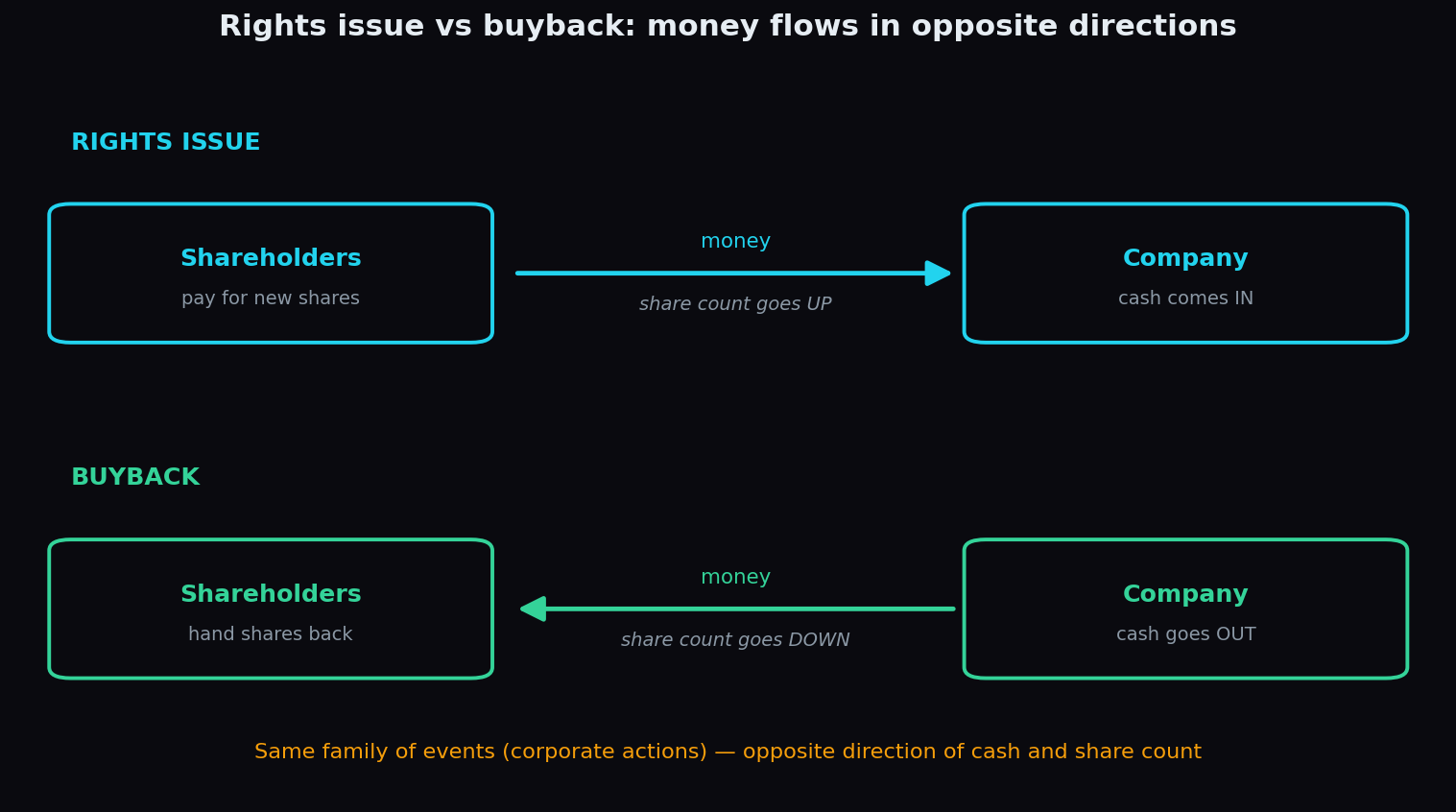
In mid-2020, Reliance Industries raised about ₹53,000 crore by asking its own shareholders for money — one new share for every 15 already held, priced at ₹1,257. Later that same year, TCS did the exact opposite: it handed roughly ₹16,000 crore back to shareholders by purchasing its own shares from them at ₹3,000 apiece. The first was a rights issue. The second was a buyback. They are mirror images of each other, and once you see the direction the money moves, both become simple.
Both belong to a family of events called corporate actions — decisions a company takes that directly change what its shareholders hold. Dividends and stock splits and bonus shares are corporate actions too. This post covers the two that involve real cash changing hands between the company and you.
Two opposite directions of money
Here is the whole idea in one picture. In a rights issue, shareholders send money to the company and the number of shares in existence goes up. In a buyback, the company sends money to shareholders and the number of shares goes down.
An everyday analogy: think of a company as a pizza and each share as one slice. A rights issue cuts the pizza into more slices, but the kitchen also gets fresh dough (the cash raised), so the pizza itself grows a little. A buyback removes slices from the table and bins them — the pizza is the same size minus the cash spent, but every remaining slice is a bigger fraction of it.
Rights issue: the company asks you for money
A rights issue is an offer of new shares made only to existing shareholders, in proportion to what they already hold, almost always at a discount to the market price. The company announces a ratio (say, 1 new share for every 4 held), a rights price (the discounted price), and a record date — the cut-off date on which you must be holding the shares to qualify.
Why would a company do this instead of borrowing, or selling shares to outsiders? Because it raises money without adding debt and without handing control to new investors. Companies use rights issues to repay loans, fund expansion, or repair a stretched balance sheet.
A worked example with round numbers
You hold 4 shares of a company trading at ₹100. The company announces a 1-for-4 rights issue at ₹80. If you subscribe, you pay ₹80 and receive 1 new share.
- Before: 4 shares × ₹100 = ₹400
- You add: 1 new share for ₹80
- After: 5 shares worth ₹480 in total = ₹96 per share
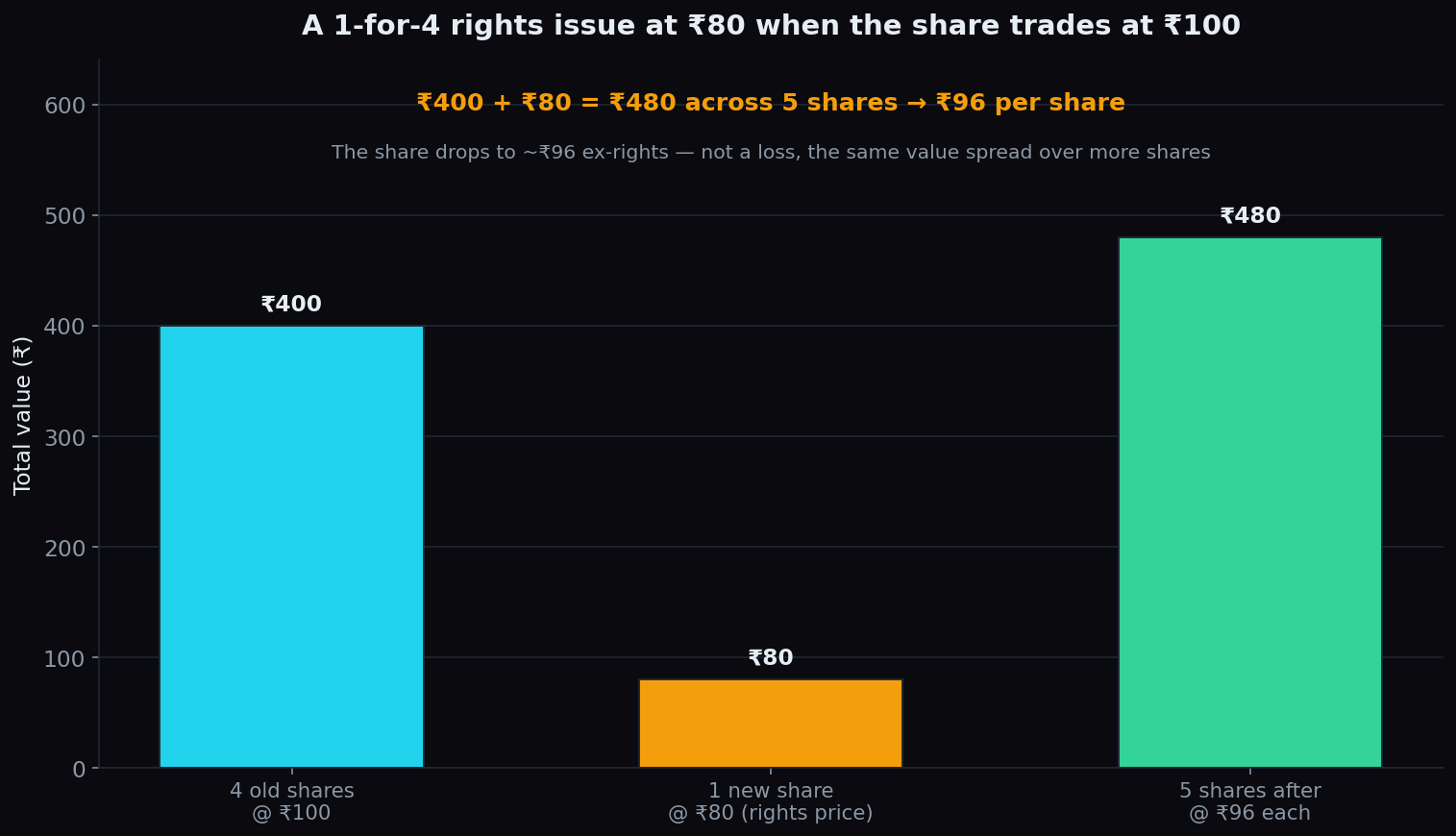
That ₹96 is called the theoretical ex-rights price. Notice the share price drops from ₹100 to about ₹96 when the stock starts trading without the right attached (“ex-rights”). Nobody lost anything — the same total value is simply spread across more shares, exactly like a split or bonus, except here fresh cash also entered the company.
Your three choices — and the one real trap
When a rights issue opens, a rights entitlement (RE) is credited to your demat account — a temporary instrument representing your right to subscribe. Under SEBI's framework in force since 2020, REs trade on the exchange for a few sessions. That gives you three options:
- Subscribe. Pay the rights price, receive the new shares, keep your ownership percentage intact.
- Renounce. If you don't want to invest more, the RE itself can be sold on the exchange during its trading window — in our example it is worth roughly ₹16 (the ₹96 ex-rights value minus the ₹80 subscription price). You monetise the discount instead of using it.
- Do nothing. This is the trap. An unused RE simply lapses worthless after the issue closes. You absorb the price drop to ₹96 and get nothing in return. In a rights issue, inaction has a real cost.
The honest read on rights issues: the discount is not a gift — it comes out of the ex-rights price. What matters is why the company needs the money. Funding growth is one story; repeatedly plugging losses with shareholders' own cash is a very different one. The offer document states the purpose. Read it.
Buyback: the company hands money back
A buyback (share repurchase) is the reverse: the company uses its own cash to purchase its shares from willing shareholders and then extinguishes them — the shares are cancelled, not parked somewhere. Fewer shares exist afterwards, so each remaining share represents a slightly larger slice of the company. It is, in effect, an IPO running in reverse.
In India, buybacks now happen through a tender offer: the company announces a fixed buyback price (typically above the market price), a record date, and a size; eligible shareholders then tender (offer up) their shares during the window. SEBI has phased out the older open-market route — since April 2025, the tender route is the way new buybacks are done. Two guardrails worth knowing: a company may buy back at most 25% of its paid-up capital and free reserves, and 15% of every tender offer is reserved for small shareholders (those holding up to ₹2 lakh worth of shares on the record date).
The acceptance ratio — a worked example
A company offers to buy back 1 crore shares at ₹120 while the stock trades at ₹100. Shareholders find that attractive, so they tender 2 crore shares in total — twice what the company wants. The company accepts them proportionately: the acceptance ratio is 50%. If you tendered 100 shares, about 50 are bought at ₹120 and the other 50 come back to your demat account. The ₹20 premium applies only to the accepted half — a detail the headline number never mentions.
Why EPS rises — and why that is only arithmetic
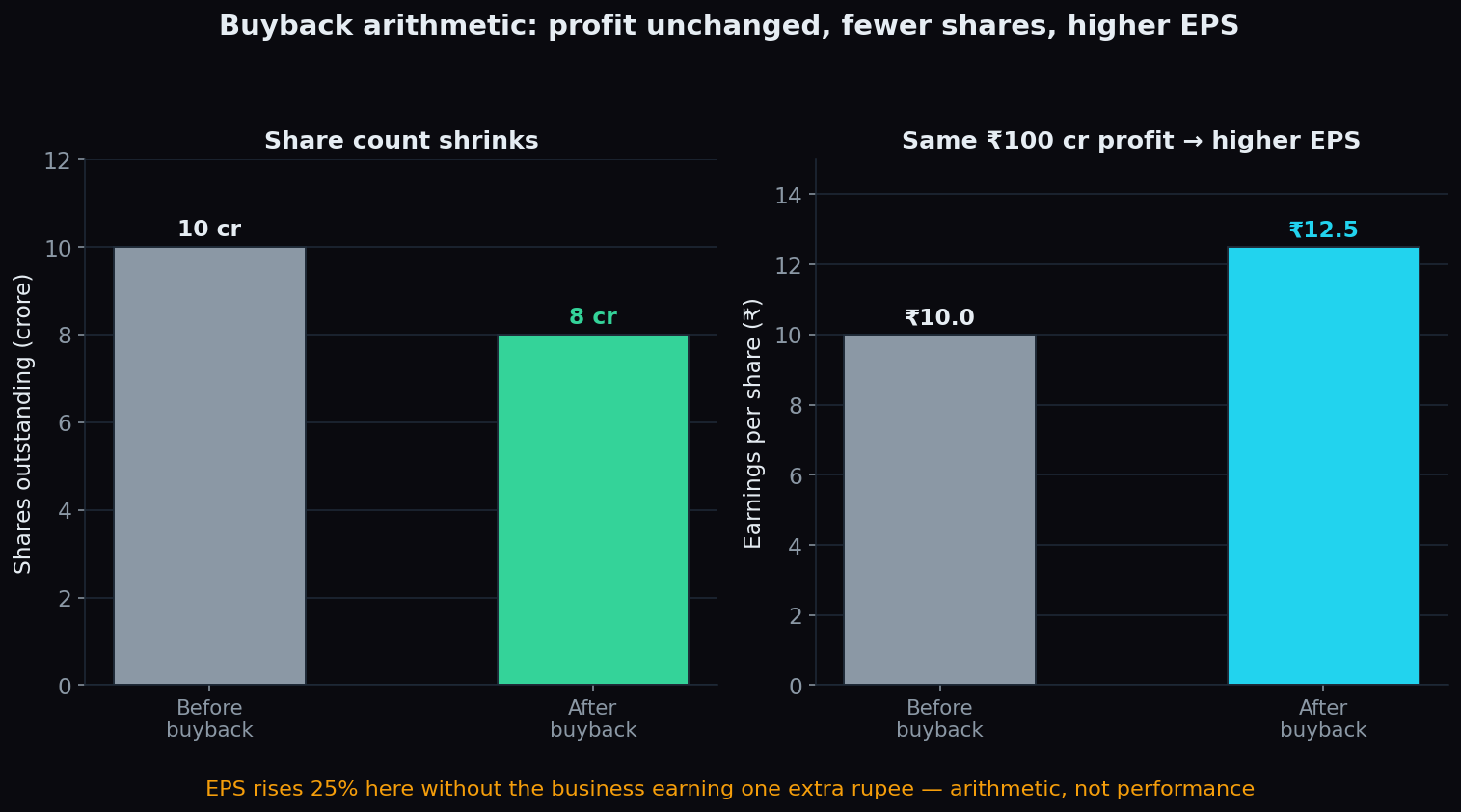
Buybacks are often praised because they raise earnings per share (EPS). The mechanism is pure division. Say a company earns ₹100 crore of profit with 10 crore shares outstanding — EPS is ₹10. It buys back 2 crore shares. Profit is unchanged, but now it is divided across 8 crore shares: EPS becomes ₹12.50, a 25% jump, without the business earning one extra rupee.
The tax angle changed recently and it matters. Since 1 October 2024, money received in a buyback is taxed in the shareholder's hands as dividend income at your slab rate (the earlier company-level buyback tax is gone), while your purchase cost becomes a capital loss you can set off separately. A buyback premium that looks generous before tax can look ordinary after it, especially in the higher slabs.
What each action usually says — and the limits
- A rights issue moves cash in. It can signal confidence (funding growth alongside promoters who subscribe to their full entitlement) or stress (repairing debt). The purpose in the offer document, and whether the promoters subscribe, tell you which story you are in.
- A buyback moves cash out. It can signal that management thinks the shares are cheap — or simply that the company has run out of better ideas for its cash. The EPS boost is arithmetic either way.
- Neither is automatically good or bad news. Studies of announcements show a range of outcomes; each case rests on the company's reasons and price. Treat both as information to read, not as a signal to act on.
Where positioning data fits in
Corporate actions come with dates — record dates, issue windows, tender windows — and around those dates, derivatives positioning often tells you how the market is leaning before the headlines do. That data is only worth reading if someone measures whether it works. We score ours in public: on Nifty, for example, the put wall — the strike carrying the heaviest put open interest below spot — held on 72% of the sessions where price touched it (n=25 touches, from 79 scored sessions). Twenty-five touches is a modest sample and we label it as such; a percentage without its n is marketing, not measurement. Every instrument's live record is on the public scoreboard.
TrueTrend turns this kind of market structure into one clear, at-a-glance read across Nifty, Bank Nifty and 12 more F&O names — levels, positioning, and our own published hit-rates next to them. Create a free account to see today's board.
The short version
- Rights issue — new shares offered to existing holders at a discount, in a fixed ratio. Cash flows into the company; share count rises; the price adjusts to the ex-rights level. Subscribe or renounce — never let an entitlement lapse.
- Buyback — the company repurchases and cancels its own shares via a tender offer, usually at a premium. Cash flows out; share count falls; EPS rises by arithmetic. Acceptance is proportionate, and proceeds are taxed as dividend income since October 2024.
- Both are described in detail in the company's offer documents filed with SEBI and the exchanges — those, not headlines, are the primary source.
See these concepts on live market data — free
Create a free TrueTrend account to watch daily support/resistance levels, market regime, and option-positioning charts on NIFTY, BankNifty and 12 more instruments. Every level we publish is scored on a public scoreboard — misses included. No card required.
Free forever tier · daily levels with published hit-rates across every instrument. Descriptive market structure, not investment advice.
Not ready for an account? Get the daily levels by email.
One short email each market day — the indices' call wall, put wall, gamma flip and max pain, and how the last session's levels scored. Free, no account, unsubscribe anytime.
Descriptive market structure, not investment advice. We never share your email.