What Is Algo Trading? How It Works and How SEBI Regulates It in India
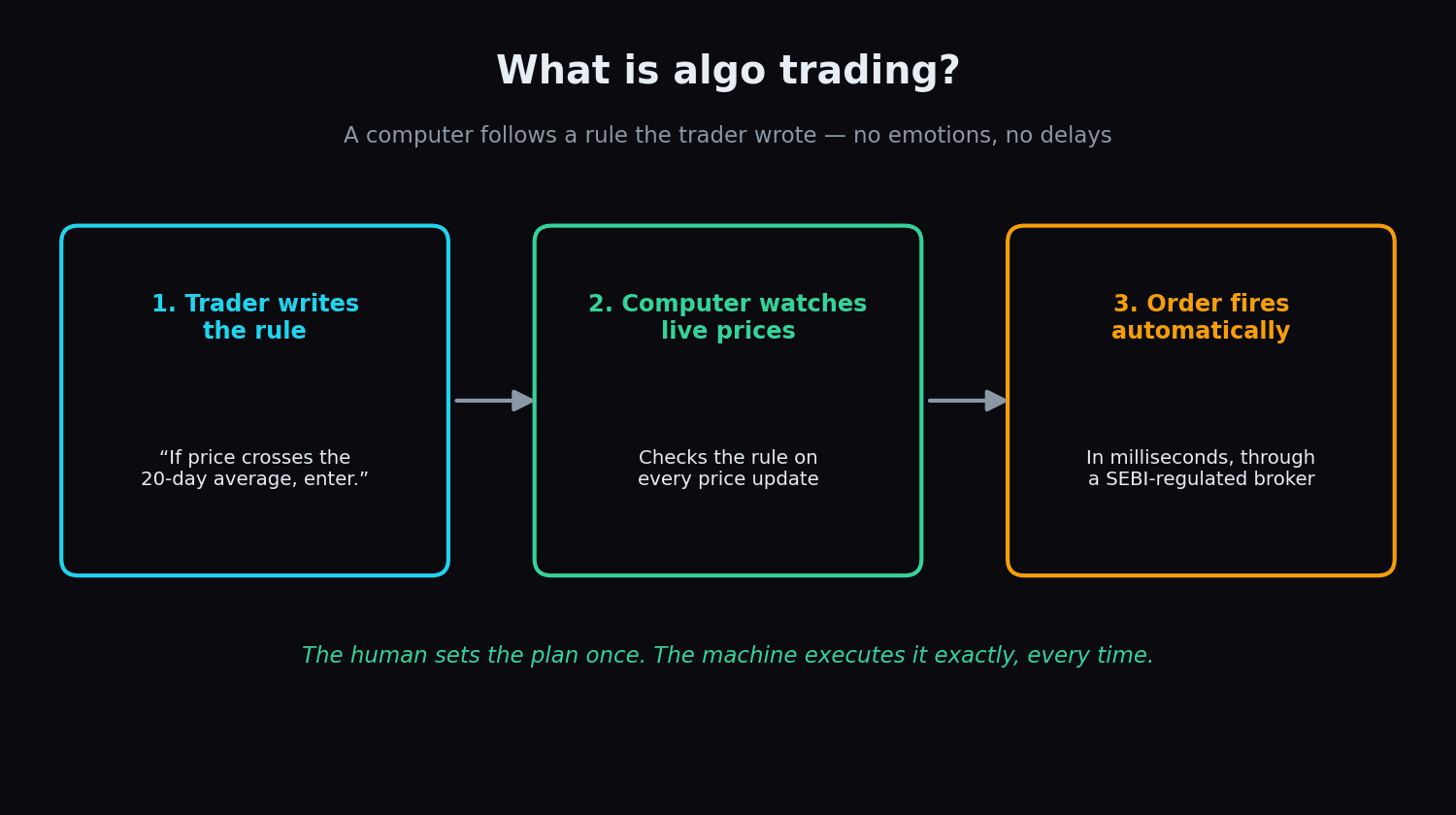
Algo trading — short for algorithmic trading — means a computer places market orders on your behalf, following exact rules you wrote in advance. No emotions, no hesitation, no lunch breaks. It already drives a large share of trading on Indian exchanges, and SEBI, the market regulator, has built a detailed rulebook around it — including a 2025 framework aimed directly at retail traders using broker APIs.
Algo trading, explained with a recipe
Picture a robot chef. You hand it a recipe: “When the water boils, add the rice. When the rice softens, lower the flame.” The robot follows every step exactly, faster than any human, and it never gets bored or scared. But notice the catch: the robot is only as good as the recipe. A bad recipe still produces a bad meal — just faster and with perfect consistency.
An algorithm (“algo” for short) is that recipe, written for markets: a fixed list of if-this-then-that instructions a computer can check against live prices. Algo trading is letting the computer act on those instructions by sending orders to the exchange through a broker, with no human clicking anything at the moment of the trade.
The human still does the hard part — deciding what the rule should be. The machine only handles the execution.
How one rule works, step by step
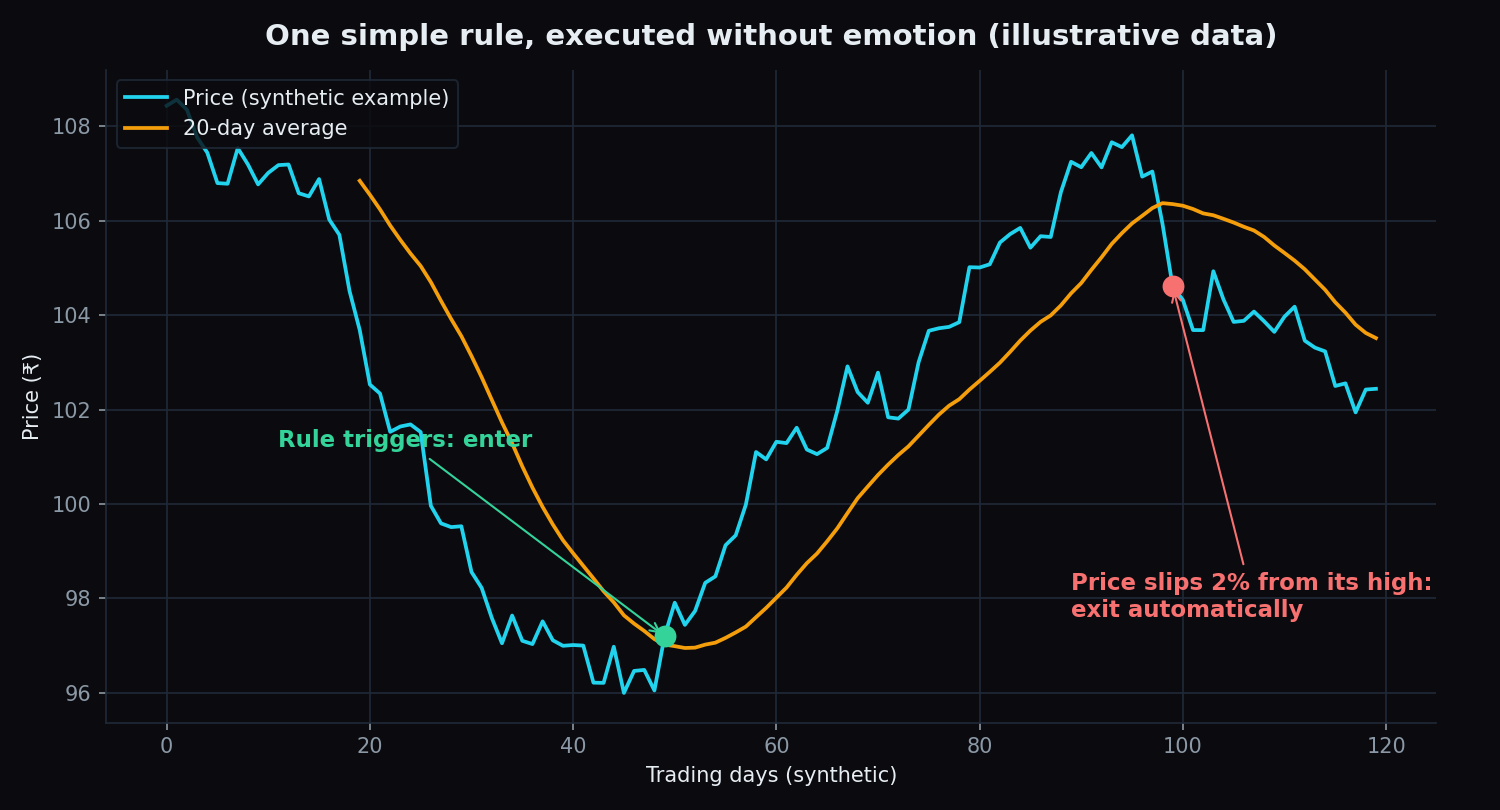
Here is a deliberately simple example with round numbers. A trader writes two instructions:
- Entry rule: if the stock’s price crosses above its 20-day moving average (the average of the last 20 closing prices), place an order for 10 shares.
- Exit rule: after entering, if the price slips 2% below its highest point since entry, square off the position automatically.
Now suppose the stock trades at ₹100 and its 20-day average sits at ₹99.90. The moment a price update prints ₹100.05 — above the average — the algo fires an order and picks up 10 shares near ₹100. The stock climbs to ₹105 over a week. Then one morning it slips 2% from that high, to ₹102.90. The algo squares off instantly. Result: roughly ₹2.90 gained per share, about ₹29 on 10 shares, before brokerage and taxes.
No panic at the top, no “let me watch one more candle” at the bottom. The rule decided everything in advance.
Speed is the headline difference
A human sees a price, thinks, and clicks — that loop takes around a second on a good day. A retail algo connected through a broker’s API (an API is simply a doorway that lets one program talk to another) reacts in a tenth of a second or less. Institutional systems go further with co-location: renting server space inside the exchange’s own data centre, so orders travel metres instead of kilometres and react in fractions of a millisecond.
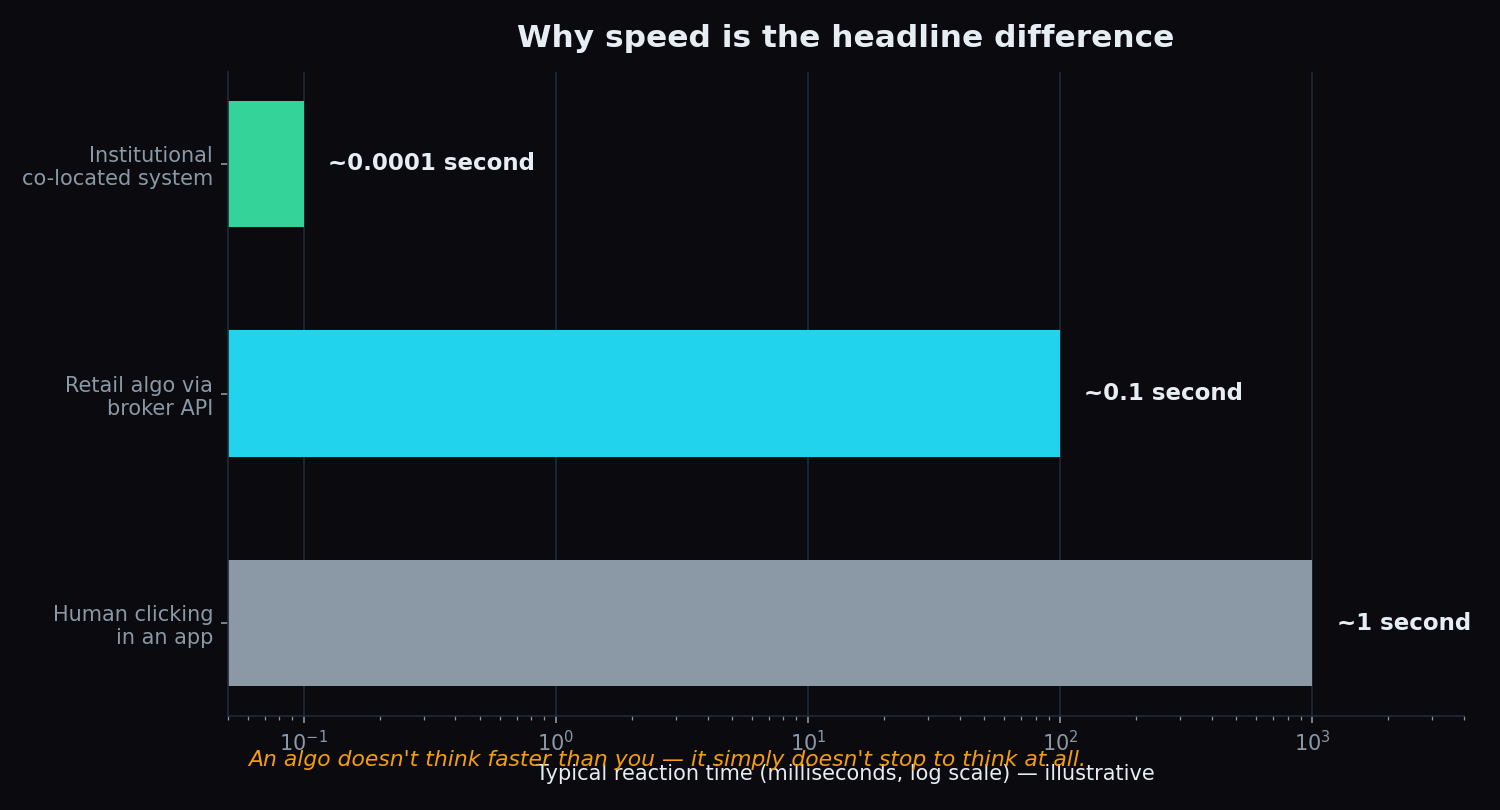
Keep the honest framing, though: an algo does not think better than you. It simply never stops to think at all. Speed makes a good rule more effective — and a bad rule more expensive.
Who actually uses algos in India
- Institutions and mutual funds use algos to slice a huge order into hundreds of small ones, so a single large trade does not push the price against them.
- Proprietary desks and high-frequency firms run co-located systems that trade thousands of times a day, often earning tiny amounts per trade from the bid–ask spread.
- Retail traders increasingly connect ready-made or self-coded strategies to broker APIs — the segment SEBI’s newest rules focus on.
How big is all this? SEBI’s own discussion papers have estimated that algo-driven orders account for roughly half of Indian exchange turnover, and the share is far higher in derivatives. The exact number moves around, but the direction is clear: most of the volume on the other side of your trade is a machine.
How SEBI regulates algo trading
SEBI’s approach has come in layers over nearly two decades:
- 2008 — Direct Market Access. SEBI first allowed institutions to send orders straight into exchange systems electronically, without a dealer manually punching them in. This opened the door to automation.
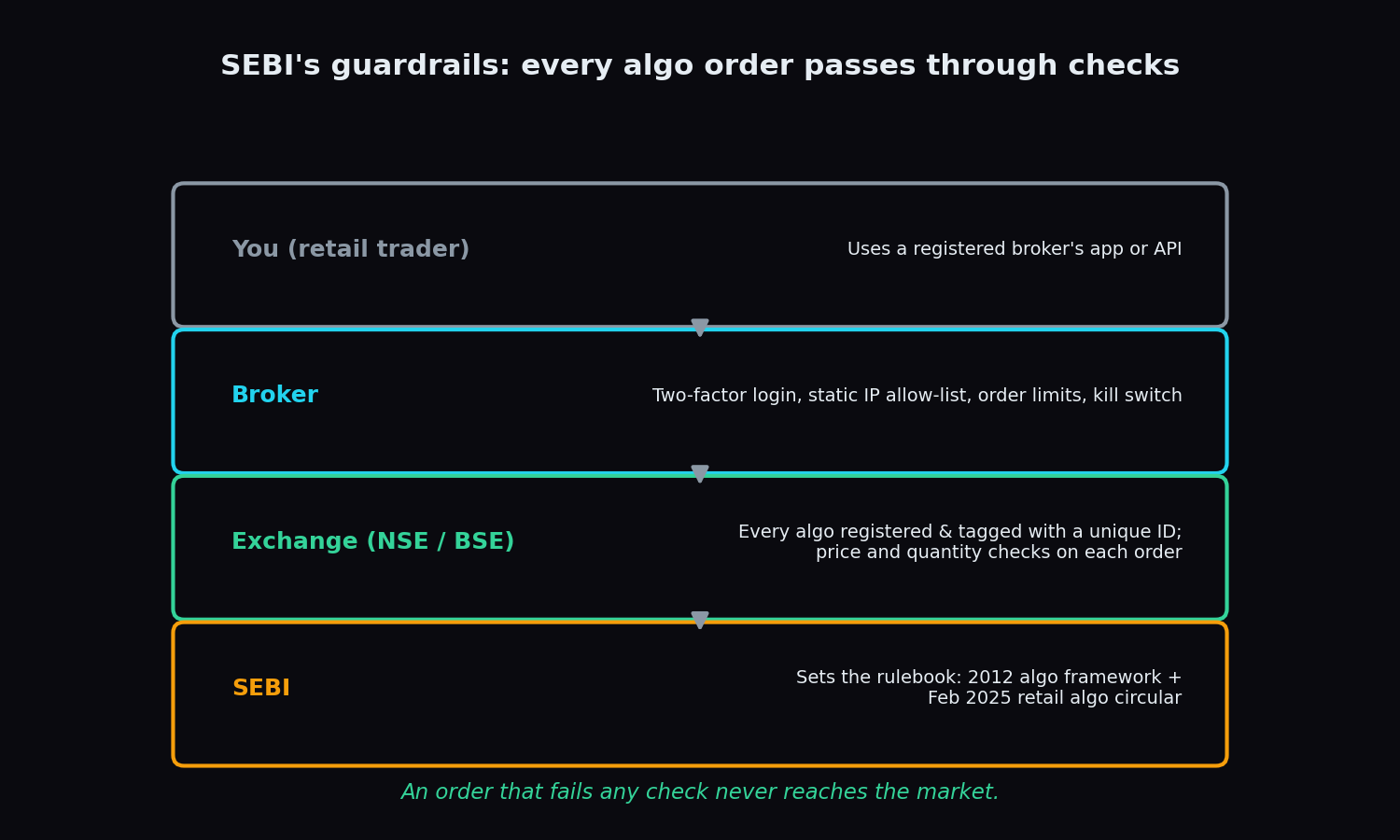
- 2012 — the first full algo framework. Exchanges must run price and quantity checks on every algo order before it reaches the market, brokers need exchange approval for each algorithm they deploy, and firms that fire far more orders than actual trades face order-to-trade ratio penalties. Exchange-level circuit breakers and price bands act as a further backstop for the whole market.
- Kill switch. Brokers and exchanges can instantly cancel all open orders from a misbehaving algorithm.
The 2025 retail algo framework
The big recent change is a SEBI circular issued on 4 February 2025 on safer retail participation in algo trading, implemented in phases during 2025. Its main ideas:
- Everything runs through registered brokers. API-based algo orders must flow through a SEBI-registered broker, and the broker is responsible for them as the principal. Third-party algo providers act as the broker’s agents and must be empanelled with the exchanges.
- Every algo gets an identity. Algos are registered with the exchange, and each order they send is tagged with a unique identifier — so regulators can trace exactly which strategy placed which order.
- Security by default. API access requires two-factor authentication and static IP allow-listing (your algo may only connect from a pre-declared internet address).
- DIY coders are covered too. If you code your own algo and it fires orders faster than a threshold set by the exchanges, you must register it through your broker — and you may share it only with close family, not the public.
One caution for readers: unregulated Telegram and social-media services offering “automated returns” sit entirely outside this framework. If a provider is not working through a registered broker, none of these protections apply. Details of the framework are worth confirming on SEBI’s official website (sebi.gov.in) before connecting real money to any API.
The honest catch
Automation fixes execution, not judgement. Three things the brochures skip:
- A bad rule executes flawlessly. The robot chef cooks the bad recipe faster. If your rule loses money on average, the algo will lose it for you with impressive efficiency.
- The past is not a promise. A rule tuned until it looks perfect on old data is often overfitted — it memorised history instead of learning anything real, and it can fall apart on live prices. No rule works every time.
- The odds do not change just because a computer clicks. SEBI’s own research found that 9 out of 10 individual F&O traders lose money. An algo automates a strategy; it cannot upgrade a weak one.
Key takeaway: algo trading removes emotion from execution, not risk from the market. The rule is the product — the computer is just a very fast, very obedient clerk, and SEBI’s framework exists to keep that clerk on a short leash.
If you are curious rather than in a hurry, that is the right instinct. Understand what a rule assumes about the market before you let a machine act on it.
Want to see market structure the way rule-based systems do — without writing a line of code? TrueTrend turns Nifty, Bank Nifty and F&O positioning into a clear, at-a-glance read, and it scores its own track record in public. Create a free account to explore it.
See these concepts on live market data — free
Create a free TrueTrend account to watch daily support/resistance levels, market regime, and option-positioning charts on NIFTY, BankNifty and 12 more instruments. Every level we publish is scored on a public scoreboard — misses included. No card required.
Free forever tier · daily levels with published hit-rates across every instrument. Descriptive market structure, not investment advice.
Not ready for an account? Get the daily levels by email.
One short email each market day — the indices' call wall, put wall, gamma flip and max pain, and how the last session's levels scored. Free, no account, unsubscribe anytime.
Descriptive market structure, not investment advice. We never share your email.