Block Deals and Bulk Deals: Big Money Footprints on NSE
A fund wants out of 40 lakh shares of a mid-cap company. It cannot simply place that order in the market — the size alone would move the price against it long before the last share is sold. So it does the trade another way, and the next evening a single line shows up on the NSE website with the fund's actual name, the quantity, and the price. That line is a block deal or a bulk deal disclosure, and it is one of the few places in the Indian market where you get to see a large institution's name attached to a specific trade.
The two terms get used interchangeably in headlines. They are not the same thing. One is a big trade that happens inside the ordinary market; the other is a big trade that happens through a separate door, at a fixed time, under stricter rules.
The everyday version of the idea
Imagine a shop that sells chairs. If you want two chairs, you walk in, pay the price on the tag, and leave. If you want five hundred chairs, walking in is a bad plan — you would clear out the shelf and the shopkeeper would raise the price on you halfway through. So you ring the owner, agree one price for the whole lot in advance, and take delivery from the warehouse. Afterwards the shop puts a notice on the board saying who bought five hundred chairs and at what price.
That notice is the disclosure. Indian exchanges run the same idea in two versions.
Bulk deal: a big trade in the ordinary queue
A bulk deal is a trade — or a set of trades — done in the normal trading session by a single client that adds up to more than 0.5% of the number of equity shares the company has listed on that exchange. There is no rupee minimum and no special window. The orders go into the same order book as everyone else's, often broken into smaller pieces across the day. What makes it a "bulk deal" is only that the day's total crossed that 0.5% line.
A worked example with round numbers. Say a company has 20 crore shares listed. Half a percent of 20 crore is 10 lakh shares. That is the threshold for this particular scrip:
- Fund A trades 6 lakh shares during the day — below the line, no disclosure.
- Fund B trades 12 lakh shares — over the line, it becomes a bulk deal.
- Fund C trades 25 lakh shares — comfortably over, also a bulk deal.
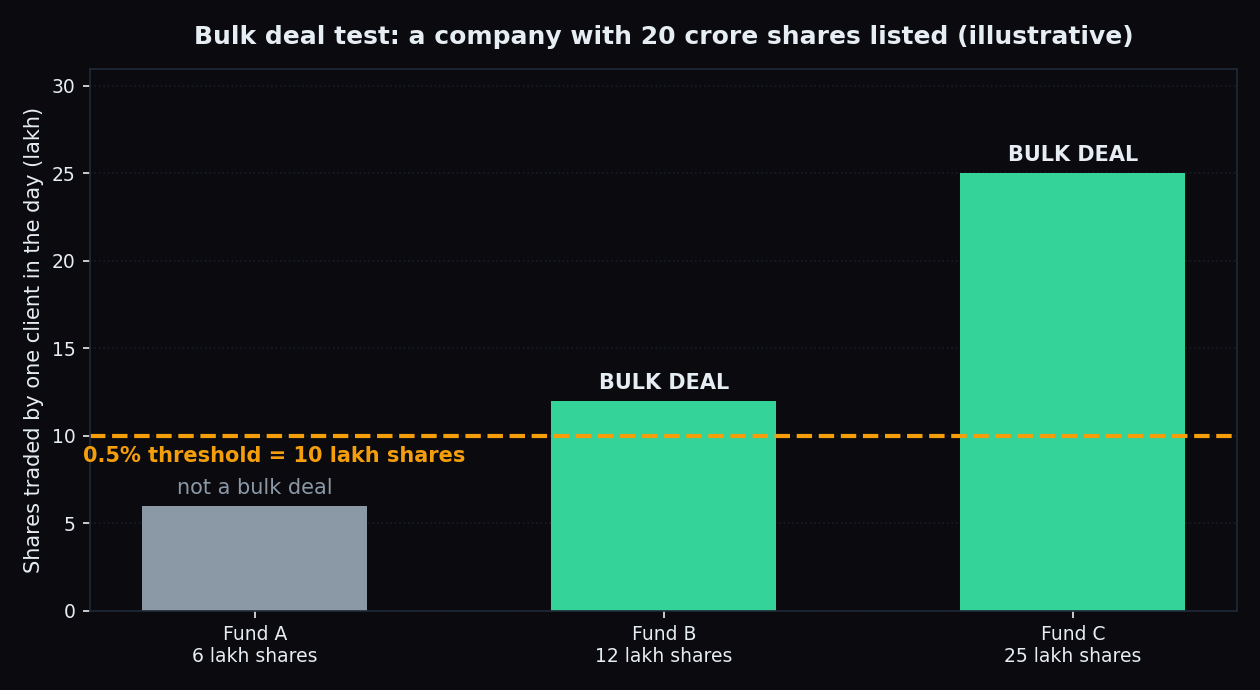
Notice what the threshold depends on: the size of the company, not the size of the money. In a company with 500 crore shares listed, 0.5% is 2.5 crore shares — an enormous trade that most funds will never do. In a small company, a modest position can cross the line easily. So the count of bulk deals in a scrip is partly a statement about how small the scrip is. This is closely tied to market capitalisation and to how liquid the stock is in the first place.
The broker who handled the trade reports it to the exchange — immediately if a single transaction crosses the threshold, and otherwise within an hour of the market closing. The exchange then publishes the details for everyone, the same day, after market hours.
Block deal: a big trade through a separate door
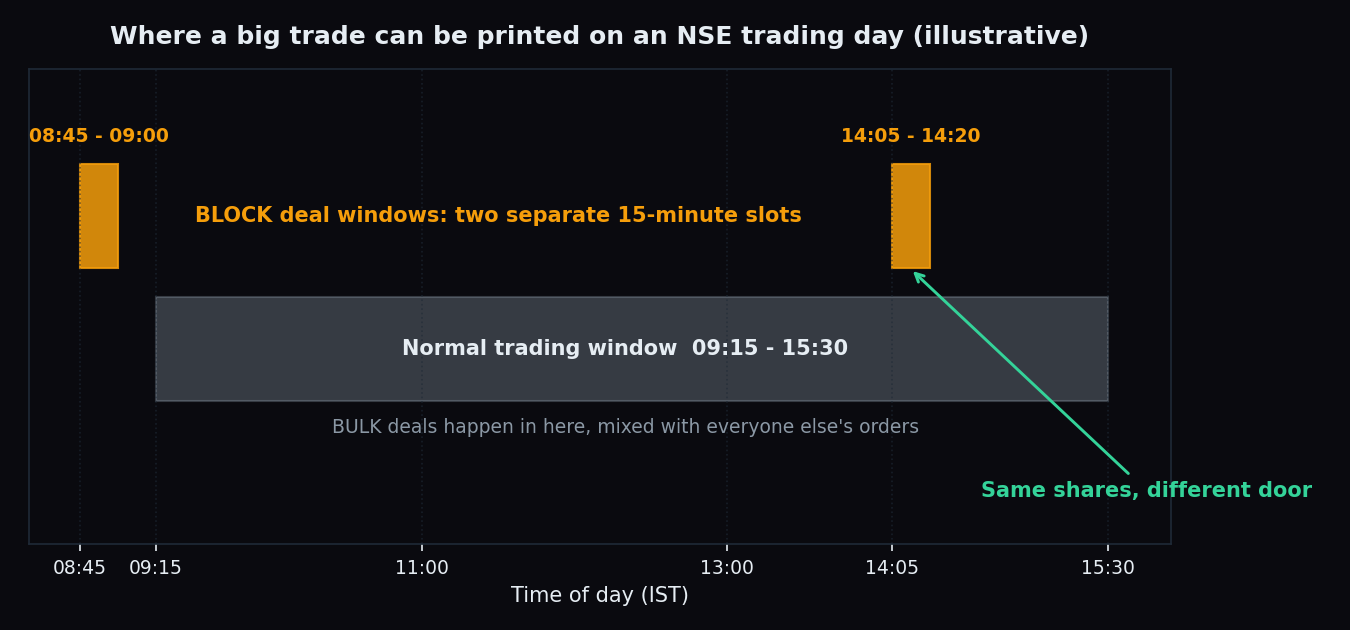
A block deal is negotiated between two parties and executed in a dedicated block deal window, not in the regular order book. Under the framework SEBI put in place from January 2018, there are two such windows in a trading day, each fifteen minutes long:
- A morning window, 08:45–09:00 — before the normal market opens. The reference price is the previous day's closing price.
- An afternoon window, 14:05–14:20. Here the reference price is the volume weighted average price of the trades in that stock between 13:30 and 14:00.
Three rules do most of the work in that window:
- Minimum size ₹10 crore per order. This is a wholesale counter. Small orders are not allowed in.
- Price within ±1% of the reference price. The two sides negotiate, but they cannot print the trade at a price far from where the stock actually is.
- It must result in delivery. A block deal cannot be squared off or reversed the same day. The shares genuinely change hands.
The price band is the part most readers underestimate. If the reference price is ₹500, the entire deal has to be printed between ₹495 and ₹505. An order at ₹489 — a 2.2% discount the buyer might well want — simply cannot go through in that window.
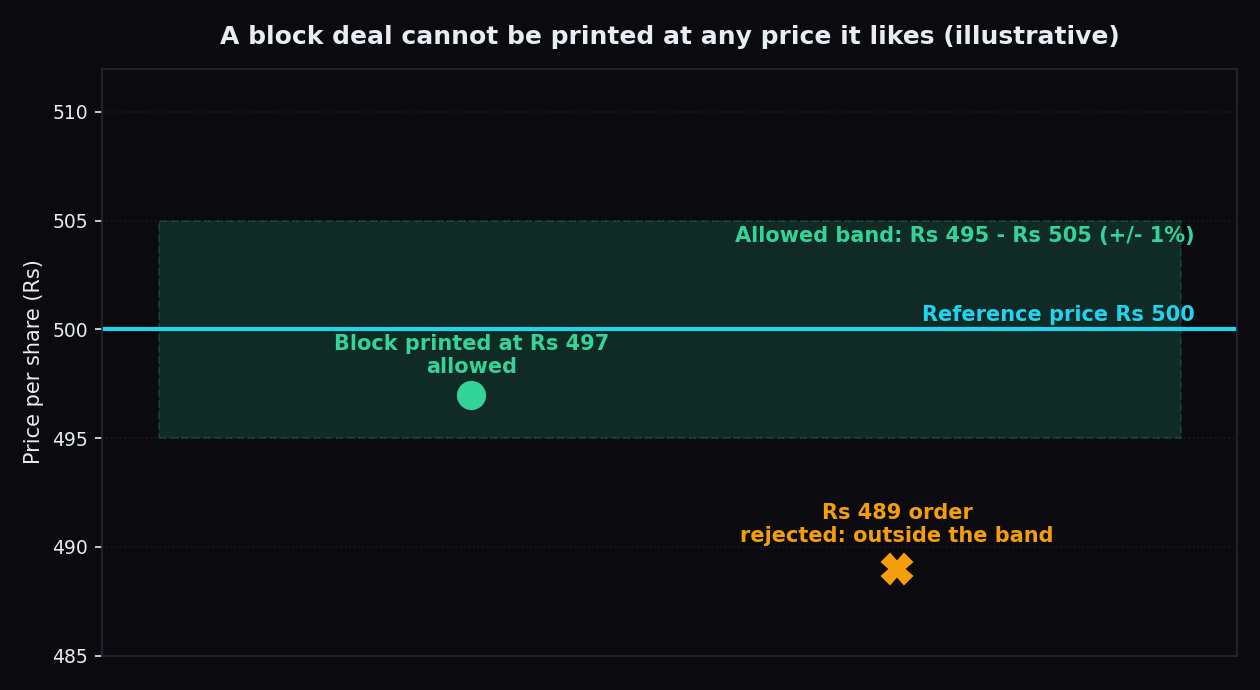
That single constraint explains a lot of block-deal behaviour. Because the discount a large seller can offer is capped, very large sales are often split across several days, or routed through other structures entirely. And it means a block printed near the bottom of the band is not evidence of panic — 1% is simply as far as the rules let the price go.
As with bulk deals, the exchange publishes block deal details after the close: the scrip, the client name, whether it was a purchase or a sale, the quantity and the traded price. NSE and BSE both put these files on their websites daily, free. Those pages are the primary source; the numbers in news coverage are copies of them.
What the disclosure actually tells you
The value of these files is that they attach a name to a size on a date. Most market data is anonymous. Here you can read that a specific fund house, insurance company, or promoter entity moved a specific quantity at a specific average price. Over months, that builds into a genuinely useful record: which institutions have been accumulating a name, which have been reducing, whether a promoter entity has been selling into strength. It pairs naturally with the aggregate picture in FII and DII flow data and, for founder-owned companies, with promoter holding and pledge disclosures.
It is also an honest lesson in trade size. A retail order of a few lakh rupees is invisible; a ₹200 crore order has to be engineered around the market's capacity to absorb it. That is the same force behind slippage, just several orders of magnitude larger.
The honest catch: four things it never tells you
This is the part usually missing from the headline.
- You do not see the other side. A disclosure that names the seller often does not name the buyer, or vice versa. Every share sold was bought by somebody. "Fund X sold 40 lakh shares" is only half a sentence.
- You do not see the reason. Redemptions, a fund manager change, an index rebalance, a lock-in expiry, an internal transfer between two schemes of the same house, an inheritance settlement — all of these look identical to conviction in the file. A sale is not automatically a verdict on the company.
- You see it after the fact. The data is published after market hours. Whatever price impact the trade had has already happened by the time you read it. It is a record, not a live feed.
- One deal is a sample of one. A single fund's decision carries no statistical weight. Patterns across many disclosures over many months are worth something; one line on one evening is an anecdote.
The useful way to hold this data: bulk and block deals tell you what large money did, with a name attached, one day late. They do not tell you what it will do next, and they were never designed to.
Where positioning data picks up the story
Cash-market deal disclosures are backward looking by design. Derivatives positioning is the other half of the picture: it shows where money is sitting now, in the form of open option contracts, though it comes without any names attached. Both are footprints; they just point in opposite directions in time.
Because the honest question is always "does this positioning data actually do anything?", we score ours in public. Across our 14 tracked instruments, in Reliance for example, the put wall — the strike with the heaviest put open interest below spot — held on 64% of the sessions where price touched it (n=14 touches, from 70 scored sessions). Fourteen touches is a small sample and we label it as such, which is rather the point: a number without its n next to it is a marketing claim, not evidence. You can see every instrument's record, updated daily, on the public scoreboard.
TrueTrend turns this kind of market structure into one at-a-glance read across Nifty, Bank Nifty and 12 more F&O names — the levels, the positioning, and our own hit-rates published alongside them. Create a free account to see today's board.
The short version
- Bulk deal — more than 0.5% of a company's listed shares traded by one client, in the normal session, disclosed the same evening.
- Block deal — a negotiated trade of at least ₹10 crore, in one of two 15-minute windows, within ±1% of a reference price, settled by delivery.
- Both are published free by the exchanges after the close. Both name a participant. Neither explains why.
For the current rulebook — thresholds and window timings are revised from time to time — the primary sources are the SEBI circulars on the block deal framework and the daily bulk and block deal files on the NSE and BSE websites.
See these concepts on live market data — free
Create a free TrueTrend account to watch daily support/resistance levels, market regime, and option-positioning charts on NIFTY, BankNifty and 12 more instruments. Every level we publish is scored on a public scoreboard — misses included. No card required.
Free forever tier · daily levels with published hit-rates across every instrument. Descriptive market structure, not investment advice.
Not ready for an account? Get the daily levels by email.
One short email each market day — the indices' call wall, put wall, gamma flip and max pain, and how the last session's levels scored. Free, no account, unsubscribe anytime.
Descriptive market structure, not investment advice. We never share your email.