The Disposition Effect: Why We Sell Winners Early and Hold Losers Too Long
Open a typical retail portfolio and you will find two kinds of positions living side by side. One stock is up 8% and was bought three weeks ago. Another is down 22% and has been sitting there since last year, waiting to “come back to my price”. Ask which one the owner is most likely to close this week, and the answer is almost always the winner. That habit has a name — the disposition effect — and it quietly turns decent stock-picking into poor results.
What is the disposition effect?
The disposition effect is the tendency to close positions that are showing a profit too early, and to hold on to positions that are showing a loss for too long. The term was coined in 1985 by the economists Hersh Shefrin and Meir Statman, and it has since been found in almost every group of investors that researchers have looked at — retail traders, mutual-fund managers, even homeowners deciding what price to list a house at.
Notice what it is not. It is not about picking the wrong stocks. Two people can own the exact same ten stocks and end up with completely different results purely because of when they close each one. The disposition effect is a bug in the exit, not the entry.
Why the brain does this
Three forces push in the same direction, and each one feels perfectly reasonable in the moment.
1. A loss hurts about twice as much as a gain feels good
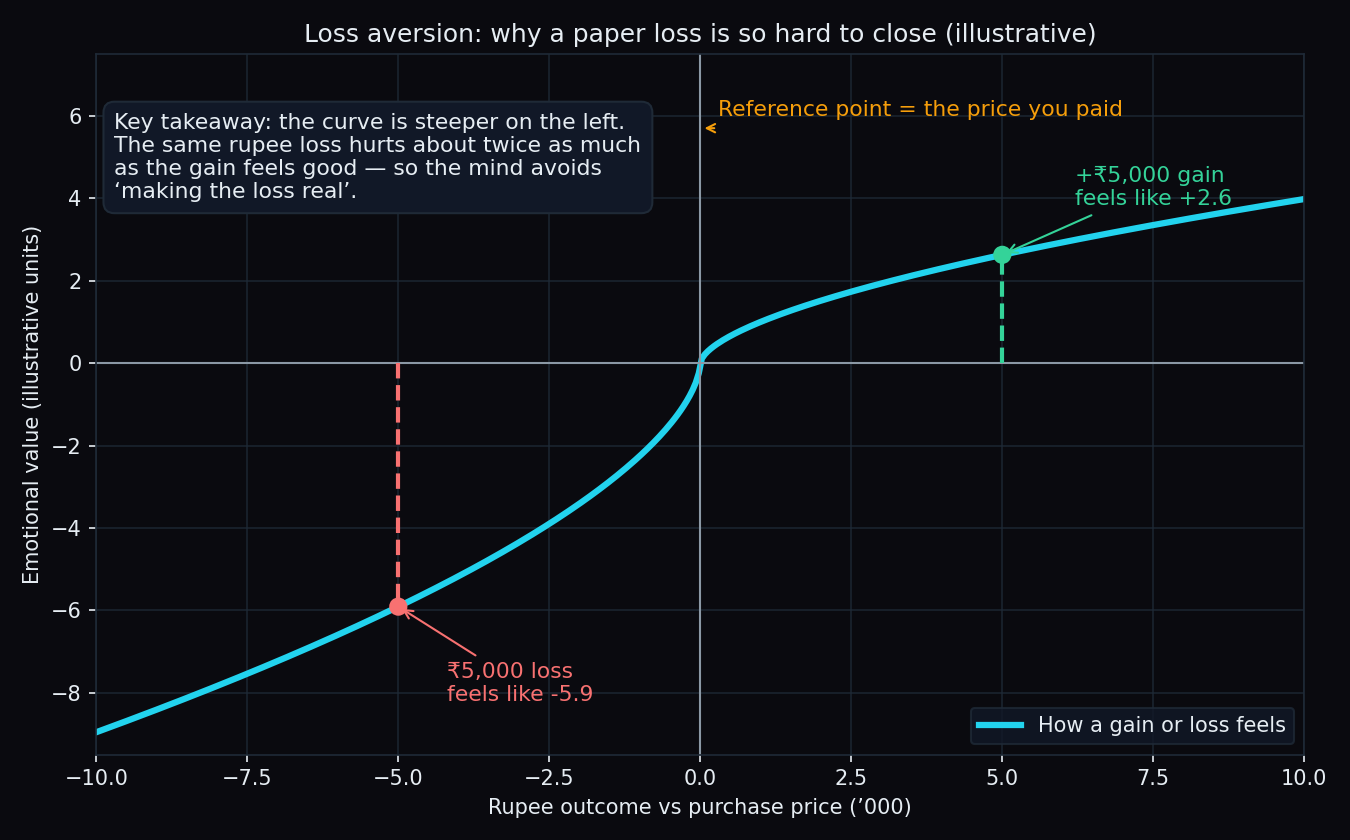
Research in behavioural economics — the prospect theory work of Daniel Kahneman and Amos Tversky — found that people do not weigh gains and losses evenly. A loss of ₹5,000 feels roughly twice as intense as a gain of ₹5,000 feels pleasant. This is called loss aversion. The curve below shows the idea: it is steep and painful on the left, flat and mildly pleasant on the right.
Two things follow from that shape. A small gain feels good quickly, and the flatness of the curve means a bigger gain does not feel much better — so the mind is happy to lock in the small one. And because a loss hurts so much, the mind finds ways to avoid feeling it at all. The easiest way is to never close the position.
2. The purchase price becomes the reference point
Every gain or loss is measured from somewhere, and the brain picks the most obvious anchor: the price you paid. Think of it as a weighing scale that was zeroed at your purchase price. From that moment on, every number on the screen is read as “above my price” or “below my price” — not as “is this a good position to own today?”
The market, of course, has no idea what you paid. The stock does not remember your entry. But the owner does, and that memory becomes the whole decision.
3. A paper loss does not feel real yet
As long as a losing position stays open, it is a paper loss — a number on a screen that could still change. Closing it converts the possibility into a fact, and the mind hates that moment the way it hates opening a credit-card bill. So the bill stays sealed. Traders call this “waiting to get back to even”; researchers call it regret aversion. It is the same hijack described in our post on fear and greed in trading, but stretched out over months instead of minutes.
The evidence: what the data shows
The best-known test of the disposition effect is a 1998 study by the finance professor Terrance Odean, who examined the trading records of roughly 10,000 accounts at a US discount broker between 1987 and 1993. He compared how often investors closed a position that was in profit with how often they closed one that was at a loss, relative to how many of each they were holding. The result: investors were about 50% more likely to realise a gain than a loss. The pattern reversed only in December, when tax-loss booking briefly made closing losers popular.
The more uncomfortable finding was what happened next. The winning stocks that investors sold went on to outperform the losing stocks they kept by roughly 3.4 percentage points over the following year. In other words, the habit was not just emotionally costly — the positions people clung to were, on average, the weaker ones. (These are findings from one US study of one era; treat the exact figures as indicative rather than universal, and check the primary source if you cite them.)
There is no equivalent public study of Indian retail exits at that level of detail, but the outcome side is well documented: in SEBI’s own study of individual F&O traders, roughly 9 out of 10 lost money. Exit habits are one of the few things a trader fully controls, which is why this bias matters more than most.
A worked example with round numbers
Suppose two traders make the same ten trades, ₹10,000 each. The market gives each trade the same fate: six of the ten eventually move 15% in the trader’s favour, and four eventually move 15% against. A 60% hit rate is a perfectly good one. The only difference is the exit habit.
- Trader A (the disposition pattern): books every winner as soon as it shows +5%, and holds every loser until it reaches −15%.
- Trader B (the opposite): cuts every loser at −5%, and lets every winner run to +15%.
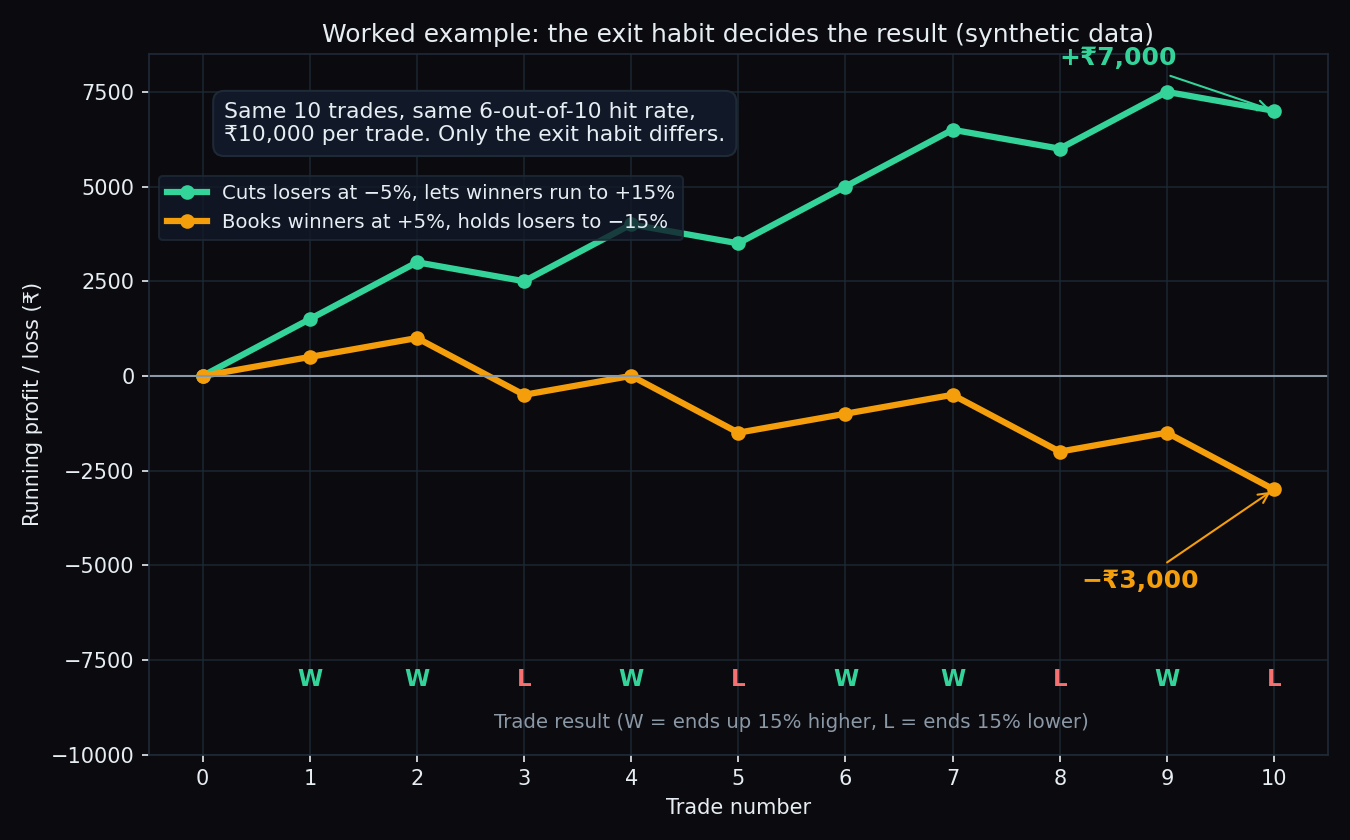
Trader A collects six small wins of ₹500 (₹3,000) and four large losses of ₹1,500 (₹6,000): a net loss of ₹3,000. Trader B collects six wins of ₹1,500 (₹9,000) and four small losses of ₹500 (₹2,000): a net gain of ₹7,000. Same stocks, same hit rate, a ₹10,000 gap — and Trader A is the one who felt good after most trades. (Synthetic numbers drawn to explain the idea, not market data.)
Why it matters: it turns a good hit rate into a loss
The disposition effect does something sneaky to your statistics. It raises your hit rate (the share of trades closed in profit) while shrinking your average win and growing your average loss. Trader A above closes 60% of trades in profit and still loses money, because each loss is three times the size of each win. That is the risk-reward ratio working in reverse.
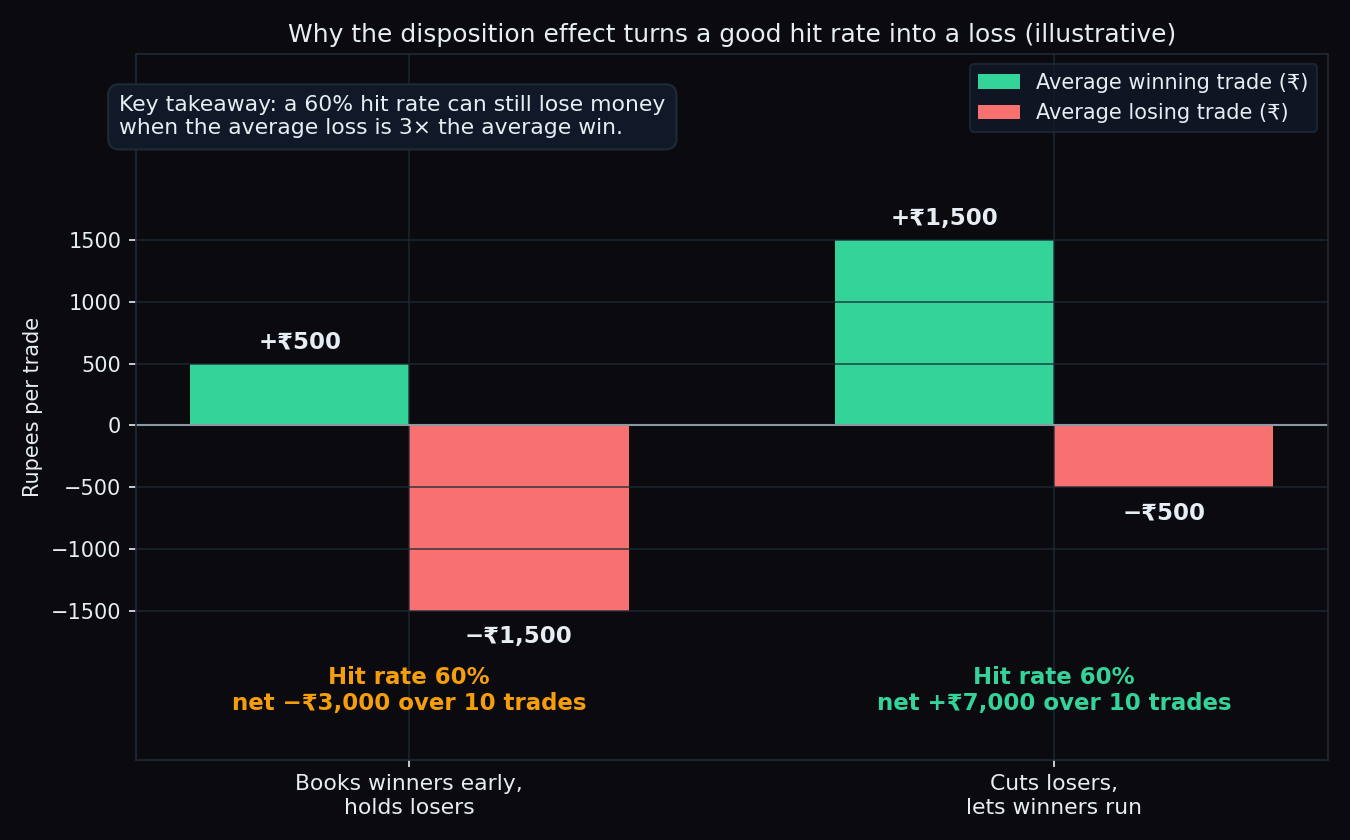
This is also why a trader can feel like they are “mostly right” and still watch the account shrink month after month. The scoreboard in their head counts trades; the account counts rupees.
The disposition effect is not a stock-picking problem. It is an exit problem: it shrinks every win to the size of your patience and grows every loss to the size of your hope.
The honest catch
Two fair objections, because the opposite habit is not free either.
- Cutting losers fast has a cost of its own. A tight exit gets hit by ordinary noise, and some of those closed positions would have recovered. In a choppy, sideways market a rule like “out at −5%” can bleed a series of small losses. The point of the example is not that −5% is the right number — it is that the exit should be chosen before the trade, on a calm day, rather than by how the loss feels afterwards.
- Sometimes holding a loser is the right call. If the reason you own a stock is still intact and only the price has moved, holding can be perfectly sound. The problem is holding because of the price you paid. A useful test: “If I had no position and this stock was at today’s price, would I open it now?” If the honest answer is no, the only thing keeping it in the portfolio is the reference point.
Tax treatment can also make the two sides genuinely unequal in India, since realised losses interact with realised gains under the income-tax rules. That is a legitimate reason the decision is not symmetrical — and a matter for a tax professional, not a blog post.
How experienced traders push back against it
Nobody switches off loss aversion; it is wired in. What experienced traders do instead is remove the decision from the moment where the bias is strongest:
- Decide the exit before the entry. A stop-loss set when the trade is opened and a planned level for taking profit turn the exit into a rule rather than a feeling.
- Judge the position, not the entry price. Some traders hide the cost column in their broker app so that the only question left is whether the position makes sense today.
- Size positions by rule. A position-sizing rule keeps any single loser small enough that closing it does not feel like a catastrophe.
- Review closed trades by rupees, not by count. Track average win against average loss every month. A rising hit rate with a falling average win is the disposition effect showing up in the numbers.
- Beware the revenge reflex. A large loss finally closed can trigger revenge trading. The cure for one bias should not become the trigger for another.
Being wrong is part of any real edge
A big part of the fix is accepting that losses are normal, not personal. Even measured, publicly scored market tendencies miss regularly. On the Nifty, for example, the strike carrying the heaviest put open interest — the put wall — has held on 67% of the sessions where the index touched it (n=30 touches, live scored data as of 24 August 2026). That is a genuinely useful tendency, and it still fails roughly 1 time in 3. If a scored, data-backed level is wrong that often, an individual trade has no right to be held until it “comes back” just to spare the owner a moment of regret.
The habit is hard to break because the pain is real. TrueTrend was built for exactly that moment: instead of staring at your entry price, you can see how Nifty, Bank Nifty and the F&O crowd are actually positioned right now — one clear, at-a-glance read, scored in public with the misses included. Create a free account.
See these concepts on live market data — free
Create a free TrueTrend account to watch daily support/resistance levels, market regime, and option-positioning charts on NIFTY, BankNifty and 12 more instruments. Every level we publish is scored on a public scoreboard — misses included. No card required.
Free forever tier · daily levels with published hit-rates across every instrument. Descriptive market structure, not investment advice.
Not ready for an account? Get the daily levels by email.
One short email each market day — the indices' call wall, put wall, gamma flip and max pain, and how the last session's levels scored. Free, no account, unsubscribe anytime.
Descriptive market structure, not investment advice. We never share your email.