Hero-or-Zero Expiry Trades: The Real Math Behind Lottery Options
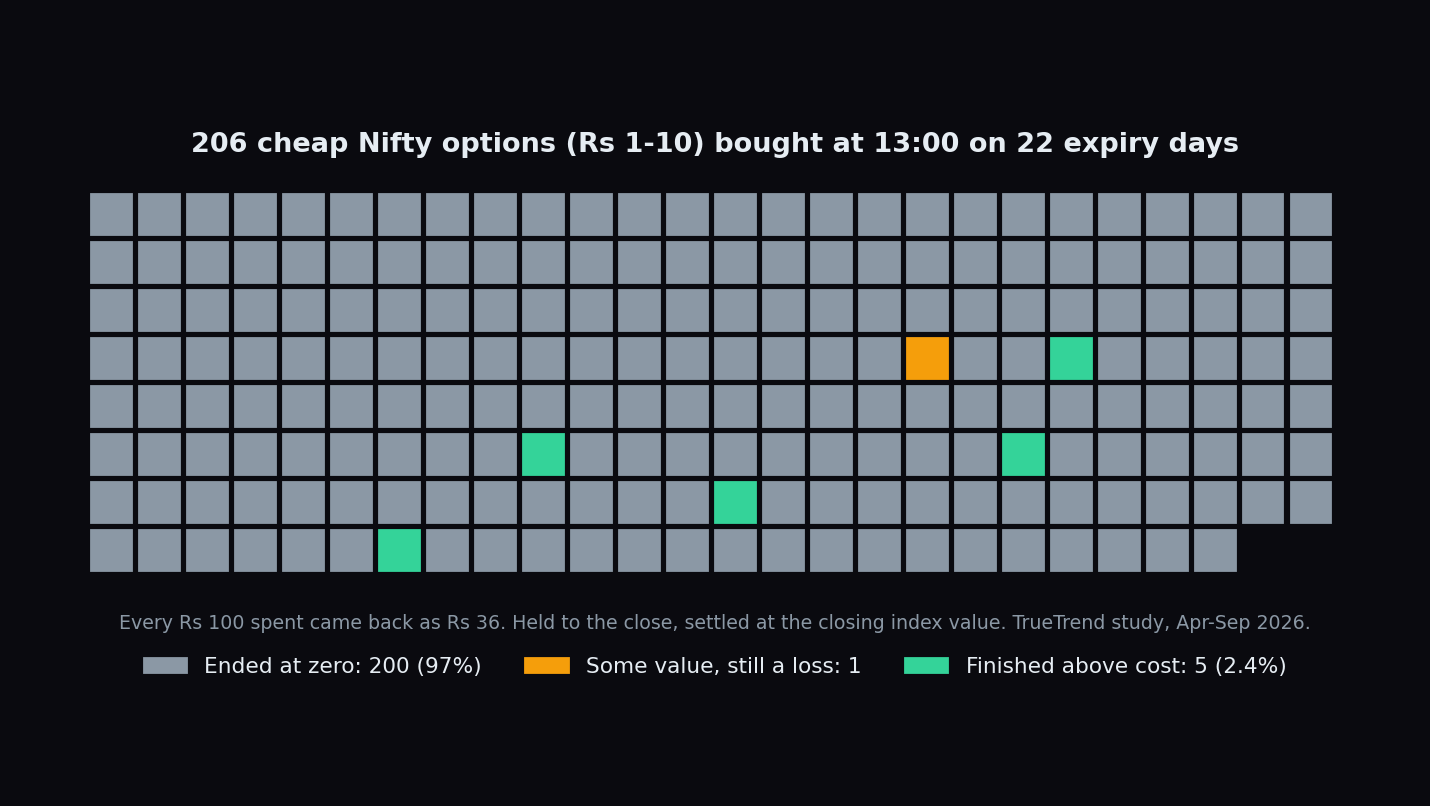
Here is what a hero-or-zero trade looks like when you run it every week instead of remembering the one time it worked. We took every Nifty weekly expiry between 28 April and 22 September 2026 (22 expiry days), and at 13:00 on each of them we “bought” every out-of-the-money option quoted between ₹1 and ₹10, at the asking price, and held it to the close. That is 206 lottery tickets. 200 of them (97%) expired at zero. Five finished above what they cost. Every ₹100 spent came back as ₹36. This post explains what these trades are, why the tickets are so cheap, and the arithmetic that decides whether they can ever pay.
What a “hero-or-zero” trade is
First, three terms.
- Expiry day is the day an option contract ends. Nifty weekly options currently expire on Tuesday; after the close the contract is settled against the closing value of the index and disappears. (Background: what happens on expiry day.)
- Out of the money (OTM) means the option’s strike is on the wrong side of the current price. A call with a strike of 23,500 when Nifty is at 23,320 is 180 points out of the money: it is only worth something at the close if Nifty finishes above 23,500. (Refresher: ITM, ATM and OTM explained.)
- Premium is the price of the option. On expiry afternoon, far OTM options trade for ₹1 to ₹10 per unit, sometimes less.
A hero-or-zero trade is picking up one of these very cheap OTM options a few hours before expiry and holding it, hoping for a sudden move that turns ₹5 into ₹50 or ₹100. If the move comes, you are the hero. If it does not, the option is worth exactly zero at 15:30. There is no middle.
It is popular for an obvious reason: the ticket is cheap, the story is exciting, and everyone has seen a screenshot of a 20x winner. What nobody screenshots is the other 19 weeks.
The analogy: a raffle ticket with a printed price
Think of a school raffle. A ticket costs ₹5. One ticket in a hundred wins a ₹300 prize. Is ₹5 a good price?
Work it out the way the organiser does. One hundred tickets bring in ₹500. The prize costs ₹300. The organiser keeps ₹200. On average, each ₹5 ticket is worth ₹3 to the person holding it. The ticket is not cheap because it is a bargain. It is cheap because it will almost certainly lose.
An expiry-day option is a raffle ticket whose price is set by thousands of professional organisers competing with each other. The people writing (creating and offering) those options price them off how likely the move is and how much time is left. When an option costs ₹3, that price already says “this almost certainly finishes at zero”. A cheap price is the probability, written in rupees.
The math, with round numbers
Every lottery option has three numbers: the cost, the chance it pays, and the payoff when it does. The trade is worth doing on average only if chance × payoff is bigger than the cost.
Say you pay ₹5 for a call 150 points out of the money with two and a half hours to go. Suppose that once in 20 expiries the index moves far enough that the option finishes worth ₹60.
- Expected payoff: 1⁄20 × ₹60 = ₹3.
- Cost: ₹5.
- Average result per ticket: ₹3 − ₹5 = −₹2.
Run it 20 times: 19 tickets lose ₹5 each (−₹95), one ticket wins ₹60 for a net +₹55, and the total is −₹40. You had a 12x winner and still lost money. For the ₹5 ticket to be fair, the win would have to arrive once in 12 expiries, or pay ₹100 instead of ₹60.
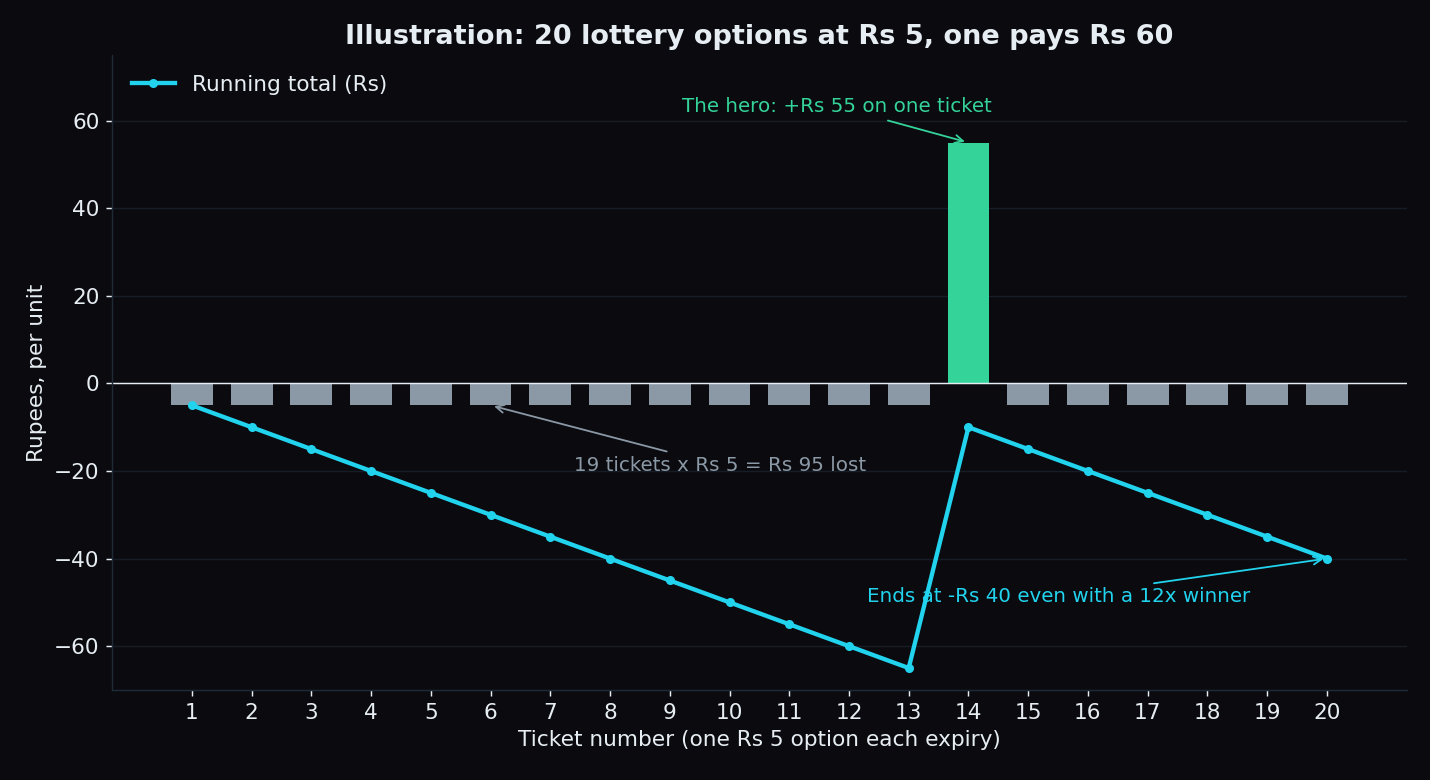
So the whole question is: how often does the big move actually arrive, and how big is it when it does? That is something we can measure.
What our data says: 22 Nifty expiries
TrueTrend records the Nifty option chain about once a minute, with the bid and ask of every strike. We used that archive to simulate the trade honestly: entry at the asking price (what you would actually pay), held to the close, settled at the official closing index value. No brokerage, no securities transaction tax, no slippage, so real results would be a little worse than everything below.
A “lottery ticket” is any OTM call or put with a live two-sided quote and an ask between ₹1 and ₹10. At 13:00, across the 22 expiry days, there were 206 of them.
- Ended at zero: 200 of 206 (97%).
- Finished with any value at all: 6 of 206 (3%).
- Finished above cost: 5 of 206 (2.4%).
- Paid 5x or more: 3 of 206 (1.5%). 10x or more: 2 of 206 (1%).
- Money in, money out: every ₹100 spent came back as ₹36.
- Days with at least one winning ticket: 4 of 22.
The best ticket in the set was the 24,250 call on 25 August, priced at ₹4.85 at 13:00 with Nifty at 24,158. The index closed at 24,335, so the call settled at ₹84.55, about 17x. It was the hero. It also produced 55% of the entire sample’s payout on its own. Remove that one day and the other 21 expiries returned ₹17 for every ₹100 spent.
Cheaper is not better
The very cheapest tickets are the worst. Split the 13:00 set by price:
- ₹1 to ₹3 (n=135): 134 ended at zero (99.3%). One paid, at about 16x. Every ₹100 came back as ₹16.
- ₹3 to ₹10 (n=72): 67 ended at zero (93%). Four finished above cost (5.6%). Every ₹100 came back as ₹47.
A ₹1.50 option is not a “cheaper” version of a ₹6 option. It is a different bet on a much bigger move that almost never happens with two hours left.
Does the entry time matter?
We ran the same simulation with entries at 10:00, 12:00, 13:00 and 14:00 (same ₹1 to ₹10 rule).
- 10:00 (n=355 tickets): 97.2% ended at zero; 2.8% finished above cost; ₹100 came back as ₹75.
- 12:00 (n=262): 96.2% zero; 3.1% above cost; ₹100 came back as ₹57.
- 13:00 (n=206): 97.1% zero; 2.4% above cost; ₹100 came back as ₹36.
- 14:00 (n=158): 94.9% zero; 4.4% above cost; ₹100 came back as ₹68.
Every entry time lost money. The 10:00 figure looks the least bad, and there is a reason: on 23 June the index fell 336 points from its 10:00 level, and a ₹3.05 put at 23,950 settled at ₹154.75, about 51x. That single day supplied 73% of everything the 10:00 tickets ever paid. Once again, one day carried the sample, and the sample still finished down a quarter.
How big are expiry-afternoon moves, really?
From 13:00 to the close on these 22 expiry days, the median Nifty move was 53 points. The index moved 100 points or more on 6 of the 22 days, 150 points or more on 2, and never 200 points. The biggest afternoon move in the sample was 193 points. Yet at 13:00 the average lottery ticket in our set was sitting 239 points away from the index. Most of these options needed a move that did not happen once in five months.
The paper hero
There is one number in the study that explains why this trade feels better than it is. Of the 206 tickets bought at 13:00, 45 (22%) traded at double their cost at some point during the afternoon. On the screen, one ticket in five became a winner. Only 5 were winners at the close.
That is time decay, or theta, doing its job: with a few hours left, a cheap option loses value very fast unless the index keeps moving toward its strike. A 50-point wobble at 14:15 can double a ₹4 option; a quiet last hour takes it to ₹0.05. (Full explainer: option theta and time decay.) The holder who saw ₹9 on the screen remembers being right. The settlement remembers zero.
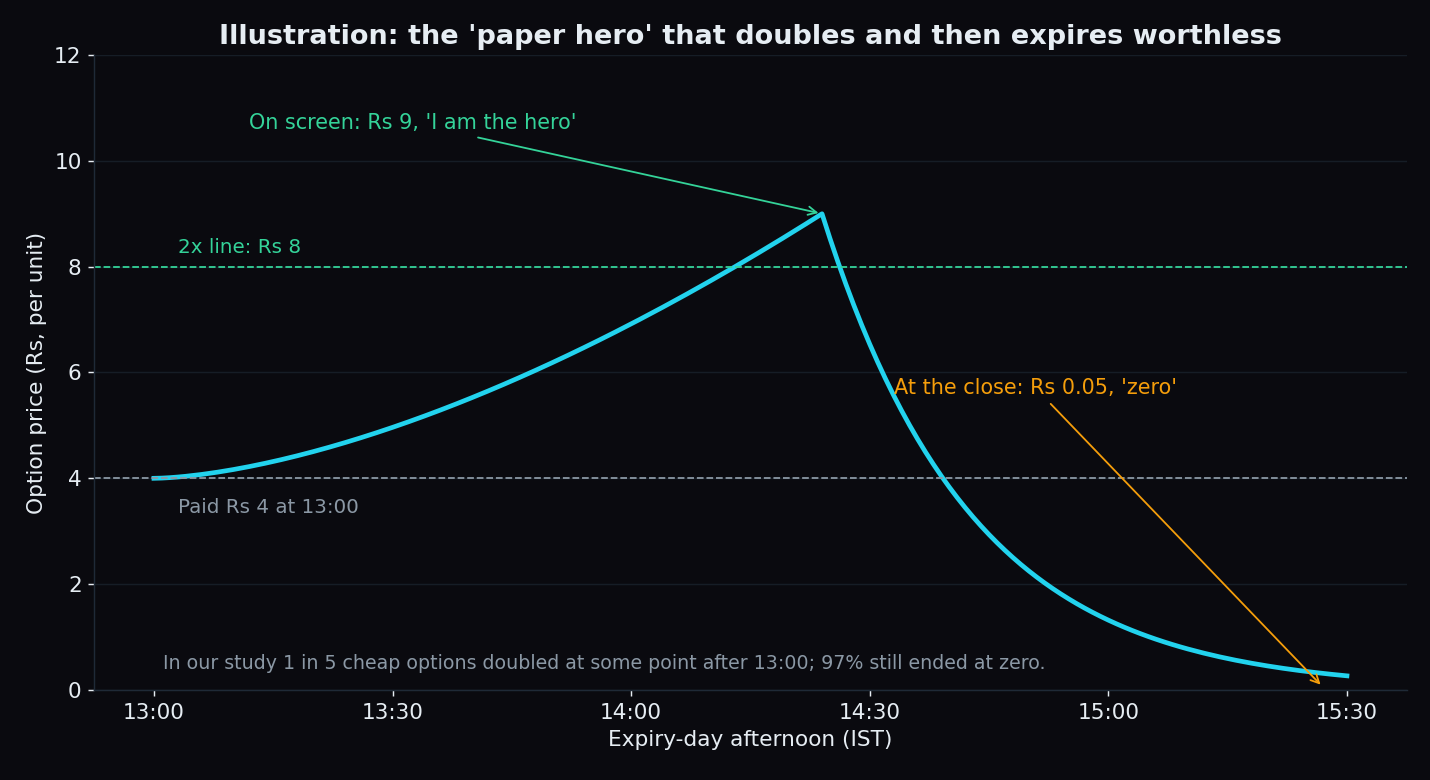
A real example from 22 September. At 13:00 Nifty was at 23,320. The 23,500 call (180 points away) was offered at ₹3.55 and the 23,150 put (170 points away) at ₹3.50. At 14:30 the index popped to 23,388 and the call was trading at ₹9.45, about two and a half times its cost. Nifty closed at 23,329. Both options settled at zero.
Why the tickets are priced the way they are
- The price is the probability. Option writers are not offering ₹3 calls out of generosity. They are pricing a low chance of a big move, and they collect a small edge for carrying the risk, week after week. That edge is your expected loss. (Why writers earn it on average: the volatility risk premium.)
- The spread is huge in percentage terms. A ₹1.40 bid and ₹1.45 ask looks like nothing. It is 3.5% of the price, paid before anything happens. Add brokerage and, if the option does finish in the money, securities transaction tax on the settlement (how STT on expiry works).
- Most of the day is calm. The moves that make heroes are rare and cluster on a handful of days, usually with a macro or global trigger. The rest of the time the index drifts a few dozen points and the entire far-OTM chain decays to nothing together.
The honest limits of this study
This is 22 expiries of one index over five months. There was no crash day in the sample, and a single 500-point afternoon would change the totals a lot. That is exactly the point: the trade’s result depends almost entirely on whether a rare day shows up while you happen to be holding, and there is no way to know in advance which Tuesday that is. We also did not model early exits. Someone who booked every 2x on the screen would have done better than our hold-to-close rule, but they would also have sold the 17x winner at 2x. The expectancy math is unforgiving either way: a 2% hit rate needs an average winner of 50x just to break even, before costs.
None of this says a cheap expiry option can never pay. Twice in the 13:00 set it paid 15x or more, and once in the 10:00 set it paid 50x. It says that over a run of weeks the average ticket returns a fraction of what it cost, and the memorable winner is what keeps people paying for the rest.
Key takeaway: A ₹3 option is not a discount on a ₹30 option. It is the market’s estimate that the move you need almost certainly will not arrive. In 22 Nifty expiries, 97% of cheap 13:00 tickets settled at zero and ₹100 became ₹36, with more than half of all winnings coming from one afternoon.
Want to see where the option chain is actually crowded on expiry day, and how those levels have held up in the past, without decoding the chain yourself? TrueTrend turns positioning across Nifty, Bank Nifty and F&O stocks into a clear, at-a-glance read, with every level scored in public on the Scoreboard. Create your free TrueTrend account.
See these concepts on live market data — free
Create a free TrueTrend account to watch daily support/resistance levels, market regime, and option-positioning charts on NIFTY, BankNifty and 12 more instruments. Every level we publish is scored on a public scoreboard — misses included. No card required.
Free forever tier · daily levels with published hit-rates across every instrument. Descriptive market structure, not investment advice.
Not ready for an account? Get the daily levels by email.
One short email each market day — the indices' call wall, put wall, gamma flip and max pain, and how the last session's levels scored. Free, no account, unsubscribe anytime.
Descriptive market structure, not investment advice. We never share your email.