US Fed Meetings and Indian Markets: Why the 11:30 PM Decision Matters
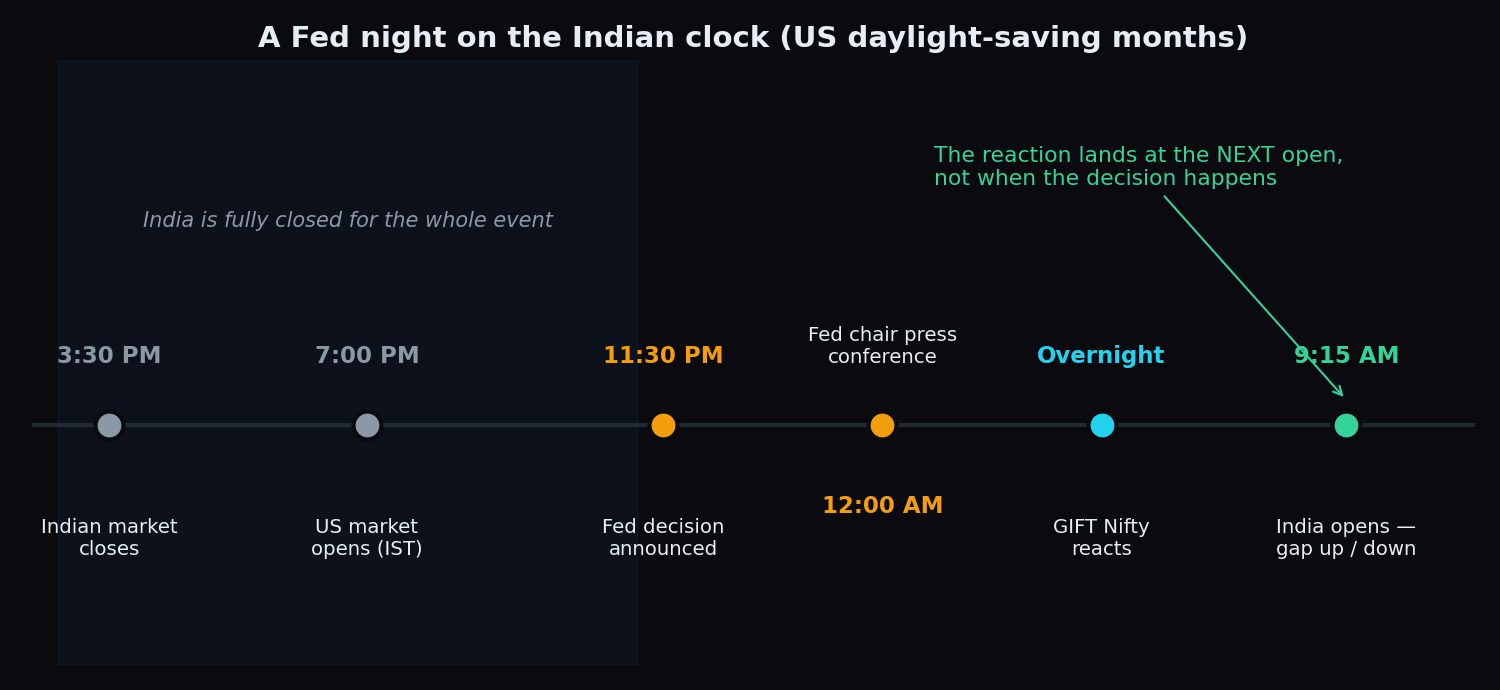
Eight nights a year, at around 11:30 PM India time, a committee in Washington announces a single number — and the next morning Nifty can open a hundred or more points away from where it closed. The Indian market is shut for the entire event. Nobody here can react in real time. Yet the US Federal Reserve’s interest-rate decision is one of the few scheduled events that can reset Indian prices overnight. This post explains what actually happens at 11:30 PM, the three routes by which a US interest rate reaches Indian stocks, and why most Fed nights still end quietly.
What actually happens at 11:30 PM?
The Federal Reserve (“the Fed”) is the central bank of the United States — the American counterpart of our RBI. Its job is to keep US inflation low and employment healthy, and its main tool is the federal funds rate: the interest rate at which US banks lend money to each other overnight. Almost every other dollar borrowing cost in the world keys off this one rate.
The rate is set by the FOMC (Federal Open Market Committee), which holds eight scheduled meetings a year, roughly one every six weeks. Each meeting ends with a written statement released at 2:00 PM Washington time. India runs 9½ hours ahead of Washington during the US daylight-saving months (roughly March to November), so the statement drops at 11:30 PM IST. In the US winter the gap widens to 10½ hours and the same release lands at 12:30 AM IST. About thirty minutes after the statement, the Fed chair takes questions from the press — and this press conference often moves markets more than the rate itself.
Why a US interest rate moves Indian stocks
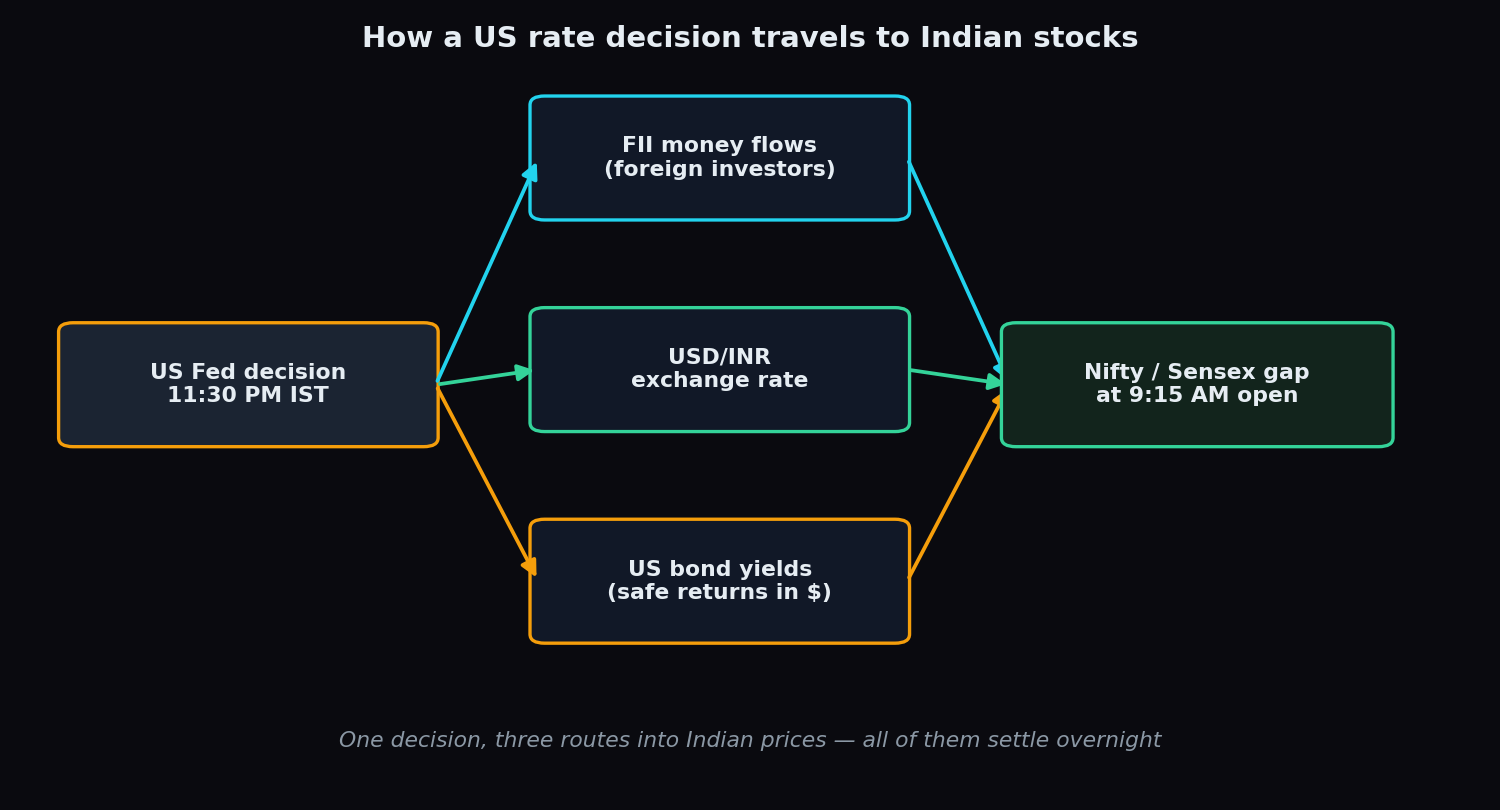
Think of the Fed as setting the interest rate at the world’s biggest bank. Global money behaves like a tenant hunting for the best deal on rent: when the safe return on dollars changes, money everywhere quietly re-checks its options. That re-checking reaches India through three main routes:
- FII flows. Foreign institutional investors (FIIs) constantly compare the safe return they can earn in dollars against the riskier, higher return they hope to earn in markets like India. When safe dollar returns rise, some of that money heads home; when they fall, more of it looks abroad. We covered how large these flows are in FII vs DII: who moves Indian markets.
- USD/INR. Rate changes move the dollar, and a stronger dollar usually means a weaker rupee. That raises the cost of imports like crude oil and quietly shrinks the dollar value of an FII’s Indian holdings. The full chain is in our USD/INR and the stock market explainer.
- Bond yields. US government bond yields act as the world’s reference for a “safe” return. When they jump, the maths of every valuation on earth shifts a little — expensive growth stocks most of all. See bond yields explained for why.
A worked example with simple round numbers
Imagine a global fund holding the equivalent of ₹1,000 crore. Its safe option — US government bonds — pays 4% a year: a sure ₹40 crore. Indian equities might plausibly earn 12%, or ₹120 crore, but with big swings and currency risk attached. The extra ₹80 crore is the reward the fund demands for taking that risk.
Now the Fed raises rates by one percentage point. The safe option suddenly pays 5% — ₹50 crore for doing nothing. The extra reward for holding Indian risk shrinks from ₹80 crore to ₹70 crore. If the rupee also slips 2% against the dollar, the fund’s dollar-measured return shrinks again. Nothing changed inside India — no results, no policy, no news — yet Indian stocks became relatively less attractive overnight. Repeat this arithmetic across thousands of funds and the flows shift, and with them, prices. The same logic runs in reverse when the Fed cuts.
India is asleep when it happens: the gap-open mechanism
The Indian cash market trades from 9:15 AM to 3:30 PM. A Fed decision at 11:30 PM lands a full eight hours after our close, so there is no Indian screen on which the reaction can play out live. The first visible “Indian” reaction appears on GIFT Nifty — the Nifty futures contract that trades in GIFT City for nearly the whole day and night — which reprices within minutes of the statement. We explain how to read it in GIFT Nifty and global cues.
By the time Nifty reopens at 9:15 AM, the news is more than nine hours old and fully digested by markets that stayed awake. The adjustment therefore shows up as a gap — the index simply opens at a different level, up or down, with no way to have traded the move in between. This is the same mechanism by which any overnight US development reaches us, as covered in how US markets affect India.
“Priced in”: why many Fed nights end quietly
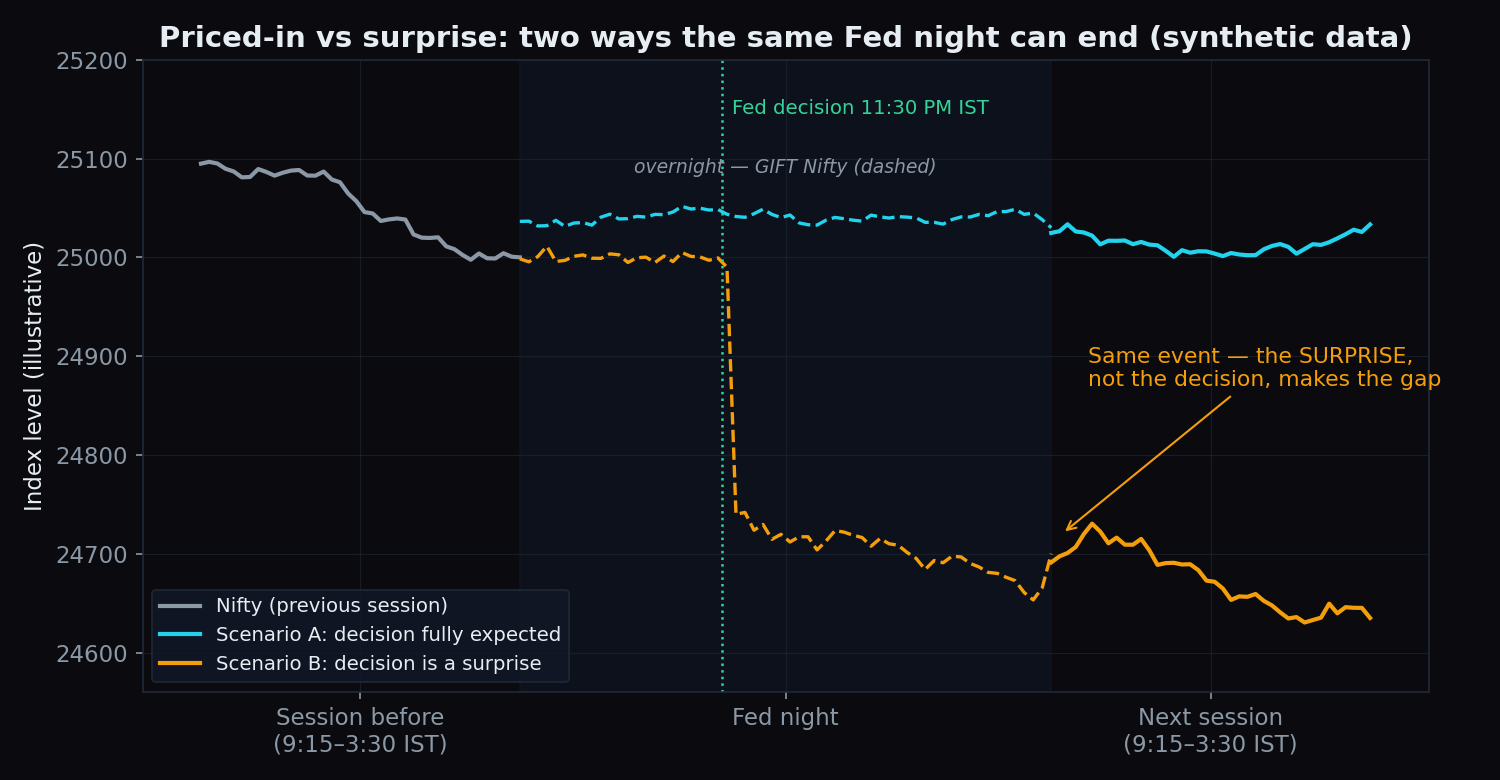
Here is the part beginners find surprising: the decision itself is usually not news. US interest-rate futures let traders stake money on what the Fed will do, and from those prices you can read the market’s implied odds weeks in advance. By decision night, the outcome is often considered near-certain — it is priced in, meaning current prices already assume it.
What moves markets is the surprise: a decision that differs from those odds, a change in the statement’s wording, a shift in the committee members’ published rate projections (the “dot plot”), or an unexpected tone in the press conference. An expected move can land with a shrug, while a mere hint about future meetings can move markets sharply at midnight IST.
What Indian traders actually watch on a Fed night
None of this requires predicting the Fed. What experienced participants do is describe the setup before the event:
- India VIX often firms up ahead of big scheduled events, because option prices carry extra insurance value for the known date. Our India VIX explainer covers what that number does and does not tell you.
- The expected move implied by option prices tends to widen around Fed nights — the market literally quotes a bigger range for the next day. The calculation is in expected move: what option prices say about the daily range.
- Gap risk is unhedgeable in real time. Anyone holding overnight positions knows the market will reopen wherever it reopens; no order placed inside Indian market hours can act on a move that happens at midnight.
The honest catch: most Fed nights are non-events for India — the outcome was priced in, and Nifty opens roughly flat. When a gap does come, it comes from the surprise, not the decision. And even a large overnight gap says nothing certain about where the index closes the next day: initial reactions partially reverse often enough that the 9:15 AM print is the start of the story, not the end of it.
Fed nights are exactly when scattered signals — global cues, USD/INR, F&O positioning — matter most and are hardest to piece together. TrueTrend turns them into one clear, at-a-glance read on how Nifty and Bank Nifty are placed before the open, and it scores its own track record in public. Create a free account and see the next Fed morning laid out for you.
See these concepts on live market data — free
Create a free TrueTrend account to watch daily support/resistance levels, market regime, and option-positioning charts on NIFTY, BankNifty and 12 more instruments. Every level we publish is scored on a public scoreboard — misses included. No card required.
Free forever tier · daily levels with published hit-rates across every instrument. Descriptive market structure, not investment advice.
Not ready for an account? Get the daily levels by email.
One short email each market day — the indices' call wall, put wall, gamma flip and max pain, and how the last session's levels scored. Free, no account, unsubscribe anytime.
Descriptive market structure, not investment advice. We never share your email.