American vs European Options: Why Indian Index Options Can't Be Exercised Early
A Nifty 24,800 call is trading at 260 with five days left, and Nifty is at 25,000. If you could exercise it today, you would collect 200. If you simply close it in the market, you collect 260. That gap of 60 is the whole reason the “can’t exercise early” rule on Indian index options matters far less than it sounds.
This post explains the two styles of options — American and European — why every Nifty and Bank Nifty option is the European kind, and the few situations where that difference really does show up.
First, what does “exercise” mean?
An option is a contract that gives its holder a right, not a duty. A call is the right to receive the difference if the underlying ends up above a fixed price; a put is the same for below. That fixed price is the strike. (New to calls and puts? Start with calls and puts explained.)
Exercising means actually using that right — telling the exchange “settle this contract now.” The holder is the person who paid the premium and owns the right. The writer is the person on the other side who received the premium and must honour the contract.
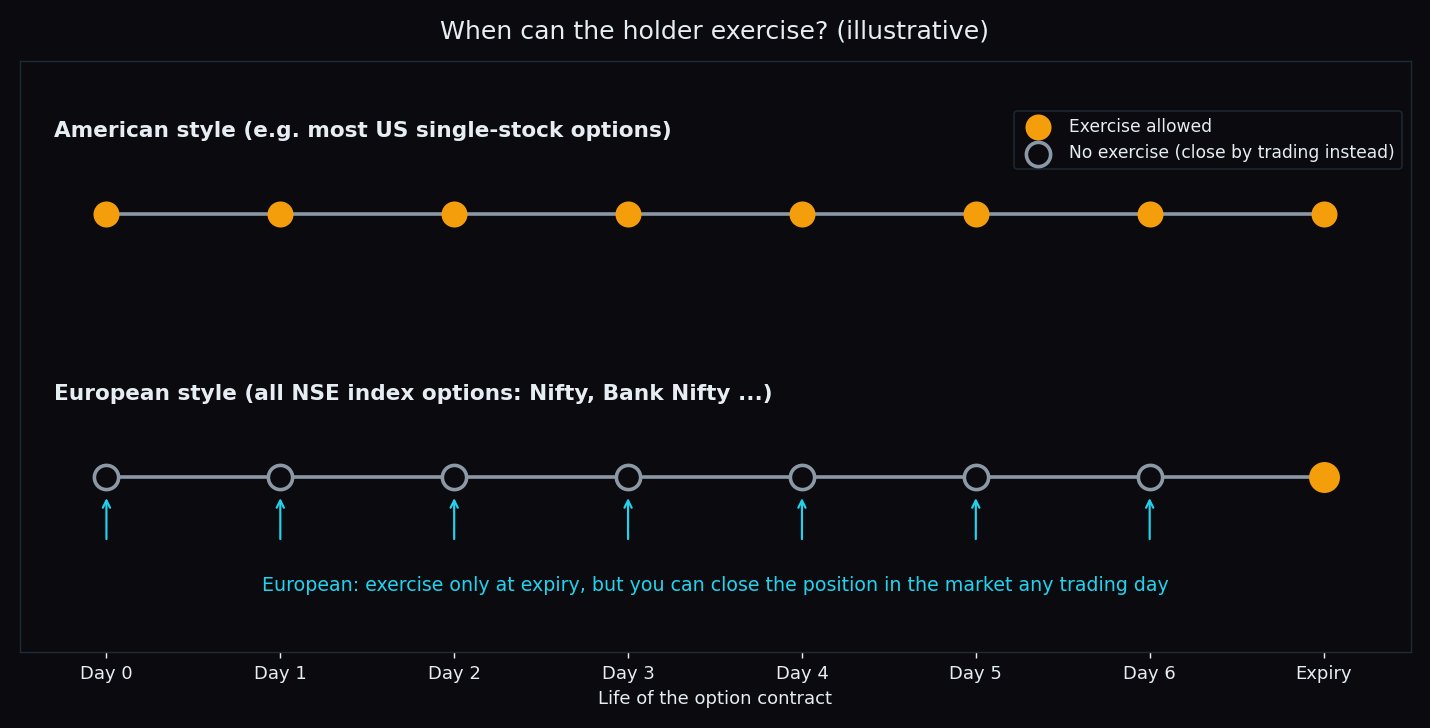
The two option styles differ on only one question: when is the holder allowed to exercise?
- American-style: on any trading day up to and including expiry.
- European-style: only at expiry.
The names have nothing to do with geography any more. Plenty of options traded in the US are European-style, and the reverse is also true.
An everyday analogy: the concert ticket
Think of an option as a concert ticket.
- An American ticket works like a pass you can use on any night of the tour.
- A European ticket is valid only on the night of the show. You cannot walk in early.
But here is the part people forget: with either ticket, you can hand it to someone else at the going rate whenever you like. You don’t need to attend the show to get value out of it. For options, that “hand it on” step is just closing your position on the exchange — and on liquid Nifty strikes you can do that every trading minute.
What India actually uses
On NSE, the index options that most people trade — Nifty 50, Bank Nifty and the other index contracts — are European-style. They are also cash-settled: you can’t take delivery of “the Nifty”, so at expiry an in-the-money contract simply pays the difference between the final settlement price and the strike, in rupees. In-the-money contracts are exercised automatically at expiry; nobody has to press a button.
Stock options in India are European-style too. They were American-style when single-stock options launched in 2001 and were moved to European style around 2010–11 (NSE’s circulars from that period have the exact dates). Unlike index options, most stock F&O contracts now end in physical settlement — actual shares change hands — but that still happens only at expiry.
For comparison, in the US most options on individual stocks are American-style, while S&P 500 index options (SPX) are European-style and cash-settled — much like Nifty. The pattern is not an accident: an index can’t be delivered, so cash settlement at one fixed moment is the clean design.
Why early exercise is usually a bad deal anyway
Every option premium has two parts (covered in depth in intrinsic and time value):
- Intrinsic value — what the option would pay if it settled right now. For a 24,800 call with Nifty at 25,000, that is 25,000 − 24,800 = 200.
- Time value — the extra the market pays for the chance that things get even better before expiry. If the premium is 260, time value is 260 − 200 = 60.
Now run the example both ways, per unit:
- Exercise early (if the rules allowed it): you receive intrinsic value only — 200. The 60 of time value vanishes.
- Close the position in the market: whoever takes the other side pays the full premium — 260.
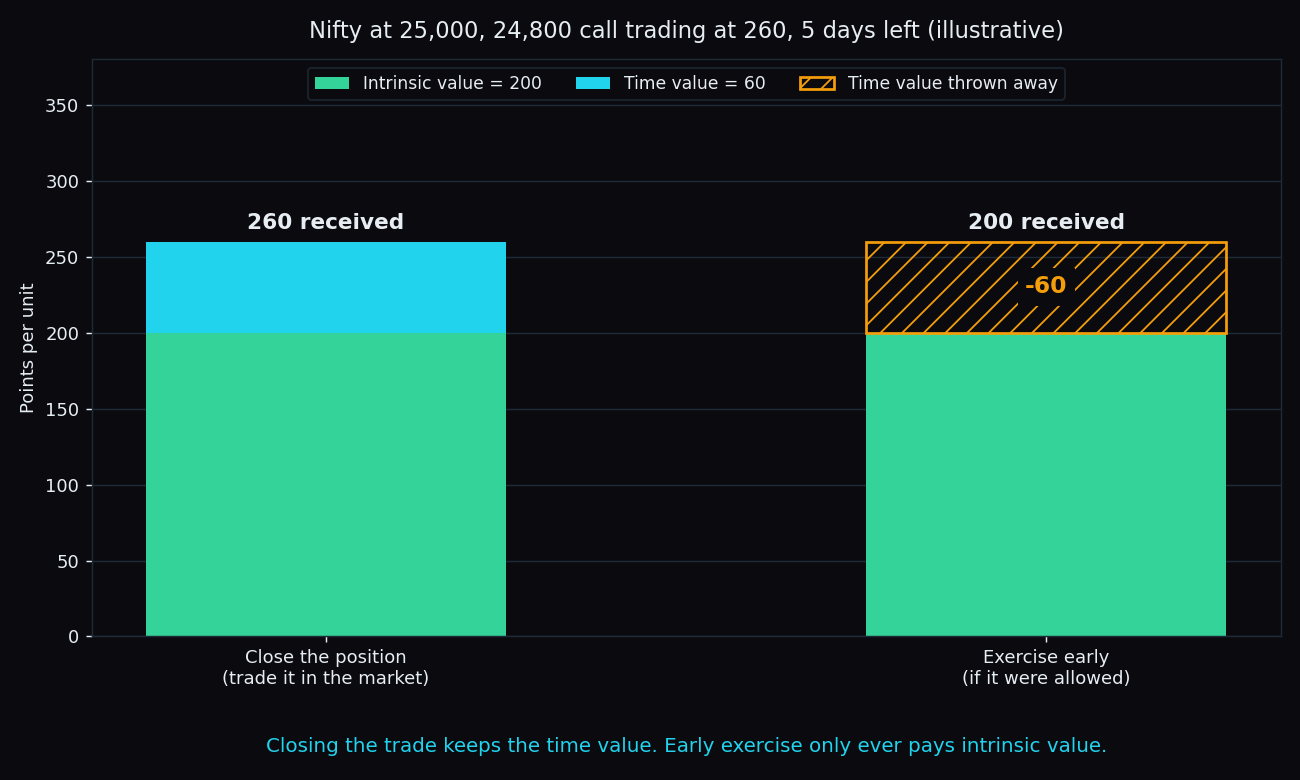
Early exercise can only ever hand you intrinsic value. Closing the trade hands you intrinsic value plus whatever time value is left. As long as there is time value and a working market, closing wins. That is why, even in the US where early exercise is allowed, it is used sparingly and mostly in special cases — such as calls on a stock just before a large dividend, where the dividend is worth more than the time value given up.
And by expiry, the question disappears. Time value melts to zero as the clock runs out (see theta and time decay), so at expiry the premium equals intrinsic value. Settling at that moment gives up nothing.
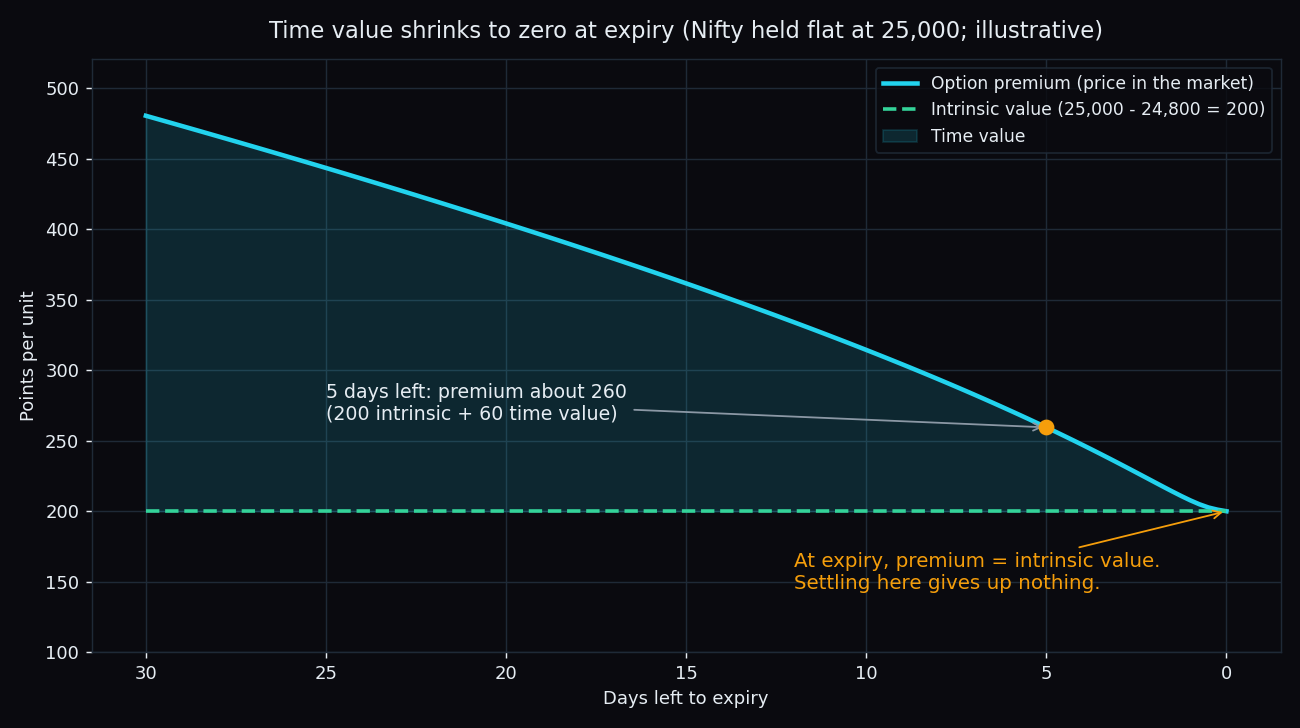
The honest takeaway: for a holder, “can’t exercise early” almost never means “can’t get out early.” You get out by closing the position, which keeps the time value that exercise would have thrown away.
The catch: when European style really does matter
The analogy breaks in a few real situations. These are the ones worth knowing.
1. Illiquid strikes
“Just close it” assumes someone is quoting a fair price. Near-the-money Nifty strikes are deep and busy. Far strikes, deep in-the-money strikes, and thinly traded stock options can have wide gaps between the best bid and best offer. A deep in-the-money option can even be quoted below its intrinsic value. An American holder could exercise to capture full intrinsic value; a European holder can’t, so they either accept the poor quote or wait for expiry.
2. Holding to expiry has its own costs
If you let an in-the-money option settle at expiry instead of closing it, the tax and charges treatment can differ from a normal closing trade. We walk through that in STT on in-the-money options at expiry. Check your broker’s current contract note and the latest rules rather than relying on old rates.
3. The settlement price is a single moment
Because every open contract resolves against one final settlement price, the last stretch of expiry day gets outsized attention (our expiry-day guide covers the current schedule). A position that looked comfortable at 2 pm can settle very differently at the close. There is no early-exercise escape hatch — only closing the trade before then.
4. For writers: no surprise assignment, but still daily risk
This is the flip side, and it helps option writers. In the US, a writer of an American option can be assigned early — told to honour the contract on any day, often right before a dividend. A writer of a Nifty option faces settlement only at expiry.
That does not make writing safe. Premiums still move every day, losses are still marked to market daily, and margin calls still arrive. European style removes the surprise of early assignment, not the risk of the position.
Does a single settlement moment pull prices around?
Because all Nifty options resolve at one moment, some traders watch max pain — the strike where option holders collectively would receive the least. It is worth testing rather than trusting. On our public scoreboard, Nifty closed within one strike of max pain in 40% of scored sessions (n=90), and Bank Nifty in just 14% (n=90). That is a sometimes-useful reference point, not a magnet.
Quick recap
- American options can be exercised any day; European options only at expiry.
- Nifty, Bank Nifty and Indian stock options are all European-style; index options are cash-settled.
- Early exercise pays only intrinsic value. Closing the trade pays intrinsic plus time value, so for holders the rule rarely costs anything.
- It matters most on illiquid strikes, at the final settlement moment, and — in the writer’s favour — by ruling out early assignment.
Because every Nifty and Bank Nifty option resolves at one settlement price, where open interest is stacked matters more as expiry approaches. TrueTrend turns that positioning into a clear, at-a-glance read across Nifty, Bank Nifty and F&O stocks — and scores its own levels in public. Create a free TrueTrend account to see it live.
See these concepts on live market data — free
Create a free TrueTrend account to watch daily support/resistance levels, market regime, and option-positioning charts on NIFTY, BankNifty and 12 more instruments. Every level we publish is scored on a public scoreboard — misses included. No card required.
Free forever tier · daily levels with published hit-rates across every instrument. Descriptive market structure, not investment advice.
Not ready for an account? Get the daily levels by email.
One short email each market day — the indices' call wall, put wall, gamma flip and max pain, and how the last session's levels scored. Free, no account, unsubscribe anytime.
Descriptive market structure, not investment advice. We never share your email.