Physical Settlement of Stock F&O: What Happens at Expiry
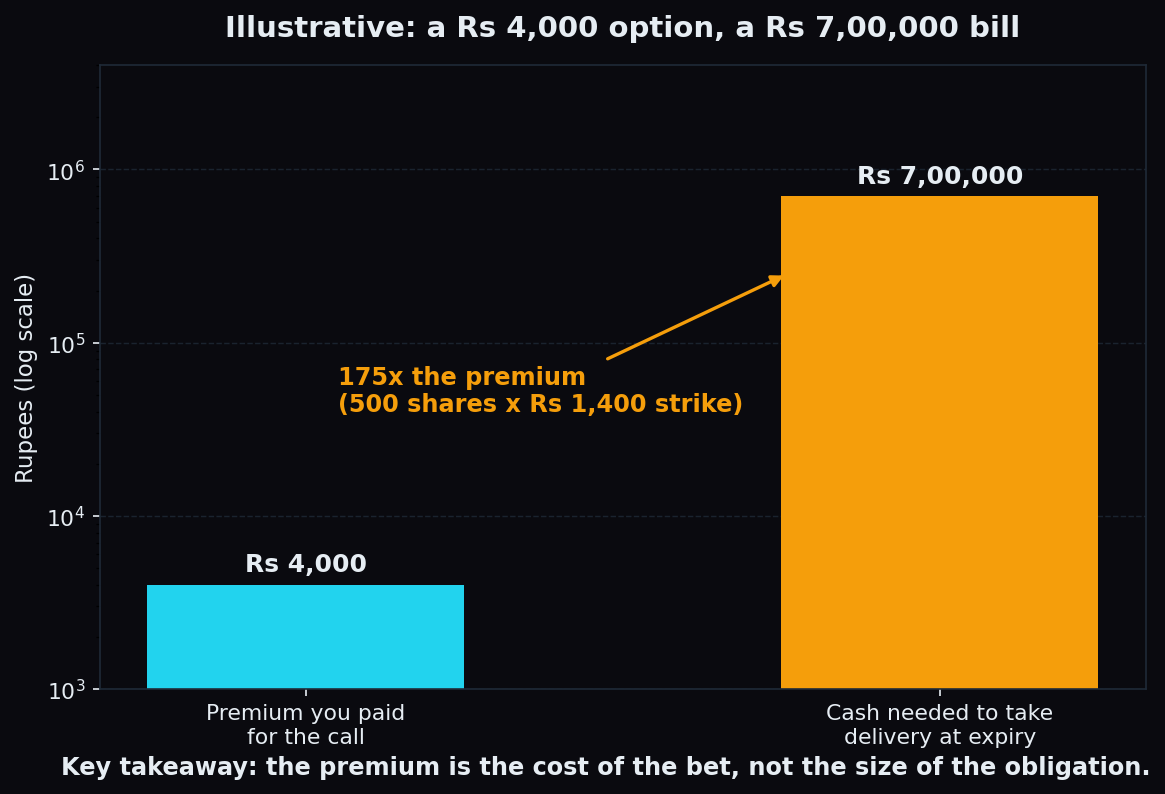
An option that cost you Rs 4,000 can end expiry day with a Rs 7,00,000 bill attached to it. Not a loss of Rs 7,00,000 — a bill. That is what physical settlement means, and it is the single biggest difference between holding an index contract to expiry and holding a single-stock contract to expiry in India. This post explains what settlement is, who owes what when the contract dies, a worked example with round numbers, and the costs that surprise people.
What "settlement" actually means
A derivative is a contract whose value comes from something else — a stock, an index (see what are derivatives). Every derivative contract has an end date, called expiry. Settlement is simply the process of closing the books on that date: working out who owes whom, and handing it over.
India uses two different methods, and which one applies depends entirely on what the contract is written on.
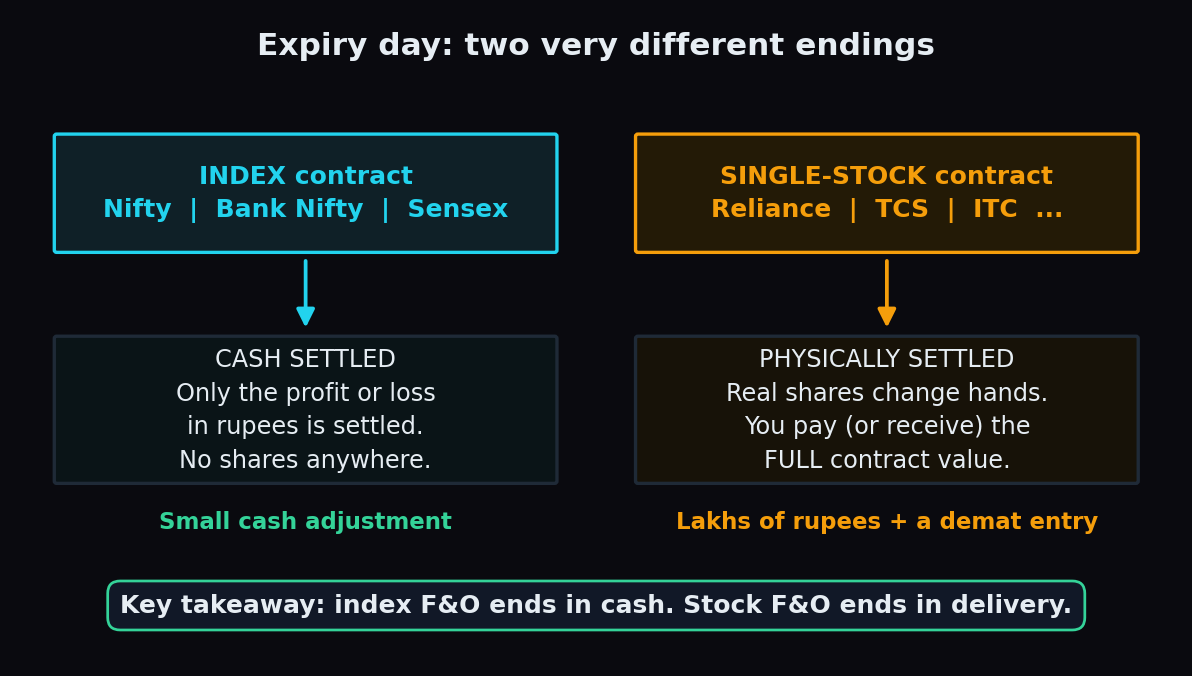
- Cash settled — only the profit or loss in rupees moves. Nothing else changes hands. This is how index derivatives work: Nifty, Bank Nifty, FinNifty, Sensex. It has to be this way, because you cannot deliver an index — it is a number, not a thing.
- Physically settled — the actual shares change hands, and the full contract value is paid. This is how single-stock derivatives work: Reliance, TCS, ITC, HDFC Bank and every other stock in the F&O list.
This was not always the case. Indian stock derivatives used to be cash settled too. SEBI moved them to compulsory delivery in stages, and by the October 2019 expiry every single-stock futures and options contract on the exchange settled physically. The stated aim was to tie the derivatives market back to the underlying shares and make it harder to push a stock around using contracts alone.
An everyday analogy: the ticket and the sack of rice
Think of two coupons in your pocket.
The first is a cricket-match bet slip. If your side wins, the bookmaker hands you cash. If it loses, you pay cash. Nobody delivers a cricket match to your house. That is an index contract: pure cash difference.
The second is a token for a 50 kg sack of rice, bought months ago at a fixed price. When the token comes due, the merchant does not settle the price difference with you. He backs a truck up to your door with the rice, and expects the agreed money in full. If you only had Rs 4,000 in your pocket because that is what the token cost, you now have a problem — and 50 kg of rice.
Single-stock F&O is the rice token. The contract is cheap; the thing behind it is not.
Who owes what at expiry
Two terms first. Lot size is the fixed number of shares in one contract — you cannot trade one share of a stock future (see lot size and contract value). In the money (ITM) means the option has real value at expiry: a call whose strike is below the closing price, or a put whose strike is above it (see option moneyness).
Here is the whole rulebook in one picture.
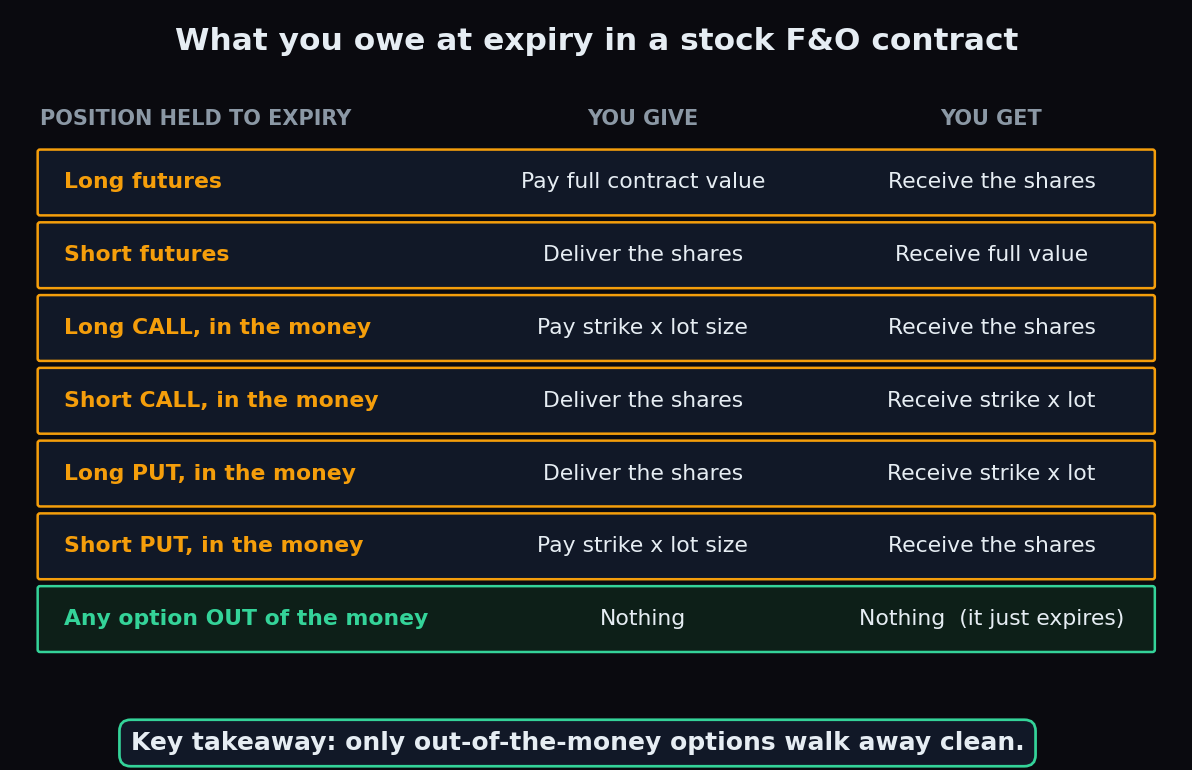
Three things are worth pulling out of that table:
- Futures always settle physically if held to expiry, whether you are in profit or in loss. There is no ITM or OTM for a future (see futures contracts explained).
- Only in-the-money options create an obligation. An out-of-the-money option simply expires. The premium is gone and nothing else happens — which is the fate of most options.
- ITM options are exercised automatically. You do not get a phone call asking whether you would like the shares. If the position is open at the close, the obligation is yours.
Notice also that option sellers are just as exposed. A trader who sold an out-of-the-money call for a small premium, and watched the stock run past the strike, ends expiry owing real shares — shares they may not own.
A worked example with round numbers
Take an imaginary stock, ABC Ltd, trading at Rs 1,395. Its lot size is 500 shares. A trader pays Rs 8 per share for the 1,400 strike call:
- Premium paid = 500 × Rs 8 = Rs 4,000. That is the entire cash outlay so far.
- Expiry day arrives and ABC closes at Rs 1,410. The call is in the money by Rs 10.
- On a cash-settled contract this would be simple: Rs 10 × 500 = Rs 5,000 credited, minus the Rs 4,000 premium, a Rs 1,000 gain.
But ABC is a stock, so the contract settles physically. What actually happens:
- The trader must pay 500 × Rs 1,400 = Rs 7,00,000 and receives 500 ABC shares in the demat account.
- Those shares are worth 500 × Rs 1,410 = Rs 7,05,000 at the closing price. So the paper gain is Rs 5,000, and the position is Rs 1,000 ahead of the premium — the same maths as before.
- Except the trader now needs Rs 7,00,000 in cash, not Rs 4,000. That is 175 times the premium.
And then the costs land. A physically settled contract is taxed like a cash-market delivery trade, not like a derivative. At the equity-delivery STT rate of 0.1%, the settlement leg alone costs roughly 0.1% of Rs 7,00,000 = Rs 700. On a normal options trade the STT would have been a fraction of that, because it is charged on the premium rather than on the full value. (Rates change over time; your contract note is the authority — and see the real cost of one trade.)
So the trader read the direction correctly, watched the option finish in the money, and after that one tax line kept about Rs 300 of the Rs 1,000 — before brokerage, stamp duty and whatever the shares do the next morning. That is the trap: the contract did nothing wrong. The settlement method ate the result.
The premium tells you what the bet costs. It tells you nothing about the size of the obligation sitting behind it. In single-stock F&O those two numbers can differ by a hundred times or more.
The expiry-week squeeze most people miss
Exchanges know that traders holding delivery-eligible positions may not have the cash. So they ask for it in advance. In the final days before a stock contract expires, an extra delivery margin is charged on positions that could end up in delivery, and it is stepped up in stages as expiry approaches — small at first, then a large share of the full delivery value by expiry day. The exact schedule is set by the exchange and is published by brokers; check the current one rather than assuming.
Three practical consequences, all of them ordinary and all of them surprising the first time:
- Your margin requirement rises without you doing anything. The position has not changed. The week has. If the account cannot fund it, the broker may square the position off (see margin and leverage explained).
- Liquidity thins out. As delivery margins bite, many participants exit stock contracts in the last few sessions rather than fund them. Spreads in far strikes can widen just when an exit is most wanted.
- Failing to deliver is not free. If a seller cannot produce the shares, the shortfall goes into the exchange auction process, and the penalties for a settlement shortage are meaningfully worse than the cost of closing the position in time.
The delivery itself flows through the same cash-market pipeline as any other share transaction, on the exchange's normal settlement cycle (see T+1 settlement explained). The shares land in, or leave, the demat account a day or so after expiry.
What our own data says about expiry pinning
A common claim is that the threat of delivery drags stock prices toward a "magnet" level near expiry. TrueTrend scores its own levels in public every session, so we can look. Our scoreboard currently covers 14 instruments — 10 physically settled single stocks and 4 cash-settled indices — over 977 scored sessions in the archive as of the 4 August 2026 session.
Taking max pain — the strike where option buyers would collectively lose the most, often described as a price magnet (see does price gravitate to max pain) — and asking how often the close landed within one strike of it:
- The 10 physically settled stocks: 34% of sessions (n = 669).
- The 4 cash-settled indices: 19% of sessions (n = 307).
- The spread between individual stocks is enormous: from 12% for SBI (n = 75) to 55% for ITC (n = 75).
It is tempting to read the 34% against 19% as delivery pressure pulling stocks toward the magnet. We do not think that reading survives scrutiny, for three reasons, and it matters more than the headline number:
- "Within one strike" is not the same width everywhere. A Rs 10 strike gap on a Rs 1,300 stock is about 0.8% of price. A 50-point gap on Nifty is closer to 0.2%. The stock test is simply a wider band, which mechanically lifts its hit-rate.
- These are all sessions, not expiry days. The scoreboard scores every trading day, so this is not a clean measurement of expiry behaviour.
- A 12%-to-55% range across ten stocks is not a stable effect. If the pin were a real, delivery-driven force, you would not expect ITC to behave four times more like a magnet than SBI.
The honest conclusion is the boring one: our data does not support the idea of a dependable expiry magnet in stock names, and the gap that looks like evidence is largely an artefact of strike spacing. Every one of those numbers, misses included, is on the public scoreboard.
The honest catch
Physical settlement is not a flaw in the system — it is the system working as designed, keeping derivative prices tethered to real shares. The catch is that it converts a small, familiar-looking position into a large, unfamiliar one on a specific date, and it does so automatically.
The mechanics worth carrying away: know whether the contract you are holding is on an index or on a stock; know that only out-of-the-money options walk away clean; know that the obligation is the full contract value, not the premium; and know that expiry week charges for the privilege of finding out. Anyone who does not want delivery has one reliable route — close or roll the position before expiry, not during it.
TrueTrend turns this kind of market structure into a clear, at-a-glance read across Nifty, Bank Nifty and the main F&O stocks — positioning, key option levels, and a public track record of how those levels actually resolved. Create a free account to see the current picture.
See these concepts on live market data — free
Create a free TrueTrend account to watch daily support/resistance levels, market regime, and option-positioning charts on NIFTY, BankNifty and 12 more instruments. Every level we publish is scored on a public scoreboard — misses included. No card required.
Free forever tier · daily levels with published hit-rates across every instrument. Descriptive market structure, not investment advice.
Not ready for an account? Get the daily levels by email.
One short email each market day — the indices' call wall, put wall, gamma flip and max pain, and how the last session's levels scored. Free, no account, unsubscribe anytime.
Descriptive market structure, not investment advice. We never share your email.