MCX Crude Oil Options: Specs, Timings, CTT and Liquidity
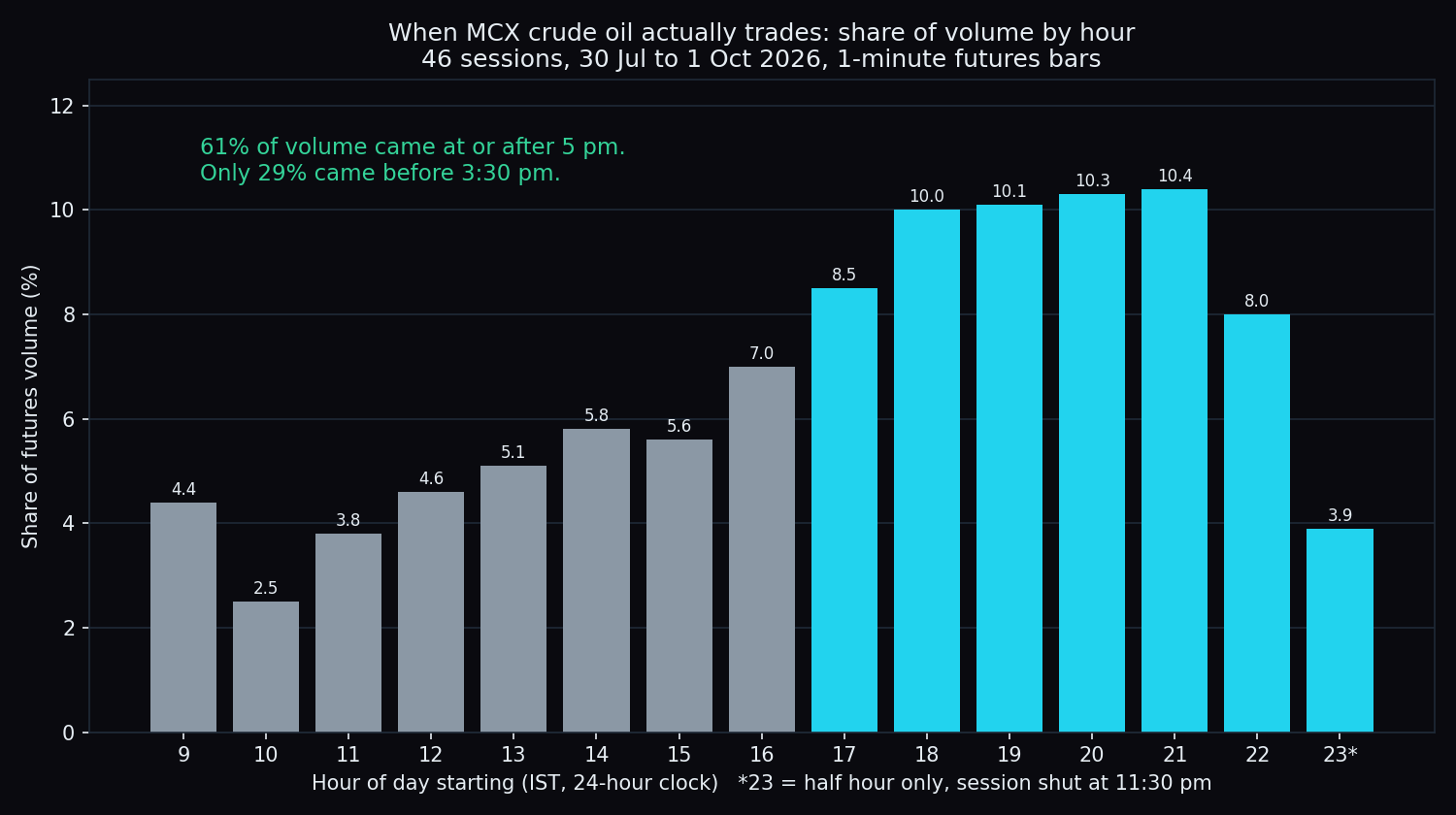
MCX crude oil options open at 9:00 in the morning. But in our sample of 46 sessions (30 July to 1 October 2026), 61% of crude oil futures volume came at or after 5:00 pm, and only 29% came before 3:30 pm, the hour when the stock market shuts. Crude is an evening market that happens to open in the morning. That one fact shapes almost everything else about these contracts — the lot, the hours, the tax and the liquidity. Here is the full picture in plain words.
What is an MCX crude oil option?
MCX is the Multi Commodity Exchange, India’s main exchange for commodity derivatives. A derivative is a contract whose value comes from something else — here, crude oil.
An option gives its holder a right, but not a duty, to take a position at a fixed price (the strike) by a fixed date (the expiry). A call gains when prices rise. A put gains when prices fall. The price paid for the option is the premium. If these words are new, start with our guide to calls and puts.
Here is the first surprise. A Nifty option is an option on an index. An MCX crude oil option is an option on a futures contract. The thing underneath it is not a barrel of oil. It is the MCX crude oil futures contract — an agreement on the price of crude for a later date. That detail matters at expiry, as we will see.
The analogy: a shop that opens at 9 but fills up at 6
Picture a wholesale market that unlocks its gates at 9 am. A few traders wander in. Prices are quoted, some deals happen. But the big lorries only arrive in the evening, and that is when the real crowd turns up.
MCX crude is that market. Crude oil is priced globally, and the heaviest trading in the world benchmark happens during American business hours — which is evening in India. The gates are open all day. The crowd comes late.
Contract specs at a glance
These are the main terms as commonly published by the exchange. Exchanges revise contract terms from time to time, so treat this as a map and check the current MCX contract specification before relying on any single line.
- Underlying: the MCX crude oil futures contract, which itself tracks the international WTI (West Texas Intermediate) crude benchmark, converted into rupees.
- Lot size: 100 barrels for the main contract. A smaller Crude Oil Mini contract covers 10 barrels.
- Price quote: rupees per barrel.
- Strike gap: strikes are listed ₹50 apart (this is what we see in the live option chain).
- Style: European — the option can only be exercised at expiry, not before. See American vs European options.
- Expiry: monthly. The option expires a couple of business days before its underlying futures contract does, typically in the middle part of the month. The exact date is on the exchange calendar.
- Settlement: at expiry, an in-the-money option turns into a position in the futures contract. This is called devolvement.
Worked example: the lot maths
Say a crude oil call option is quoted at a premium of ₹300. The quote is per barrel, and one lot is 100 barrels.
- Cost of one lot = ₹300 × 100 = ₹30,000.
- Every ₹1 change in the premium = ₹100 per lot.
- The same option in the Mini contract (10 barrels) = ₹300 × 10 = ₹3,000, and ₹1 of premium = ₹10.
So the Mini is simply the same idea at one-tenth the size.
Timings: one long session
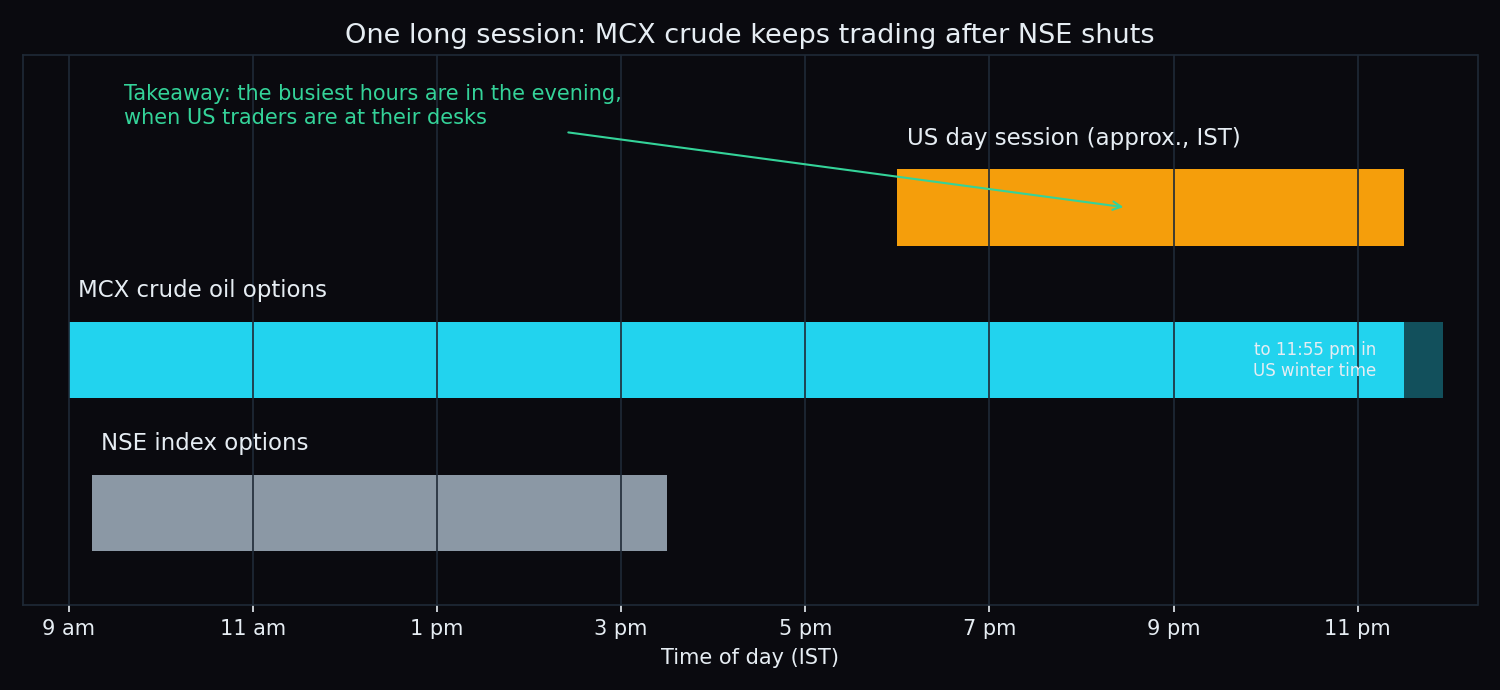
MCX non-agricultural commodities trade Monday to Friday in one continuous session that starts at 9:00 am. The close depends on the US clock: about 11:30 pm while the US is on daylight saving time (roughly March to November) and about 11:55 pm in the US winter. Our data matches this: 45 of the 46 sessions in our sample opened at 9:00 am (one was an evening-only session that began at 5:00 pm, the pattern on some market holidays), and the sessions closed at 11:30 pm.
That is more than 14 hours, against 6 hours 15 minutes for NSE index options. But the hours are not equal. Here is where the volume actually sat.
What we measured, from 1-minute futures bars across 46 sessions:
- Each hour between 6 pm and 10 pm carried about 10% of the day’s volume.
- The quietest hour was 10 am to 11 am, at 2.5%.
- 61% of volume came at or after 5 pm; 29% came before 3:30 pm.
- Prices moved more in the evening too: the average 1-minute high-to-low range was about ₹10 between 6 pm and 9 pm, against about ₹4 to ₹5 between 9 am and 11 am.
Scheduled news adds to this. The weekly US oil inventory report, for example, lands in the Indian evening. A position opened at lunch in India still has the busiest and jumpiest part of the day ahead of it.
Expiry and devolvement: the part that surprises people
A Nifty option that expires in the money is settled in cash. Money is credited or debited and it is over.
A crude oil option that expires in the money becomes a futures position. Round numbers:
- You hold one lot of the ₹8,000 call. At option expiry the reference price is ₹8,100.
- The call is in the money by ₹100. It devolves into one long crude oil futures lot at ₹8,000.
- That futures lot controls 100 barrels — about ₹8.1 lakh of crude — and needs futures margin (a deposit held against the position), which is far larger than a typical option premium.
Two more details are worth knowing. First, exchanges ask for extra devolvement margin on in-the-money positions in the last days before expiry, so the margin needed can rise even if nothing else changes. Second, options whose strikes are very close to the settlement price (called “close to the money”) follow special exercise rules and may need an explicit instruction through the broker. The precise rules sit in the MCX circulars and in each broker’s expiry policy; they are worth reading before the first expiry, not after.
CTT: the tax on commodity trades
CTT stands for Commodities Transaction Tax. It is the commodity cousin of STT (Securities Transaction Tax) on shares and index derivatives, and it is collected by the exchange through the broker on each taxable trade.
The structure, as commonly published at the time of writing:
- On options: CTT is charged on the sale side, on the premium. The rate widely quoted is 0.05% of premium, paid by the party who sold.
- On exercise: a separate, very small CTT applies when an option is exercised, calculated on the settlement price and paid by the option holder.
- On futures: CTT is charged on the sale side of non-agricultural commodity futures, on the full contract value. The rate widely quoted is 0.01%.
Tax rates change with Union Budgets, so check the rate on a recent contract note or the latest exchange circular instead of trusting any article, including this one.
Worked example: CTT against the spread
Take the ₹300 option again. One lot is worth ₹30,000 of premium.
- CTT at 0.05% on the sale leg = ₹30,000 × 0.0005 = ₹15.
- The bid-ask spread — the gap between the best price someone will pay (bid) and the best price someone will accept (ask) — had a median of about ₹0.85 on at-the-money crude options in our data. Paying the ask on the way in and taking the bid on the way out costs that gap once: ₹0.85 × 100 = ₹85.
So on a typical near-the-money lot, the spread cost was several times the CTT. Brokerage, exchange charges, GST and stamp duty come on top; our post on the real cost of one trade walks through that stack for index options, and the same logic applies here.
Liquidity: what we measured
Liquidity means how easily you can trade without moving the price. The simplest gauge is the bid-ask spread: a narrow gap means a busy, competitive market.
We sampled the MCX crude oil option chain every 10 minutes across 41 sessions (6 August to 1 October 2026), which gave 3,394 snapshots. Three findings.
1. Near the money, the spread stayed tight all day
The median spread on the at-the-money call and put was between 0.24% and 0.31% of the option price in every hour from 9 am to the close — roughly ₹0.70 to ₹1.00 per barrel. We expected the quiet morning to show much wider gaps. It did not. The morning has less volume, but the at-the-money quotes were still tight.
2. Far from the money, the spread blew out
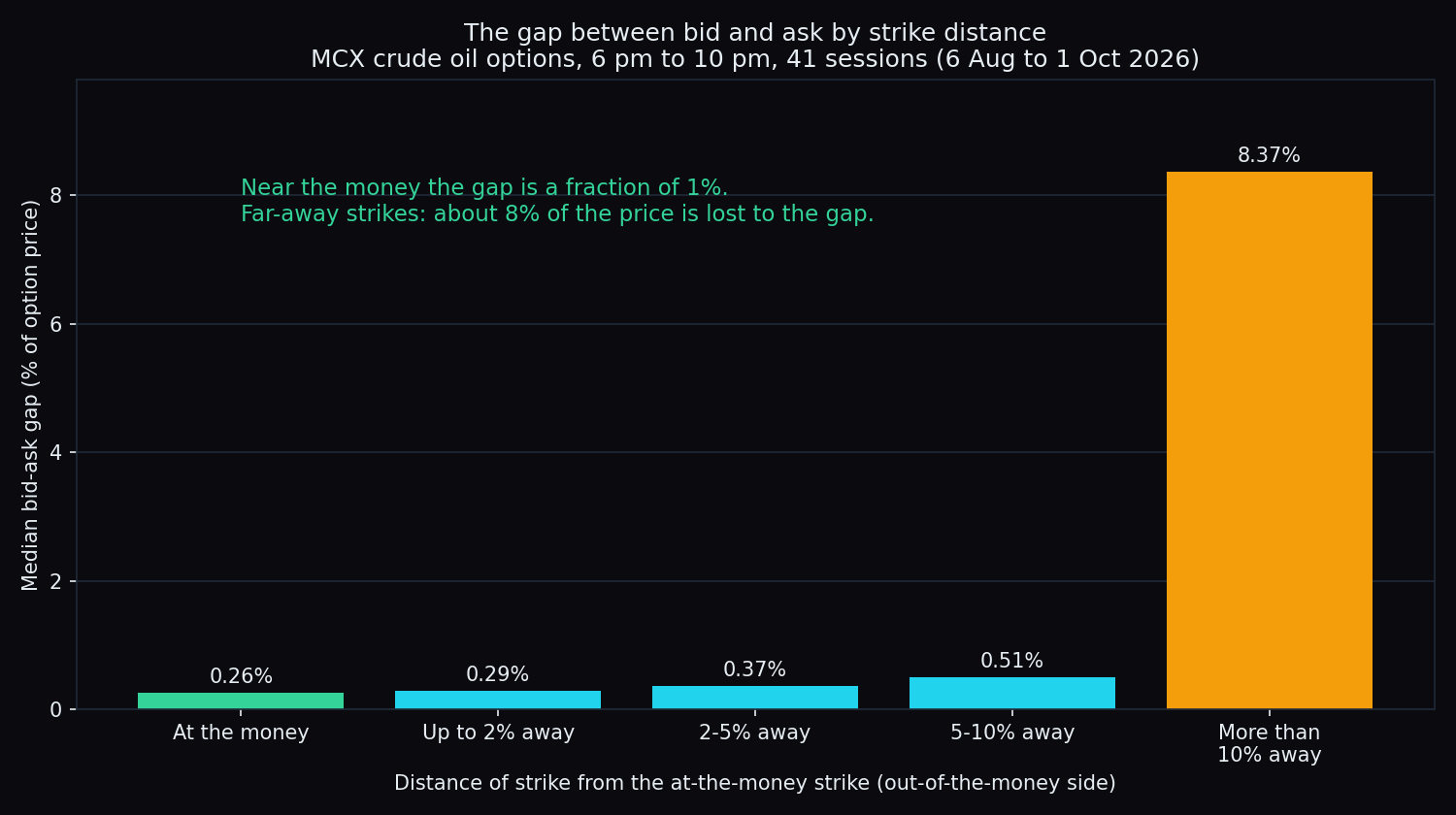
In the busy 6 pm to 10 pm window, the median spread by distance from the at-the-money strike (measured on the out-of-the-money side) was:
- At the money: 0.26% of the option price (n = 960 readings)
- Up to 2% away: 0.29% (n = 5,744)
- 2% to 5% away: 0.37% (n = 9,630)
- 5% to 10% away: 0.51% (n = 16,581)
- More than 10% away: 8.37% (n = 72,339)
Cheap far-away options look small in rupees, but the gap eats a big slice of their price. And this understates it: we only counted strikes that had both a bid and an ask. Many distant strikes had no bid at all.
3. Open interest crowds onto round strikes
Open interest (OI) is the number of contracts still open. Strikes are listed every ₹50, so half of them end in a round hundred. Yet those round-hundred strikes held about 88% of all open interest (n = 40 sessions, 7 pm snapshot). The in-between ₹50 strikes exist, but few positions sit there.
Crude is not Nifty: the volatility gap
Implied volatility (IV) is the amount of movement that option prices are bracing for; our IV explainer covers it. In our records, the median at-the-money IV for crude oil was about 52% (n = 40 sessions, 7 August to 1 October 2026). For Nifty over the same weeks it was about 10.5% (n = 39 sessions). Crude futures themselves ranged from about ₹7,100 to about ₹10,000 per barrel inside our two-month window.
In plain words: over this period, crude option prices were bracing for roughly five times the percentage movement that Nifty option prices were. Habits formed on index options — how far a strike “feels”, how fast a premium changes — do not carry over unchanged. For how crude feeds into Indian shares, see crude oil and Indian markets.
What our public scoreboard says about crude so far
We score our own option-chain levels in public on the TrueTrend scoreboard. Crude oil is a recent addition, and the honest summary is: too early to say much.
- Call wall held when touched: 40% (n = 5 touches)
- Put wall held when touched: 0% (n = 2 touches)
- Closed within one strike of max pain: 13% (n = 38 sessions)
- Gamma-flip side respected to the close: 100% (n = 11 sessions) — this figure is mechanically inflated, because the flip level often sits far from the price, so it should not be read as an edge.
Samples of 2 and 5 touches prove nothing in either direction. We publish them anyway because hiding thin numbers is how track records get dressed up. The max-pain figure has the most data behind it, and it says crude closed near max pain on only about one session in eight.
The honest catch
- Short sample. 41 to 46 sessions, all from one two-month stretch in which crude swung widely. Spreads and volume patterns can differ in calmer or wilder periods.
- Quoted, not traded. We measured the best bid and ask on screen for a small size. A large order can face a wider effective gap.
- US summer time only. The whole sample falls in the months when MCX shuts at 11:30 pm. The hour-by-hour shape may shift by about an hour once US clocks change.
- Main contract only. We measured the 100-barrel contract. The Mini has its own order book and its own liquidity.
- Rules change. Lot sizes, expiry dates, margin rules and CTT rates are set by the exchange and the government and are revised. The MCX contract specification and circulars are the primary source.
Key takeaway: MCX crude oil options are options on futures, quoted per barrel in 100-barrel lots, taxed through CTT on the sale side, and they devolve into futures at expiry. The session runs from 9 am to late night, but 61% of volume in our sample came after 5 pm. Near-the-money spreads were tight all day (about 0.25% of price); beyond 10% away they were about 8%.
Reading a commodity option chain strike by strike, late into the evening, is slow work. TrueTrend turns option-chain positioning into a clear, at-a-glance read across Nifty, Bank Nifty and F&O names — and scores its own levels in public. Create a free TrueTrend account to see it for yourself.
See these concepts on live market data — free
Create a free TrueTrend account to watch daily support/resistance levels, market regime, and option-positioning charts on NIFTY, BankNifty and 12 more instruments. Every level we publish is scored on a public scoreboard — misses included. No card required.
Free forever tier · daily levels with published hit-rates across every instrument. Descriptive market structure, not investment advice.
Not ready for an account? Get the daily levels by email.
One short email each market day — the indices' call wall, put wall, gamma flip and max pain, and how the last session's levels scored. Free, no account, unsubscribe anytime.
Descriptive market structure, not investment advice. We never share your email.